JSTOR Global Plants Home
  • Home
  • Browse
  • About
  • Access
  • Account
    • Saved Items
    • Profile
  • Log in

Global Plants

Skip to Main Content
  • JSTOR Global Plants Home
  • Global Plants

    • Browse
    • About
    • Access
    • Account
      • Saved Items
      • Profile
Log in
  • Browse
  • About
  • Access
  • Account
    • Saved Items
    • Profile
Advanced Search

Compilation
Serratula arvensis

3 Images see all

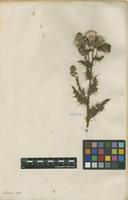
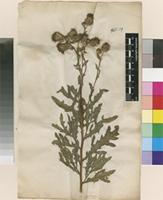
Filed as Carduus indet. [family ASTERACEAE]
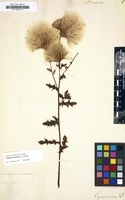
Filed as Serratula arvensis [family COMPOSITAE]
Lectotype of Serratula arvensis L. [family ASTERACEAE]
Previous
Next

Name

Identification
Serratula arvensis L. [family ASTERACEAE ] (stored under name); Verified by Not on sheet, Cirsium arvense (L.) Scop. [family ASTERACEAE ] Verified by Not on sheet,
Related name
  • Cirsium arvense
  • Carduus indet.
  • Serratula arvensis
Common name
  • chardon du Canada ou des champs, Flora of North America Vol. 19
  • Canada or creeping or field thistle, Flora of North America Vol. 19
  • cirse des champs, Flora of North America Vol. 19

Flora

Entry for Cirsium arvense (Linnaeus) Scopoli [family COMPOSITAE]
Herbarium
Flora of North America (FNA)
Collection
Flora of North America
Resource Type
Reference Sources
Entry From
Flora of North America, Vol 19,
Names
Cirsium arvense (Linnaeus) Scopoli [family COMPOSITAE], Fl. Carniol. ed., 2, 2: 126. 1772
Serratula arvensis Linnaeus [family COMPOSITAE], Sp. Pl., 2: 820. 1753
Breea arvensis (Linnaeus) Lessing [family ]
Carduus arvensis (Linnaeus) Robson [family COMPOSITAE]
Cirsium arvense var. argenteum (Peyer ex Vest) Fiori [family COMPOSITAE]
Cirsium arvense var. horridum Wimmer & Grabowski [family COMPOSITAE]
Cirsium arvense var. integrifolium Wimmer & Grabowski [family COMPOSITAE]
Cirsium arvense var. mite Wimmer & Grabowski [family COMPOSITAE]
Cirsium arvense var. vestitum Wimmer & Grabowski [family COMPOSITAE]
Cirsium incanum (S. G. Gmelin) Fischer ex M. Bieberstein [family COMPOSITAE]
Cirsium setosum (Willdenow) Besser ex M. Bieberstein [family COMPOSITAE]
Treatment Author(s)
David J. Keil
Information
Perennials, dioecious or nearly so, 30–120(–200) cm; colonial from deep-seated creeping roots producing adventitious buds. Stems 1–many, erect, glabrous to appressed gray-tomentose; branches 0–many, ascending. Leaves: blades oblong to elliptic, 3–30 × 1–6 cm, margins plane to revolute, entire and spinulose, dentate, or shallowly to deeply pinnatifid, lobes well separated, lance-oblong to triangular-ovate, spinulose to few-toothed or few-lobed near base, main spines 1–7 mm, abaxial faces glabrous to densely gray-tomentose, adaxial green, glabrous to thinly tomentose; basal absent at flowering, petioles narrowly winged, bases tapered; principal larger cauline proximally winged-petiolate, distally sessile, well distributed, gradually reduced, not decurrent; distal cauline becoming bractlike, entire, toothed, or lobed, spinulose or not. Heads 1–many, borne singly or in corymbiform or paniculiform arrays at tips of main stem and branches. Peduncles 0.2–7 cm. Involucres ovoid in flower, ± campanulate in fruit, 1–2 × 1–2 cm, arachnoid tomentose, ± glabrate. Phyllaries in 6–8 series, strongly imbricate, (usually purple-tinged), ovate (outer) to linear (inner), abaxial faces with narrow glutinous ridge, outer and middle appressed, entire, apices ascending to spreading, spines 0–1 mm (fine); apices of inner phyllaries flat, ± flexuous, margins entire to minutely erose or ciliolate. Corollas purple (white or pink); staminate 12–18 mm, (remaining longer than pappus when head is fully mature), tubes 8–11 mm, throats 1–1.5 mm, lobes 3–5 mm; pistillate 14–20 mm, (overtopped by pappi in fruit), tubes 10–15 mm, throats ca. 1 mm, lobes 2–3 mm; style tips 1–2 mm. Cypselae brown, 2–4 mm, apical collar not differentiated; pappi 13–32 mm, exceeding corollas. 2n = 34.
Phenology
jun-aug (summer), sep-oct (fall)
Altitude range
0–2600 m;
Distribution
GreenlandSt. Pierre and MiquelonnativeEurasia.USA Ala.USA AlaskaUSA Ariz.USA Ark.USA Calif.USA Colo.USA Conn.USA Del.USA D.C.USA IdahoUSA Ill.USA Ind.USA IowaUSA Kans.USA Ky.USA MaineUSA Md.USA Mass.USA Mich.USA Minn.USA Mo.USA Mont.USA Nebr.USA Nev.USA N.H.USA N.J.USA N.Mex.USA N.Y.USA N.C.USA N.Dak.USA OhioUSA Oreg.USA Pa.USA R.I.USA S.Dak.USA Tenn.USA Tex.USA UtahUSA Vt.USA Va.USA Wash.USA W.Va.USA Wis.USA Wyo.Canada Alta.Canada B.C.Canada Man.Canada N.B.Canada Nfld. and Labr. (Nfld.)Canada N.W.T.Canada N.S.Canada Ont.Canada P.E.I.Canada Que.Canada Sask.Canada Yukon
Discussion
Cirsium arvense is one of the most economically important agricultural weeds in the world. It was introduced to North America in the 1600s and soon was recognized as a problem weed. Weed control legislation against the species was passed by the Vermont legislature in 1795 (R. J. Moore 1975). Canada thistle is now listed as a noxious weed in most areas where it occurs. It has very high seed production, and the runner roots readily survive the fragmentation that accompanies cultivation.
Numerous variants of Cirsium arvense have been named based upon such features as pubescence, extent of leaf division, and spininess. Although extreme variants can be strikingly different, they are connected by such a web of intermediates that there seems to be little value in according any of them formal taxonomic recognition.
Native/Introduced
introduced;

Related Materials

  • Terms and Conditions
  • Privacy Policy
  • Cookie Policy
  • Cookie Settings
  • Accessibility
  • Help
  • Contact Us
  • Facebook
  • Twitter
ITHAKA

JSTOR is part of ITHAKA, a not-for-profit organization helping the academic community use digital technologies to preserve the scholarly record and to advance research and teaching in sustainable ways.

©2000-2026 ITHAKA. All Rights Reserved. JSTOR®, the JSTOR logo, JPASS®, Aluka®, and ITHAKA® are registered trademarks of ITHAKA.

╳