JSTOR Global Plants Home
  • Home
  • Browse
  • About
  • Access
  • Account
    • Saved Items
    • Profile
  • Log in

Global Plants

Skip to Main Content
  • JSTOR Global Plants Home
  • Global Plants

    • Browse
    • About
    • Access
    • Account
      • Saved Items
      • Profile
Log in
  • Browse
  • About
  • Access
  • Account
    • Saved Items
    • Profile
Advanced Search

Compilation
Senecio rhomboideus

6 Images see all

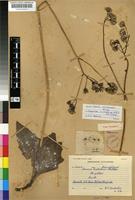
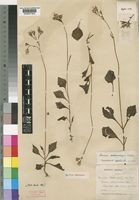
Type of Senecio rhomboideus Harv. [family ASTERACEAE]
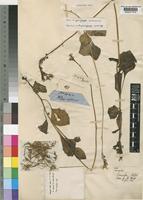
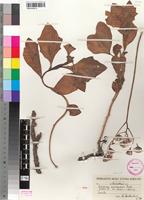
Senecio ruwenzoriensis S.Moore [family COMPOSITAE]
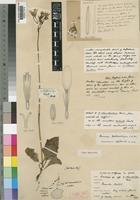
Syntype of Senecio rhomboideus Harv. [family ASTERACEAE]
Senecio ruwenzoriensis S.Moore [family COMPOSITAE]
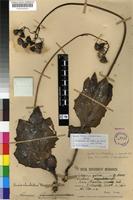
Isotype of Senecio dieterlenii E.Phillips [family ASTERACEAE]
Previous
Next

Name

Identification
Senecio ruwenzoriensis S.Moore [family COMPOSITAE ] (stored under name); Senecio rhomboideus Harv. [family COMPOSITAE ] Senecio bulborrhizus C.A.Sm. [family COMPOSITAE ] Verified by Smith, C.A.,
Related name
  • Senecio rhomboideus
  • Senecio dieterlenii
  • Senecio ruwenzoriensis
  • Senecio bulborrhizus

Flora

Entry for SENECIO rhomboideus Harv. [family COMPOSITAE]
Herbarium
Royal Botanic Gardens, Kew (K)
Collection
Flora Capensis
Resource Type
Reference Sources
Entry From
Flora Capensis, Vol 3, page 44, (1894) Author: (By W. H. HARVEY).
Names
SENECIO rhomboideus Harv. [family COMPOSITAE]
Information
root tuberous? all parts glabrous; stem leafy at base, ending in a long, nude, corymbose or panicled peduncle; leaves petiolate, fleshy, rhomboid or ovate, repand and denticulate, cuneate and tapering much at base, drying thin, closely netted-veined; inv. scarcely calycled, of 8–9 taper-pointed scales, fl…? Founded on a single imperfect specimen, mixed with “ S. subnudus ,” from which the foliage so remarkably differs that I think it must be kept distinct. The fl. heads would seem to be similar to those of S. oxyriæfolius.
Distribution
SOUTH AFRICA Eastern frontier? Ecklon! (Herb. Sd.)

Related Materials

  • Terms and Conditions
  • Privacy Policy
  • Cookie Policy
  • Cookie Settings
  • Accessibility
  • Help
  • Contact Us
  • Facebook
  • Twitter
ITHAKA

JSTOR is part of ITHAKA, a not-for-profit organization helping the academic community use digital technologies to preserve the scholarly record and to advance research and teaching in sustainable ways.

©2000-2026 ITHAKA. All Rights Reserved. JSTOR®, the JSTOR logo, JPASS®, Aluka®, and ITHAKA® are registered trademarks of ITHAKA.

╳