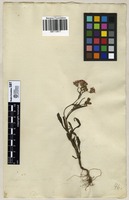
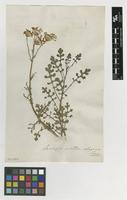
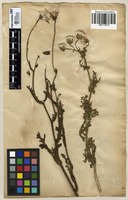
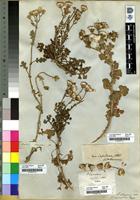
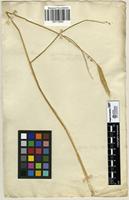
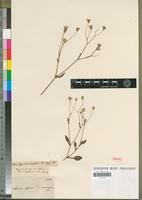
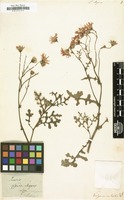
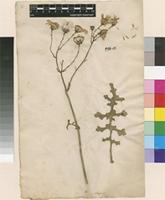
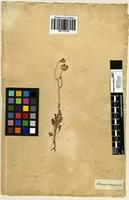
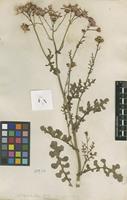
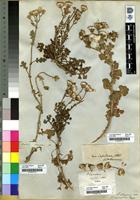
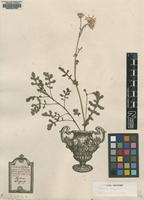
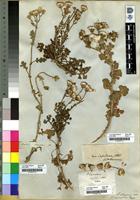
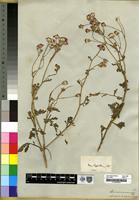
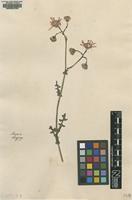
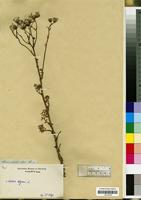
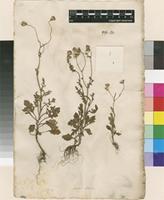
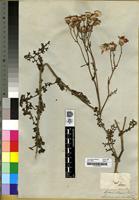
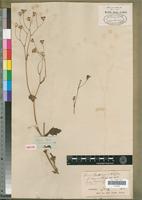
A var. with double flowers is the well-known “American Grounsel,” of Engl. gardens; why called “American” I know not. The wild plant seems constantly annual; the cultivated variety may be kept for 2 or more years. Mr. Kippist has kindly furnished me with the following , as the result of his examination of the Linnæan specimens of “ Senecio elegans: ” it seems to establish the incorrectness of Lessing's change of name to “ pseudo-elegans .” “I find [in the Linnæan Cabinets] two plants pinned together, both marked S. elegans in Linnæus's own hand. There is no habitat to either, nor any information as to the history of the specimens. The first sheet, however, having the No. ‘13’ (corresponding with the 1st Ed. of the Sp. Pl.) prefixed to the name elegans must be taken as the type specimen, and this is assuredly the pseudo-elegans of Less., the calyx being most distinctly bicalyculate, glabrous, with the outer scales serrulato-ciliate, and each of the pedicels bearing 4–5 squamæ. Why Lessing should have changed the name, I know not, especially as, in all three of the figures quoted by Linnæus, and even in Commelin's wretched plate, the invol. is clearly bicalyculate. * * * Linnæus sub-sequently introduced into his herbarium, with the name ‘ S. elegans ,’ a totally different plant, with the aphyllous pedicels and a uniseriate, hairy involucre; apparently agreeing with S. elegans, γ. viscosissimus, DC. ”—The error perhaps originated with Thunberg who gave the name carnosus to the plant with bicalyculate involucres; and the names S. elegans, S. arenarius and S. myrrhifolius to that with uniseriate involucres.