Entry for SENECIO brachypodus DC. [family COMPOSITAE]
Herbarium
Royal Botanic Gardens, Kew (K)
Collection
Flora Capensis
Resource Type
Reference Sources
Entry From
Flora Capensis, Vol 3, page 44, (1894) Author: (By W. H. HARVEY).
Names
SENECIO brachypodusDC. [family COMPOSITAE], l. c. 403
SENECIO macropodusEckl. [family COMPOSITAE], ! in Hb. (non DC.)
Information
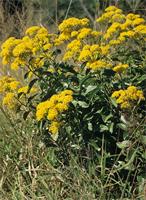
herbaceous? quite glabrous; stem (or branches) elongate, terete, leafy; leaves tapering at base into a short petiole, broadly ovate, acute, subentire or repando-denticulate, penninerved, membranous and netted-veined when dry; corymb compound, much-branched, shortly pedunculate or subsessile, pedicels scaly, scarcely longer than the head; inv. of 8 scales, shorter than the disc, truncate and sparingly calycled at base; disc-fl. 6–8, rays 3–4; achenes glabrous. 2–3 feet or more high; stems (or branches?) simple, weak, flexuous and perhaps scandent, laxly leafy throughout. Leaves 3–4 inches long, 2–2 1/2 inches wide, a little fleshy perhaps when fresh, but drying thin, distantly and minutely denticulate. Corymb fastigiate. Inv. 2–3 lines long. Rays yellow.
Distribution
SOUTH AFRICA Philipstown, Katriver, Ecklon! (Herb. Sd., Cap.)