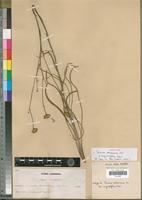
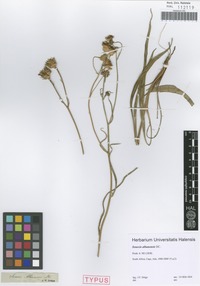
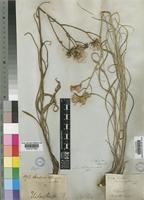
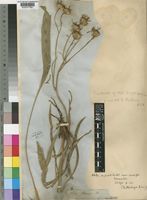
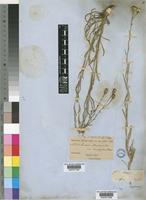
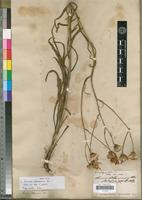
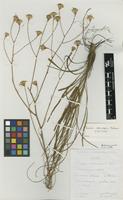
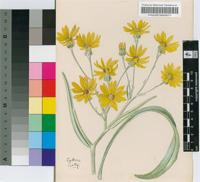
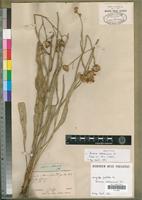
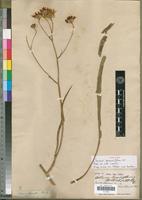
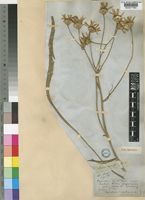
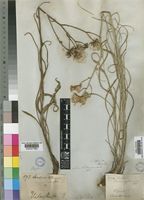
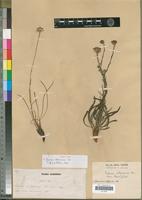
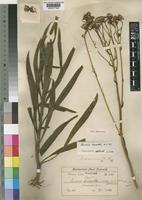
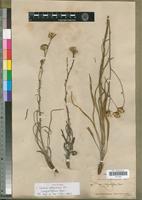
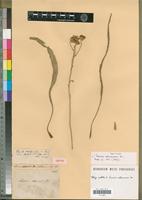
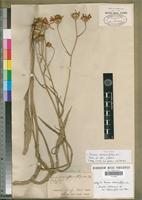
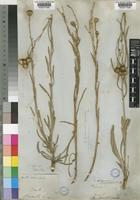
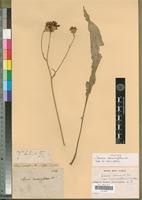
glabrous or cobwebby; root-stock not woolly; radical leaves several, long-petioled, elongato-lanceolate or lance-linear, tapering to each end, rigid, midribbed (the broader penninerved beneath), callous-denticulate, with subrecurved margin; stem erect, ribbed and furrowed, laxly leafy, corymbose at the summit; cauline leaves sessile, narrow, taper-pointed, with revolute margins; corymb lax, few or several-headed, the pedicels elongate, nude or scaly; inv. of 15–20, glabrous or cobweb-woolly, narrow, acuminate scales, calycled with several longish subulate bracts; rays numerous, spreading; achenes glabrous, finely striate, narrowed to the base, slightly tapering upwards. Stem 8 inches to 2 ft. high. Leaves 3–15 inches long, narrow-lanceolate or linear. Heads sometimes 2–3 on long, simple pedicels; sometimes 10–12, in a branching, very lax corymb. Pedicels 3–4 inches long. Heads 1/2– 3/4 inch across. Very variable in size, but generally recognizable by its leaves, involucre and achenes. I suspect that S. affinis and S. inornatus, both unknown to me, are varieties of this common plant. Our var. ε. looks different, but has scarcely characters sufficient to separate it specifically. S. leiocarpus, DC.! of which I have seen Ecklon's specimens in the Cape Govt. Herb. seems to me to be founded on a half-starved, narrow-leaved form of this species; the specimens, however, are in miserable condition, half decayed.