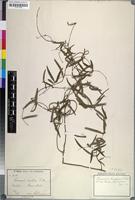
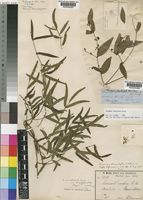
Secamone punctulataDecne. [family ASCLEPIADACEAE ] (stored under name); Verified by Goyder, D.J., Secamone emetica(Retz.) R.Br. ex Schult. [family ASCLEPIADACEAE ] Verified by Schumann, Secamone stenophyllaK.Schum. [family ASCLEPIADACEAE ] Secamone punctulataDecne. [family ASCLEPIADACEAE ] Verified by Brown, N.E.,
Related name
Secamone emetica
Secamone punctulata
Secamone stenophylla
Flora
Entry for SECAMONE punctulata N. E. Br. Var. β stenophylla [family ASCLEPIADACEAE]
Herbarium
Royal Botanic Gardens, Kew (K)
Collection
Flora of Tropical Africa
Resource Type
Reference Sources
Entry From
Flora of Tropical Africa, Vol 4, Part 1, page 231, (1904) Author: (By N. E. Brown.)
Names
SECAMONE punctulataN. E. Br. Var. β stenophylla [family ASCLEPIADACEAE]
SECAMONE stenophyllaK. Schum. [family ASCLEPIADACEAE], in Engl. Pfl. Ost-Afr. C. 325.
Information
Leaves 1 1/4–2 1/4 in. long, 1 3/4–3 lin. broad, linear or linear-oblong, acute, rounded at the base.
Distribution
German East Africa Mozamb. Dist. Usambara; Masheua, Holst, 3510!
Notes
I find no distinction besides the form of the leaves between S. stenophylla and S. punctulata, and the Zanquebar specimen is intermediate between the two. The name punctulata refers to the dots often visible in the leaves; they are formed by crystals of lime.