JSTOR Global Plants Home
  • Home
  • Browse
  • About
  • Access
  • Account
    • Saved Items
    • Profile
  • Log in

Global Plants

Skip to Main Content
  • JSTOR Global Plants Home
  • Global Plants

    • Browse
    • About
    • Access
    • Account
      • Saved Items
      • Profile
Log in
  • Browse
  • About
  • Access
  • Account
    • Saved Items
    • Profile
Advanced Search

Compilation
Secale africanum

4 Images see all

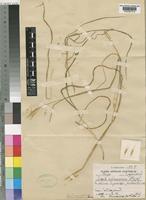
Secale africanum Stapf [family POACEAE]
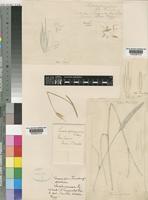
Type of Secale africanum Stapf [family POACEAE]
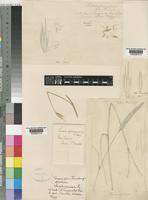
Secale africanum Stapf [family POACEAE]
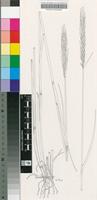
Secale africanum Stapf
Previous
Next

Name

Identification
Secale africanum Stapf [family POACEAE ]
Related name
  • Secale africanum

Flora

Entry for SECALE africanum Stapf [family POACEAE]
Herbarium
Royal Botanic Gardens, Kew (K)
Collection
Flora Capensis
Resource Type
Reference Sources
Entry From
Flora Capensis, Vol 7, page 310, (1900) Author: (By O. STAPF.)
Names
SECALE africanum Stapf [family POACEAE], in Hook. Icon. Pl. t. 2601
SECALE cereale Thunb. [family POACEAE], Prodr. 23; Fl. Cap. ed. i. 440; ed. Schult. 118; Durand & Schinz, Consp. Fl. Afr. v. 937, not of Linn.
Information
culms slender, over 1/2 ft. long, glabrous, smooth, upper internodes exserted; upper leaves glabrous, smooth; sheaths tight; ligules very short, obtuse; blades linear, narrow, up to 6 in. long; spike linear, very dense, 2 1/2–3 in. by 2 1/3–3 lin.; rhachis fragile, edges of joints densely villous; spikelets 5–6 lin. long (exclusive of the awns), closely imbricate; glumes linear, gradually narrowed to a fine point or produced into a very short bristle, upper about as long as the valves, lower usually somewhat shorter, keels finely scabrid; valves lanceolate-oblong, produced into a fine scabrid straight awn, 3–3 1/2 lin. long, scabrid on the sides; nerves distinct, green upwards, keel very minutely spinulous-scabrid; keels of pale scabrid. null
Distribution
CENTRAL REGION Sutherland Div.; Rogge Veld, Thunberg!
Notes
Thunberg says in his Travels, ed. 3, ii. 168:—“These (Rogge Velds) … have been so named from a kind of rye, which grows wild here in abundance near the bushes.” Burchell, however, says (Travels, i. 256):—“I saw none of the wild rye which has been said to be so abundant as to give the name to this district; but this might be owing to the season of the year.” S. africanum differs from S. cereale, Linn., and S. montanum, Guss., in the smaller spikelets, slightly unequal glumes, more conspicuously nerved and scabrid valves, and in all the keels being very minutely spinulous or scabrid.

Related Materials

  • Terms and Conditions
  • Privacy Policy
  • Cookie Policy
  • Cookie Settings
  • Accessibility
  • Help
  • Contact Us
  • Facebook
  • Twitter
ITHAKA

JSTOR is part of ITHAKA, a not-for-profit organization helping the academic community use digital technologies to preserve the scholarly record and to advance research and teaching in sustainable ways.

©2000-2026 ITHAKA. All Rights Reserved. JSTOR®, the JSTOR logo, JPASS®, Aluka®, and ITHAKA® are registered trademarks of ITHAKA.

╳