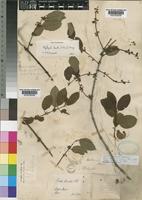
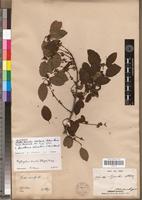
Scutia discolorKlotzsch [family RHAMNACEAE ] Isotype of Berchemia discolor(Klotzsch) Hemsl. [family RHAMNACEAE ] (stored under name); Verified by Johnston, M.C.,
Related name
Scutia discolor
Berchemia discolor
Flora
Entry for BERCHEMIA discolor Hemsl. [family RHAMNACEAE]
Herbarium
Royal Botanic Gardens, Kew (K)
Collection
Flora of Tropical Africa
Resource Type
Reference Sources
Entry From
Flora of Tropical Africa, Vol 1, page 377, (1868) Author: (by Mr. W. B. Hemsley).
Names
BERCHEMIA discolorHemsl. [family RHAMNACEAE]
Scutia discolorKlotzsch [family RHAMNACEAE], in Peters' Mossamb. Bot. 110. t. 21.
Information
A shrub or small tree, glabrous in all its parts. Leaves alternate or subopposite, petiolate, ovate ovate-elliptical or lanceolate, obtuse or acute, sometimes slightly unequal at the base, 1–2 1/2 in. long, entire or obscurely crenate, subcoriaceous, glaucous beneath, shining above, lateral nerves conspicuous. Stipules very deciduous. Cymes axillary, sessile or shortly pedunculate, 6–10-flowered; pedicels 2–3 lines long. Drupe large, fleshy, yellow, 6–8 lines long and 2–3 in. in diam., 2-celled, 2-seeded.
Range
Confined, as far as at present known, to the E. coast of Africa.
Distribution
Mozamb. Dist. Senna, Dr. Peters (in flower only); Tette, Dr. Kirk! “Wood resinous, fruit edible,” Kirk.
Notes
This differs from all previously described species of the genus in its axillary inflorescence and larger fruits. We have what appears to be the same plant from Natal, Gerrard .