JSTOR Global Plants Home
  • Home
  • Browse
  • About
  • Access
  • Account
    • Saved Items
    • Profile
  • Log in

Global Plants

Skip to Main Content
  • JSTOR Global Plants Home
  • Global Plants

    • Browse
    • About
    • Access
    • Account
      • Saved Items
      • Profile
Log in
  • Browse
  • About
  • Access
  • Account
    • Saved Items
    • Profile
Advanced Search

Compilation
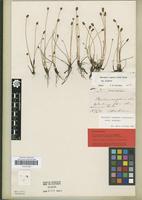
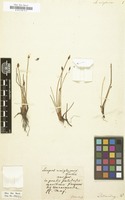
Scirpus uniglumis

6 Images see all

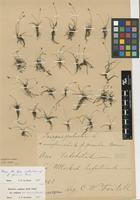
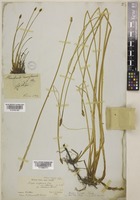
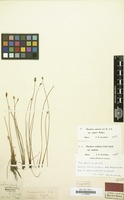
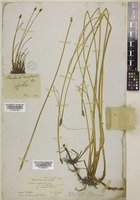
Eleocharis palustris (L.) Roem. & Schult. [family CYPERACEAE]
Type? of Scirpus uniglumis Link [family CYPERACEAE]
Type of Scirpus uniglumis Link f. nulliseta H.Lindb. [family CYPERACEAE]
Filed as Scirpus uniglumis [family CYPERACEAE]
Type of Eleocharis fennica Palla [family CYPERACEAE]
Type of Eleocharis palustris (L.) R. Br. [family CYPERACEAE]
Previous
Next

Name

Identification
Scirpus uniglumis Link [family CYPERACEAE ] (stored under name); Verified by Not on sheet, Eleocharis uniglumis (Link) Schult. [family CYPERACEAE ] Verified by Not on sheet, Eleocharis uniglumis (Link.) Schult. [family CYPERACEAE ] Verified by S.O. Strandhede, 1964
Related name
  • Scirpus palustris
  • Eleocharis uniglumis
  • Eleocharis fennica
  • Scirpus uniglumis
Common name
  • Éléocharide unigume, Flora of North America Vol. 23

Flora

Entry for Eleocharis uniglumis (Link) Schultes [family CYPERACEAE]
Herbarium
Flora of North America (FNA)
Collection
Flora of North America
Resource Type
Reference Sources
Entry From
Flora of North America, Vol 23,
Names
Eleocharis uniglumis (Link) Schultes [family CYPERACEAE], Mant., 2: 88. 1824
Scirpus uniglumis Link [family CYPERACEAE], Jahrb. Gewächsk., 1(3): 77. 1820
Eleocharis halophila (Fernald & Brackett) Fernald [family CYPERACEAE]
Eleocharis uniglumis var. halophila Fernald & Brackett [family CYPERACEAE]
Treatment Author(s)
S. Galen Smith*
Jeremy J. Bruhl*
M. Socorro González-Elizondo*
Francis J. Menapace*
Information
Plants perennial, mat-forming; rhizomes evident, long, 0.3–1 mm thick, soft to firm, cortex often fugaceous, longer internodes 10–25 mm, scales fugaceous, 5–6 mm, membranous, not fibrous. Culms terete, often with some blunt ridges when dry, (5–)10–60 cm × 0.2–1.5 mm, firm, internally spongy. Leaves: distal leaf sheaths persistent, not splitting, proximally red, distally stramineous to green, often callose, thinly papery to thickly membranous, apex often dark red-brown, obtuse to subacute, tooth absent. Spikelets ovoid to lanceoloid, 5–10 × 2–3(–4) mm, apex acute; proximal scale amplexicaulous, entire; subproximal scale with flower; floral scales often spreading in fruit, 10–20, 3–4 per mm of rachilla, brown to often red-brown, midrib regions mostly stramineous to green, broadly ovate, 3–4 × 1.8–2.5 mm, entire, apex acute to obtuse, often some carinate in distal part of spikelet. Flowers: perianth bristles 0–4(–5), light brown to stramineous, stout, usually unequal, rudimentary to equaling achene; stamens 3; anthers dark yellow to stramineous, 1.2–2 mm; styles 2-fid. Achenes not persistent, dark yellow or medium or dark brown, ellipsoid, obovoid, or obpyriform, biconvex, angles obscure, 1.3–1.8 × 1–1.4 mm, apex rounded, neck absent or short, smooth at 30X, or sometimes finely rugulose at 10–20X with 20 or more horizontal ridges in vertical series. Tubercles brown to whitish, pyramidal, much higher than wide to slightly depressed, sometimes spongy and with vertical rows of depressions, 0.4–0.8 × 0.3–0.8 mm.
Phenology Fruiting
summer
jun
jul
aug
Altitude range
0–2300 m;
Distribution
Eurasia.USA Colo.USA Del.USA MaineUSA Mass.USA Nebr.USA Nev.USA N.H.USA N.J.USA N.Mex.USA N.Y.USA N.C.USA N.Dak.USA R.I.USA S.Dak.USA UtahUSA Va.Canada Alta.Canada B.C.Canada Man.Canada N.B.Canada Nfld. and Labr.Canada N.W.T.Canada N.S.Canada Ont.Canada P.E.I.Canada Que.
Discussion
Plants treated as Eleocharis uniglumis fall within the large morphologic variation of Eurasian E. uniglumis. Two subspecies and 3 varieties were recognized for northern Europe (S.-O. Strandhede 1966), and five species that were recognized by I. D. Zinserling (1935) were placed in synonymy under E. uniglumis (S.-O. Strandhede 1966). Recognition of infraspecific taxa within North American E. uniglumis is premature. Plants commonly called E. halophila or E. uniglumis var. halophila, found mostly in Atlantic Coastal brackish habitats, have floral scales that are usually narrower and more densely placed on the rachilla than plants usually called E. uniglumis, which are found mostly in the interior; some plants are intermediate in expression of these characters. The achene and tubercle shape characters used by M. L. Fernald (1950) to distinguish E. uniglumis from E. halophila are not valid. In North America, E. uniglumis is difficult to separate from E. erythropoda and E. kamtschatica, in both of which the spikelets have only the proximal scale without a flower (empty) and the proximal scale completely amplexicaulous. Eleocharis uniglumis differs from E. erythropoda only in its broader floral scales, which are less densely placed on the rachilla; it differs from E. kamtschatica only in its smaller tubercles. It is also difficult to separate from some specimens of E. macrostachya in which the spikelets have proximal scales that are sometimes completely amplexicaulous; such plants differ from E. uniglumis only in the absence of a flower in the axil of the subproximal scale of some of the spikelets. I have not seen voucher specimens for the chromosome numbers of 2n = 27 and 28 reported by S.-O. Strandhede (1967) from Massachusetts and Nebraska, which are lower than the 2n = (44–)46(47–88) reported for Europe (S.-O. Strandhede 1965).

Related Materials

  • Terms and Conditions
  • Privacy Policy
  • Cookie Policy
  • Cookie Settings
  • Accessibility
  • Help
  • Contact Us
  • Facebook
  • Twitter
ITHAKA

JSTOR is part of ITHAKA, a not-for-profit organization helping the academic community use digital technologies to preserve the scholarly record and to advance research and teaching in sustainable ways.

©2000-2026 ITHAKA. All Rights Reserved. JSTOR®, the JSTOR logo, JPASS®, Aluka®, and ITHAKA® are registered trademarks of ITHAKA.

╳