JSTOR Global Plants Home
  • Home
  • Browse
  • About
  • Access
  • Account
    • Saved Items
    • Profile
  • Log in

Global Plants

Skip to Main Content
  • JSTOR Global Plants Home
  • Global Plants

    • Browse
    • About
    • Access
    • Account
      • Saved Items
      • Profile
Log in
  • Browse
  • About
  • Access
  • Account
    • Saved Items
    • Profile
Advanced Search

Compilation
Scirpus rostellatus

13 Images see all

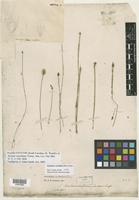
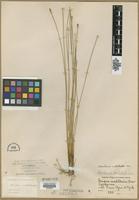
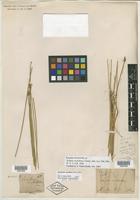
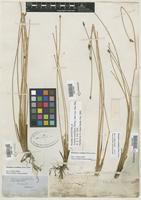
Type? of Scirpus rostellatus Torr. [family CYPERACEAE]
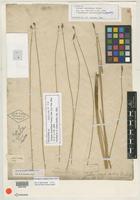
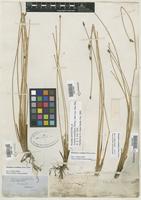
Syntype of Scirpus rostellatus Torr. [family CYPERACEAE]
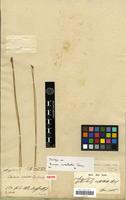
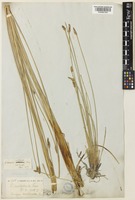
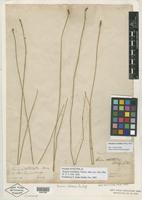
Isotype of Scirpus rostellatus Torr. [family CYPERACEAE]
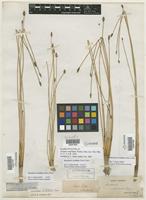
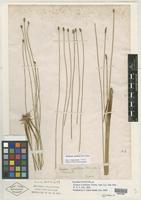
Type? of Scirpus rostellatus Torr. [family CYPERACEAE]
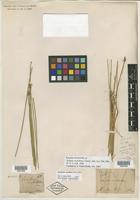
Isotype of Scirpus rostellatus Torr. [family CYPERACEAE]
Type? of Scirpus rostellatus Torr. [family CYPERACEAE]
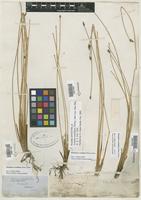
Eleocharis rostellata (Torr.) Torr. [family CYPERACEAE]
Type? of Scirpus rostellatus Torr. [family CYPERACEAE]
Previous
Next

Name

Identification
Scirpus rostellatus Torr. [family CYPERACEAE ] (stored under name); Verified by C. L. Gilly, 1942
Related name
  • Eleocharis rostellata
  • Scirpus rostellatus
Common name
  • Beaked spike-rush, Flora of North America Vol. 23
  • walking sedge, Flora of North America Vol. 23

Flora

Entry for Eleocharis rostellata (Torrey) Torrey [family CYPERACEAE]
Herbarium
Flora of North America (FNA)
Collection
Flora of North America
Resource Type
Reference Sources
Entry From
Flora of North America, Vol 23,
Names
Eleocharis rostellata (Torrey) Torrey [family CYPERACEAE], Fl. New York, 2: 347. 1843
Scirpus rostellatus Torrey [family CYPERACEAE], Ann. Lyceum Nat. Hist. New York, 3: 318. 1836
Treatment Author(s)
S. Galen Smith*
Jeremy J. Bruhl*
M. Socorro González-Elizondo*
Francis J. Menapace*
Information
Plants densely tufted, mat-forming by means of rooting culm tips. Culms 1.5–3 times as wide as thick, 20–100 cm × 0.35–2 mm, firm to hard, wiry, with to 8 subacute ribs, rarely nearly smooth; some culms arching or decumbent and rooting at tips. Leaves: distal leaf sheaths not splitting abaxially, proximally dark red to brown, apex usually reddish. Spikelets ovoid, 5–17 × 2.5–5 mm, apex acute; spikelets on stolons rudimentary, non-flowering, proliferous when rooting; proximal scale empty, amplexicaulous, ovate, 2–4 mm; subproximal scale with flower; floral scales 20–40, 2–3 per mm of rachilla, stramineous to medium brown, midrib region paler, ovate, 3.5–6 × 2–3 mm, membranous to cartilaginous, apex entire, rounded to subacute. Flowers: perianth bristles brown, equaling achene or tubercle, densely spinulose; anthers brown, 2–2.4 mm. Achenes often very variable within one plant, ovoid to obovoid or obpyriform, 1.5–2.5 × 1–1.2 mm, beak to 1 × 0.6 mm. Tubercles when present pale to dark brown, pyramidal, to 0.5 × 0.3 mm.
Phenology Fruiting
late spring
summer
jun
jul
aug
fall
sep
oct
nov
Altitude range
50–2400 m;
Distribution
MexicoWest Indies (Cuba).West Indies (Haiti).West Indies (Puerto Rico).USA Ariz.USA Calif.USA Conn.USA Del.USA Fla.USA IdahoUSA Ill.USA Ind.USA Kans.USA La.USA MaineUSA Md.USA Mass.USA Mich.USA Minn.USA Mont.USA Nebr.USA Nev.USA N.J.USA N.Mex.USA N.Y.USA N.C.USA OhioUSA Okla.USA Pa.USA R.I.USA S.C.USA S.Dak.USA Tex.USA UtahUSA Va.USA Wash.USA Wis.USA Wyo.Canada B.C.Canada N.S.Canada Ont.
Discussion
Eleocharis rostellata is highly competitive, often forming large monospecific colonies. The South American E. platypus C. B. Clarke is often treated as a synonym of E. rostellata. Eleocharis rostellata superfically closely resembles E. suksdorfiana in its culms, spikelets, and achenes, but differs in the absence of creeping rhizomes, presence of stoloniferous culms, absence of a flower in the proximal scale, and achene surface details. The collection of E. rostellata I have seen from Miami-Dade County, Florida, is from 1877. I have not seen vouchers for Archuleta County, Colorado, by H. D. Harrington (1954), or for the localities in Montana and South Carolina, which are based on the map in H. K. Svenson (1934).

Related Materials

  • Terms and Conditions
  • Privacy Policy
  • Cookie Policy
  • Cookie Settings
  • Accessibility
  • Help
  • Contact Us
  • Facebook
  • Twitter
ITHAKA

JSTOR is part of ITHAKA, a not-for-profit organization helping the academic community use digital technologies to preserve the scholarly record and to advance research and teaching in sustainable ways.

©2000-2026 ITHAKA. All Rights Reserved. JSTOR®, the JSTOR logo, JPASS®, Aluka®, and ITHAKA® are registered trademarks of ITHAKA.

╳