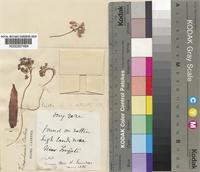
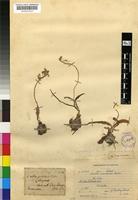
Scilla inandensisBaker [family HYACINTHACEAE ] Verified by Unknown, Ledebouria cooperi(Hook.f.) Jessop [family HYACINTHACEAE ] (stored under name); Verified by Unknown,
Related name
Scilla inandensis
Ledebouria cooperi
Flora
Entry for SCILLA inandensis Baker [family HYACINTHACEAE]
Herbarium
Royal Botanic Gardens, Kew (K)
Collection
Flora Capensis
Resource Type
Reference Sources
Entry From
Flora Capensis, page 253, (1897) Author: (By J. G. BAKER).
Names
SCILLA inandensisBaker [family HYACINTHACEAE]
Information
bulb ovoid, 1/2– 3/4 in. diam.; leaves 2–3, sessile, lanceolate, 3 in. long, 1/3– 1/2 in. broad at the middle, narrowed gradually to the base and apex; peduncle slender, curved, 3–6 in. long; raceme moderately dense, oblong, 1–1 1/2 in. long, 1 in. diam.; central pedicels 1/4– 1/3 in. long, lower cernuous; perianth campanulate, 1/8– 1/6 in. long, greenish outside, mauve-purple inside; filaments filiform, bright purple, nearly as long as the perianth; ovary globose, stipitate, discoid at the base. null
Distribution
EASTERN REGION Natal; Inanda, Wood, 630! near Tongaati River, Mrs. K. Saunders!