

Compilation
Schrebera gilgiana
3 Images see all
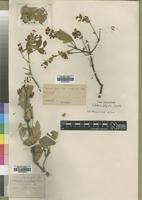
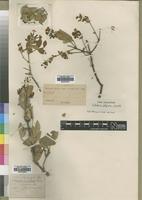
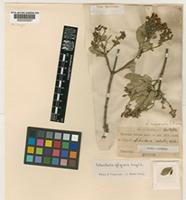
Name
Identification
Schrebera gilgiana Lingelsh. [family OLEACEAE ] Schrebera argyrotricha Gilg [family OLEACEAE ] (stored under name);
Related name
- Schrebera mazoensis
- Schrebera alata
- Schrebera gilgiana
- Schrebera argyrotricha
Flora
Entry for Schrebera alata Hochst. Welw. [family OLEACEAE]
Herbarium
Royal Botanic Gardens, Kew (K)
Collection
Flora Zambesiaca
Resource Type
Reference Sources
Entry From
FZ, Vol 7, Part 1, page 300, (1983) Author: F. K. Kupicha
Names
Schrebera mazoensis S. Moore [family OLEACEAE], in Journ. Bot. 45: 48 (1907). — Turrill, tom. cit.: 5 (1952). Type: Zimbabwe, Mazoe, Eyles 202 (BM, holotype).
Schrebera saundersiae var. latialata Gilg Gilg & Schellenb. [family OLEACEAE], in Engl., op. cit. 51: 66 (1913). Type as for Schrebera latialata.
Schrebera nyassae Lingelsh. [family OLEACEAE], in Engl., Pflanzenr. IV, 243: 106 (1920). Type from Tanzania.
Schrebera gilgiana Lingelsh. [family OLEACEAE], in Engl., tom. cit.: 108 (1920). Syntypes from S. Africa (Transvaal and Natal) and Zimbabwe, Marloth 3403 (not seen).
Nathusia holstii Engl. & Gilg [family OLEACEAE], in Engl., Pflanzenw. Ost–Afr.C: 308 (1895). Type from Tanzania.
Schrebera goetzeana Gilg [family OLEACEAE], in Engl., Bot. Jahrb. 28: 450 (1900). — Baker, tom. cit.: 16 (1902). — Turrill, tom. cit.: 5 (1952). Type from Tanzania.
Schrebera obliquifoliolata Gilg [family OLEACEAE], op. cit. 30: 72 (1901). — Baker, tom. cit. Type from Kenya.
Schrebera holstii Engl. & Gilg Gilg [family OLEACEAE], loc. cit. — Baker, tom. cit.: 17 (1902). — Turrill, op. cit.: 6 (1952). Type as for Nathusia holstii.
Schrebera welwitschii Gilg [family OLEACEAE], tom. cit.: 73(1901). — Baker, tom. cit.: 15 (1902). Syntypes from Angola.
Schrebera latialata Gilg [family OLEACEAE], loc. cit. Type from S. Africa (Natal).
Schrebera tomentella Welw. Gilg [family OLEACEAE], tom. cit.: 74 (1901). — Baker, tom. cit.: 16 (1902). Type as for Schrebera alata var, tomentella.
Schrebera argyrotricha Gilg [family OLEACEAE], loc. cit. — Wright in F.C. 4 483 (1907). — Verdoorn, tom. cit.: 553, fig. 2 (1956); op. cit.: 102 (1963). Type from S. Africa (Transvaal).
Schrebera greenwayi Turrill [family OLEACEAE], in Kew Bull. 7: 135 (1952); op. cit.: 5 (1952). Type from Tanzania.
Schrebera alata Hochst. Welw. [family OLEACEAE], in Trans. Linn. Soc. 27: 41 (1869). — Baker in F.T.A. 4 15 (1902). — Turrill in F.T.E.A., Oleaceae: 4, fig. 1 (1952). — Verdoorn in Bothalia 6: 550, fig. 1 (1956); in Fl. Southern Afr.26: 100 (1963). — F. White, F.F.N.R.: 338 (1962). — Chapman and White, Evergr. For. Malawi: 44 (1970). — Liben in Fl.d’ Afr.Centr., Oleaceae: 2 (1973). — Fanshawe, Check–list Woody Pl. Zamb.: 39 (1973). — R.B. Drumm. in Kirkia 10: 267 (1975). Type from Ethiopia.
Nathusia alata Hochst. [family OLEACEAE], in Flora 24, 1, IntelligenzbL: 25 & 2: 672(1841). Type as above.
Schrebera saundersiae Harvey [family OLEACEAE], Thes. Cap. 2: 40, t. 163 (1859). — Wright in F.C. 4 483 (1907). Type from S. Africa (Natal).
Schrebera alata var. tomentella Welw. [family OLEACEAE], tom. cit.: 42 (1869). Type from Angola.
Information
A tree 4–15 m. tall, or sometimes a small bush; trunk slightly fluted; slash cream, becoming darker with exposure; bark pale brown or grey, fairly smooth, with short longitudinal fissures. Young branches glabrous or thinly to densely tomentose, older twigs with very conspicuous lenticels. Leaves imparipinnate with 5 (7) leaflets, the terminal leaflet and distal pair inserted together; leaf axis distinctly articulated at leaflet insertion; petiole and rhachis ± equal in length (in leaves with 5 leaflets). Total leaf length 6–26 cm.; terminal leaflet 3–14 x 1·2–5·5 cm., laterals 2–12 x 1–5 cm.; leaflets elliptic or obovate, rounded to acuminate at apex; terminal leaflet tapered at base, laterals acute or tapered. Petiole and rhachis often winged, glabrous or pubescent; lamina glabrous above, glabrous or sparsely pilose below especially on main veins. Tertiary vein reticulation conspicuous. Inflorescence a terminal several–to many–flowered cyme 4–9 cm. long with deciduous bracts and bracteoles and glabrous to tomentose branches; pedicels up to 2 mm. long. Flowers white to pink, sweet–scented, heterostylous with “pin” and “thrum” forms. Calyx 2–4 mm. long, minutely puberulous to pubescent, truncate or very unevenly dentate at apex. Corolla tube 8–12 mm. long in “pin” flowers, 11–16 mm. in “thrum” flowers, usually pilose inside; lobes (5) 6–7, 3–7 x 2–6 mm., unevenly obovate with apex usually bilobed, each with a triangular patch of brownish dilated hairs extending from the corolla mouth up to 1/2 the length of the petal. Stamens inserted near the top of the corolla tube (“pin” flower) or at the mouth (“thrum”); anthers 1·25–1·5 (2) mm. long, on filaments up to 1 mm. long. Style correspondingly of 2 lengths, either exserted from or slightly shorter than corolla tube. Fruit a woody bivalved capsule 2·5–4·5 cm. long, brown, ± clavate, with wrinkled surface, splitting open at maturity to reveal two locules divided by a papery dissepiment. Seeds 4 per locule, c. 2 cm. long, pendulous.
Habitat
In fringing forest, in Brachystegia woodland, in evergreen forest in gullies.
Distribution
Malawi S Likhubula Valley, c. 1830 m., fl. 7.ii.1958, Chapman 517 (FHO; K; MAL; PRE).Malawi C Ntchisi Distr., Ntchisi Mt., 1400 m., fr. 2.viii.1946, Brass 17109 (BM; K; PRE; SRGH).Zimbabwe S Victoria, fr. 1909, Monro 978 (BM; K).Zimbabwe E Umtali Distr., Imbeza Valley, near Yakarra stream, 1280 m., fl. 15.L1955, Chase 5443 (BM; COI; K; LISC; PRE; SRGH).Zimbabwe C Chilimanzi Distr., Shasha Kopjes, fr. v.1951, Gibson 31/51 (K; SRGH).Zimbabwe W Bulawayo Distr., Old Gwanda road, fr. 23.iii.1968, Bean 16/68 (SRGH).Mozambique M Namaacha Falls, fl. 22.ii.1955, E. M. & W. 541 (LISC; SRGH).Mozambique MS Macuta Mts., 720 m., st. 2.vi.1971, Mutter & Gordon 1783 (LISC; SRGH).Mozambique Z Gúruè Mts., st. 24.ix.1944, Mendonça 2253 (LISC).Mozambique T near the Posto Zootecnico, Angonia, st. 13.v.1948, Mendonça 4224 (LISC).Zambia S Choma, Siasikabole–Singane area, 3·2 km. S. of Singani’s court, near Muzuma R., 1280 m., st. 11.viii.1961, Bainbridge 536 (FHO).Zambia E Lundazi Distr., Nyika Plateau, near top of Kangampande Mt., 2130 m., fr. 2.v.1952, White 2556 (FHO; K).Zambia W Misaka Forest Reserve, st. 12.viii.1968, Mutimushi 2629 (K).Mozambique N Lichinga, Massangulo Mts., c. 1400 m., fr. immat. 25.ii.1964, Torre & Paiva 10818 (LISC).Malawi N Nkhata Bay Distr., Viphya Plateau, 50 km. SW. ofMzuzu, 1770 m., fr. immat. 27.iii.1976, Pawek 10939 (MAL; SRGH).Zimbabwe N Mazoe, 1340 m., fl. iv.1912, Eyles 7433 (BM).Zambia N Mpika Distr., Muchinga Escarpment, 47 km. N. of Mpika, 1830 m., fl. 29.xi.1952, White 3787 (FHO; K).
Distribution (external)
S. Africa (Natal and Transvaal)
Swaziland
Angola
Zaire
Rwanda
Burundi
Uganda
Tanzania
Kenya
Ethiopia
Notes
Fanshawe (loc. cit.) records 5. alata from the Barotse Prov. of Zambia. As the extensive synonymy implies, this widespread species is rather variable. Taxonomists have particularly emphasised the presence or absence of indumentum on young stems and leaves and the degree of winging of the petiole and leafrhachis. In the F.Z. area the latter does not appear of any interest, but glabrous and pubescent forms occur in a well–marked geographical pattern. Thus all specimens from Malawi and from Mozambique (N, Z, T, MS) are glabrous, as are most specimens from M(M). All specimens from Zimbabwe (N, W, C, S) are pubescent. Collections from Zimbabwe (E) and Zambia may be either glabrous or hairy. The pattern does not seem to be continued outside the F.Z. area, most countries having a mixture of forms. It is interesting that Manilkara mochisia (Sapotaceae) exhibits a very similar distribution of glabrous and hairy forms in the F.Z. area.