JSTOR Global Plants Home
  • Home
  • Browse
  • About
  • Access
  • Account
    • Saved Items
    • Profile
  • Log in

Global Plants

Skip to Main Content
  • JSTOR Global Plants Home
  • Global Plants

    • Browse
    • About
    • Access
    • Account
      • Saved Items
      • Profile
Log in
  • Browse
  • About
  • Access
  • Account
    • Saved Items
    • Profile
Advanced Search

Compilation
Schoberia occidentalis

5 Images see all

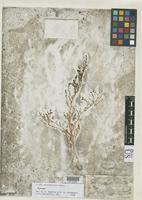
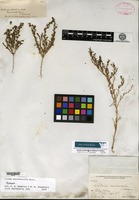
Holotype of Schoberia occidentalis Watson, S. 1871 [family CHENOPODIACEAE]
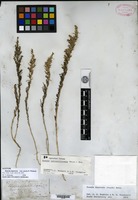
Syntype of Suaeda depressa (Pursh) S. Watson var. erecta S. Watson [family CHENOPODIACEAE]
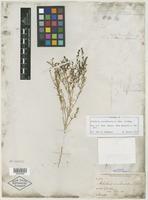
Isotype of Schoberia occidentalis S. Watson [family CHENOPODIACEAE]
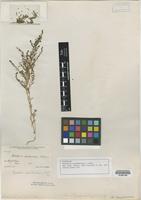
Isotype of Schoberia occidentalis S. Watson [family AMARANTHACEAE]
Syntype of Schoberia occidentalis S. Watson [family CHENOPODIACEAE]
Previous
Next

Name

Identification
Isotype of Schoberia occidentalis S. Watson [family CHENOPODIACEAE ] (stored under name); Verified by Not on sheet,
Related name
  • Schoberia occidentalis
Common name
  • Western seepweed, Flora of North America Vol. 4

Flora

Entry for Suaeda occidentalis (S. Watson) S. Watson [family CHENOPODIACEAE]
Herbarium
Flora of North America (FNA)
Collection
Flora of North America
Resource Type
Reference Sources
Entry From
Flora of North America, Vol 4,
Names
Suaeda occidentalis (S. Watson) S. Watson [family CHENOPODIACEAE], Proc. Amer. Acad. Arts., 9: 90. 1874
Schoberia occidentalis S. Watson [family ], Botany (Fortieth Par allel), 295. 1871
Treatment Author(s)
Wayne R. Ferren Jr.
H. Jochen Schenk
Information
Herbs, annual, erect, green to red, 0.5–3.5 dm, glaucous. Stems erect, green to red, usually branched from near base and throughout; branches ascending to widely spreading, slender. Leaves ascending or spreading; blade linear to linear-elliptic, widest at middle, adaxial surface flat, 5–30 × 0.5–15 mm, apex acute to apiculate. Glomes in flexuous-spreading, 1–6 cm compound spikes, 1–3-flowered; bracts subtending branches leaflike, not wider than leaves; bracts subtending flowers leaflike, widest at middle, shorter than leaves, 2–12 × 0.5–15 mm, not thin-margined basally. Flowers bisexual; perianth zygomorphic or irregular (1 or 3 segments usually larger), 1–3 mm diam.; perianth segments transversely winged proximally (continuously in disk or interrupted), rounded and keeled abaxially and/or horned or hooded distally; stigmas usually 2. Seeds dimorphic; lenticular, 1–1.5 mm diam., with seed coat black, shiny; or flat, 1–1.5 mm diam., with seed coat brown, dull.
Phenology
jun-aug (summer), sep-nov (fall)
Altitude range
1000–2200 m;
Distribution
USA Calif.USA IdahoUSA Mont.USA Nev.USA Oreg.USA UtahUSA Wash.USA Wyo.
Discussion
This species is easily confused with Suaeda calceoliformis, which occurs throughout its range. There are virtually no differences in floral characters. Bracts of S. occidentalis often appear thin-margined at the base in dried specimens but not in fresh material, whereas bracts of S. calceoliformis have visible membranous margins in both. Differences in bract and branching characteristics are usually distinct in fresh specimens. Larger specimens of S. occidentalis are usually branched throughout, with the spreading branches resulting in a more-or-less spherical shape of the plant. The mostly ascending branches of the more-erect S. calceoliformis tend to be concentrated in the upper half of the main stems, with primary branches sometimes arising from the base, and therefore creating a candelabrum shape of the plant.

Related Materials

  • Terms and Conditions
  • Privacy Policy
  • Cookie Policy
  • Cookie Settings
  • Accessibility
  • Help
  • Contact Us
  • Facebook
  • Twitter
ITHAKA

JSTOR is part of ITHAKA, a not-for-profit organization helping the academic community use digital technologies to preserve the scholarly record and to advance research and teaching in sustainable ways.

©2000-2026 ITHAKA. All Rights Reserved. JSTOR®, the JSTOR logo, JPASS®, Aluka®, and ITHAKA® are registered trademarks of ITHAKA.

╳