JSTOR Global Plants Home
  • Home
  • Browse
  • About
  • Access
  • Account
    • Saved Items
    • Profile
  • Log in

Global Plants

Skip to Main Content
  • JSTOR Global Plants Home
  • Global Plants

    • Browse
    • About
    • Access
    • Account
      • Saved Items
      • Profile
Log in
  • Browse
  • About
  • Access
  • Account
    • Saved Items
    • Profile
Advanced Search

Compilation
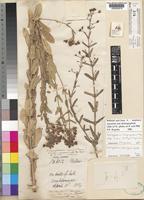
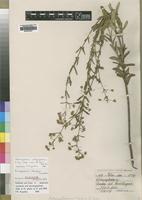
Schizoglossum oblongum

2 Images see all

Lectotype of Schizoglossum oblongum Schltr. [family ASCLEPIADACEAE]
Isolectotype of Schizoglossum oblongum Schltr. [family ASCLEPIADACEAE]
Previous
Next

Name

Identification
Schizoglossum oblongum Schltr. [family ASCLEPIADACEAE ] Verified by Kupicha,F., Schizoglossum atropurpureum (E.Mey.) Kupicha [family ASCLEPIADACEAE ] (stored under name); Verified by Kupicha,F.,
Related name
  • Schizoglossum oblongum
  • Schizoglossum virens
  • Schizoglossum atropurpureum

Flora

Entry for SCHIZOGLOSSUM virens E. Meyer [family ASCLEPIADACEAE]
Herbarium
Royal Botanic Gardens, Kew (K)
Collection
Flora Capensis
Resource Type
Reference Sources
Entry From
Flora Capensis, Vol 4, page 518, (1909) Author: By N. E. BROWN.
Names
SCHIZOGLOSSUM virens E. Meyer [family ASCLEPIADACEAE], Comm. 219;—Decne in DC. Prodr. viii. 554; Schlechter in Engl. Jahrb. xxi. Beibl. 54, 3, excl. syn.
SCHIZOGLOSSUM oblongum Schlechter [family ASCLEPIADACEAE], in Journ. Bot. 1894, 260, and 1896, 420.
Cynanchum virens Dietr. [family ASCLEPIADACEAE], Synop. Pl. ii. 906, not of 905.
Information
stem 2–3 ft. high, simple or branching in the upper part, stout, 1 1/2–2 1/2 lin. thick at the basal part, pubescent with minute curved hairs; internodes numerous, 2/3–1 1/2 in. long; leaves ascending or spreading, those at the middle and lower part of the stem 1 1/2–2 in. long, 1/2– 3/4 in. broad, oblong, obtuse or subacute, truncate or truncately subhastate at the base, the upper and those on the branches much smaller and more hastate, minutely scabrous near the margins above and on the veins beneath, otherwise glabrous; petiole 1–3 lin. long; umbels 3–9 to a branch or stem, racemose, pedunculate, 3–15-flowered; peduncles 1/4–1 1/4 in. long, subtomentose; bracts 1 1/2–2 lin. long, subulate or filiform; pedicels 1/3– 1/2 in. long, subtomentose; sepals 1 1/2–1 3/4 lin. long, 3/4 lin. broad, lanceolate or oblong-lanceolate, acute, minutely pubescent; corolla-lobes ascending, 2 1/2–3 lin. long, 1 1/2–2 lin. broad, oblong, very obtusely rounded at the apex, slightly concave, glabrous on both sides, sometimes minutely ciliate at the base, greenish or yellowish-green; corona-lobes much shorter than the staminal column, 1/2– 2/3 lin. long, 1/3– 1/2 lin. broad, ovate-oblong or oblong, obtusely rounded at the apex, with an appendage and 2 distant parallel keels placed near the margins and having a short keel on each side extending from the base of the appendage obliquely downwards and out to the margins on the inner face, so that viewed sideways the margins appear to make a fold at this point; appendage 2/3 lin. long, arising just below the apex of the lobe and usually more than half as broad as it is at the base, linear, deeply bifid or trifid or divided to the base into 2–3 contiguous subulate segments, erect, reaching to or slightly overtopping the style-apex, slightly recurved-hooked at the apex; staminal column 3/4–1 lin. long; anther-appendages subreniform, very obtuse, erect beneath the rim of the broad flat or slightly concave style-apex; caudicles attached to the side of the oblong pollen-masses between the middle and apex. null
Distribution
EASTERN REGION Natal; between Umtsikaba River and Durban, Drège, 4956! on a hill at Umhlongwe, Wood, 3012! and in Natal Herb. 489! and without precise locality, Gerrard, 1302 partly!
Notes
The specimen in E. Meyer's Herbarium, which Schlechter in Engl. Jahrb. xxi. Beibl. 54, 3, states was mixed with S. euphorbioides, E. Meyer (Drège, 4960), and has named S. tridentatum, Schlechter, is E. virens, E. Meyer, and is evidently a portion of the same gathering as Drège, 4596; it is quite distinct in its coronal structure from S. tridentatum, with the type of which (Flanagan, 1040) I have compared it. In E. Meyer's Herbarium, Schlechter has labelled the type specimens of S. cordifolium, E. Meyer, as S. virens, and to the type of S. virens he has not added a label.

Related Materials

  • Terms and Conditions
  • Privacy Policy
  • Cookie Policy
  • Cookie Settings
  • Accessibility
  • Help
  • Contact Us
  • Facebook
  • Twitter
ITHAKA

JSTOR is part of ITHAKA, a not-for-profit organization helping the academic community use digital technologies to preserve the scholarly record and to advance research and teaching in sustainable ways.

©2000-2026 ITHAKA. All Rights Reserved. JSTOR®, the JSTOR logo, JPASS®, Aluka®, and ITHAKA® are registered trademarks of ITHAKA.

╳