JSTOR Global Plants Home
  • Home
  • Browse
  • About
  • Access
  • Account
    • Saved Items
    • Profile
  • Log in

Global Plants

Skip to Main Content
  • JSTOR Global Plants Home
  • Global Plants

    • Browse
    • About
    • Access
    • Account
      • Saved Items
      • Profile
Log in
  • Browse
  • About
  • Access
  • Account
    • Saved Items
    • Profile
Advanced Search

Compilation
Saxifraga debilis

6 Images see all

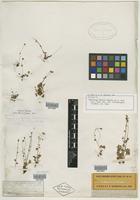
Isotype of Saxifraga debilis Engelm. ex A. Gray [family SAXIFRAGACEAE]
Type of Saxifraga debilis Engelmann ex A. Gray [family SAXIFRAGACEAE]
Isotype of Saxifraga debilis Engelm. ex A. Gray [family SAXIFRAGACEAE]
Type of Saxifraga debilis Engelmann ex A. Gray [family SAXIFRAGACEAE]
Isosyntype of Saxifraga debilis Engelmann, G. 1864 [family SAXIFRAGACEAE]
Previous
Next

Name

Identification
Saxifraga debilis Engelmann ex A. Gray [family SAXIFRAGACEAE ] (stored under name); Verified by Engelm. ex. A. Gray, 1863
Related name
  • Saxifraga cernua
  • Saxifraga debilis
  • Saxifraga rivularis

Flora

Entry for Saxifraga debilis Engelmann ex A. Gray [family SAXIFRAGACEAE]
Herbarium
Flora of North America (FNA)
Collection
Flora of North America
Resource Type
Reference Sources
Entry From
Flora of North America, Vol 8,
Names
Saxifraga debilis Engelmann ex A. Gray [family SAXIFRAGACEAE], Proc. Acad. Nat. Sci. Philadelphia, 15: 62. 1864,
Saxifraga cernua Linnaeus var. debilis (Engelmann ex A. Gray) Engler [family SAXIFRAGACEAE]
Saxifraga hyperborea R. Brown subsp. debilis (Engelmann ex A. Gray) Á. Löve, D. Löve & B. M. Kapoor [family SAXIFRAGACEAE]
Saxifraga rivularis Linnaeus var. debilis (Engelmann ex A. Gray) Dorn [family SAXIFRAGACEAE]
Treatment Author(s)
Luc Brouillet
Patrick E. Elvander†
Information
Plants usually densely tufted, sometimes loosely so, not stoloniferous, not rhizomatous. Leaves basal and cauline, (3–5, proximal similar to basal); petiole ± flattened, 5–70 mm; blade round or reniform, (3–)5–7-lobed (lobes obtuse), (3–)4.5–6.7(–10.3) mm, slightly fleshy, margins entire, eciliate, surfaces glabrous. Inflorescences 2–3(–5)-flowered, capitate cymes, sometimes solitary flowers, (flowers subsessile), (3–)6.7–9(–19.4) cm, tangled, nonglandular-hairy; bracts petiolate. Flowers (hypanthium V-shaped in longisection, glabrous or sparsely short stipitate-glandular); sepals erect, oblong to ovate, (0.7–1 mm wide), margins eciliate, surfaces abaxially glabrous; petals white to pale purple, not spotted, oblong, (1.7–)3–4.4(–6.2) mm, ± equaling sepals; ovary 1/2 inferior. 2n = 26.
Phenology
Flowering summer
Altitude range
2500–4000 m
Distribution
USA Colo.USA Mont.USA N.Mex.USA UtahUSA Wyo.
Discussion
Saxifraga debilis is known only from the central and southern Rocky Mountains, where it is often called S. rivularis (a species not present in the area). Its V-shaped (in longisection), glabrous or sparsely short stipitate-glandular hypanthia, and larger, more-lobed leaves (similar to S. bracteata in this) distinguish it from S. hyperborea, which is sometimes sympatric (M. H. Jørgensen et al. 2006).

Related Materials

  • Terms and Conditions
  • Privacy Policy
  • Cookie Policy
  • Cookie Settings
  • Accessibility
  • Help
  • Contact Us
  • Facebook
  • Twitter
ITHAKA

JSTOR is part of ITHAKA, a not-for-profit organization helping the academic community use digital technologies to preserve the scholarly record and to advance research and teaching in sustainable ways.

©2000-2026 ITHAKA. All Rights Reserved. JSTOR®, the JSTOR logo, JPASS®, Aluka®, and ITHAKA® are registered trademarks of ITHAKA.

╳