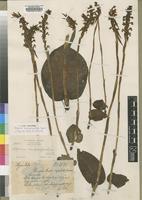
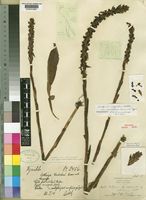
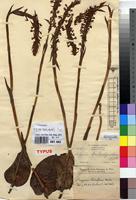
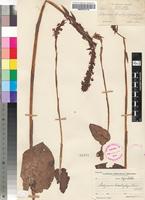
Isotype of Satyrium brachyrhynchumSchltr. [family ORCHIDACEAE ] Satyrium cheirophorumRolfe [family ORCHIDACEAE ] (stored under name);
Related name
Satyrium colliferum
Satyrium neglectum
Satyrium brachyrhynchum
Satyrium speciosum
Satyrium cheirophorum
Flora
Entry for SATYRIUM cheirophorum Rolfe [family ORCHIDACEAE]
Herbarium
Royal Botanic Gardens, Kew (K)
Collection
Flora of Tropical Africa
Resource Type
Reference Sources
Entry From
Flora of Tropical Africa, Vol 7, page 12, (1898) Author: (By R. A. Rolfe.)
Names
SATYRIUM cheirophorumRolfe [family ORCHIDACEAE]
Information
Plant somewhat slender, with a few lanceolate sheaths on the stem; base not seen. Raceme 2 1/2–4 in. or more long, lax. Bracts lanceolate, acuminate, 8–12 lin. long. Pedicels 4 lin. long. Sepals 6 lin. long; odd one linear-oblong, obtuse; lateral broader, somewhat spreading. Petals united for a third of their length to the sepals, and similar to the odd one. Lip galeate, subcompressed, 4 1/2 lin. long, the basal third united to the lateral sepals; mouth rather narrow; apex triangular-ovate, apiculate, reflexed; spurs linear, slightly curved, 6 lin. long. Column 4 lin. long; stigma broadly ovate; rostellum broad, tridenticulate.
Distribution
Nyasaland Mozamb. Dist. Shire Highlands, near Blantyre, Last!