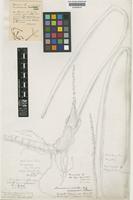
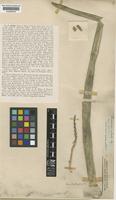
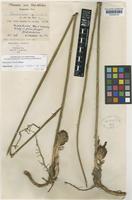
Sansevieria sulcataBojer ex Baker [family DRACAENACEAE ] Isotype of Sansevieria pfennigiiMbugua [family DRACAENACEAE ] (stored under name); Verified by Mbugua, P.K.,
Related name
Acyntha unrecorded
Sansevieria pfennigii
Sansevieria comorensis
Sansevieria sulcata
Flora
Entry for SANSEVIERIA sulcata Bojer ex Baker [family DRACAENACEAE]
Herbarium
Royal Botanic Gardens, Kew (K)
Collection
Flora of Tropical Africa
Resource Type
Reference Sources
Entry From
Flora of Tropical Africa, Vol 7, page 331, (1898) Author: (By J. G. BAKER.)
Names
SANSEVIERIA sulcataBojer ex Baker [family DRACAENACEAE], in Journ. Linn. Soc. xiv. 549 (in syn.). —Kew Bulletin, 1887, May, 10 and 3, fig. 7.
Information
Leaves few to a tuft, terete, 2–3 ft. long, nearly 1 in. diam. at the middle, dull green, not mottled, tapering gradually to an almost pungent point, marked from the apex to the base with 5 distinct grooves; facial groove rather deeper than the others; laterals also a little deeper than the dorsal. Primordial leaves terete. Flowers unknown.
Notes
Locality not known with certainty; probably the coast of German East Africa. The above description is taken from the living plant at Kew. A plant received from Lamu Island, British East Africa, from Mr. R. M. Ormerod in 1896, differs in having leaves 1 1/2 in. diam.