JSTOR Global Plants Home
  • Home
  • Browse
  • About
  • Access
  • Account
    • Saved Items
    • Profile
  • Log in

Global Plants

Skip to Main Content
  • JSTOR Global Plants Home
  • Global Plants

    • Browse
    • About
    • Access
    • Account
      • Saved Items
      • Profile
Log in
  • Browse
  • About
  • Access
  • Account
    • Saved Items
    • Profile
Advanced Search

Compilation
Sansevieria pearsonii

5 Images see all

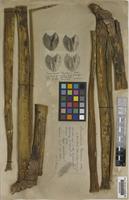
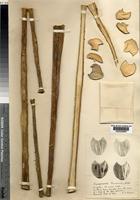
Type of Sansevieria pearsonii N.E.Br. [family DRACAENACEAE]
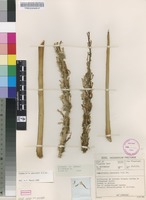
Filed as Sansevieria pearsonii N.E.Br. [family DRACAENACEAE]
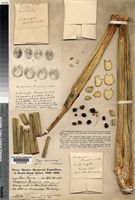
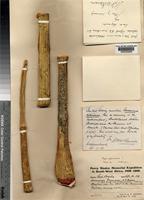
Type of Sansevieria pearsonii N.E.Br. [family DRACAENACEAE]
Previous
Next

Name

Identification
Sansevieria pearsonii N.E.Br. [family DRACAENACEAE ] (stored under name); Verified by Unknown,
Related name
  • Sansevieria pearsonii

Flora

Entry for Sansevieria pearsonii [family DRACAENACEAE]
Herbarium
South African National Biodiversity Institute, Compton Herbarium, Cape Town (SAM)
Collection
Flora of Southern Africa
Resource Type
Reference Sources
Entry From
Flora of South Africa, (2003) Author: Dr J.P. Roux
Names
Sansevieria pearsonii [family DRACAENACEAE]
Common names
S. desertii N.E. Br.: 208 (1915); Verdoorn: t. 806 (1941). Syntypes: Botswana, on banks of Botletle River, Mrs Lugard 9 (K); Botswana, shores of Lake Ngami and the Botletle River, Nicolls s.n. (K).
Information
Perennials forming large colonies. Rhizome and roots typical. Leaves distichous, erect, alternate, + 5-7, cylindrical, bases overlapping below, + 0,5-1,0 m long, hard, smooth becoming ribbed with age, grooved on inside, margins red with a white outer membrane; immature leaves of seedlings + 10, rosulate, linear-acuminate, gradually curving inwards at maturity, becoming distichous and cylindrical with an apical groove. Inflorescence a tall raceme, emerging from centre of leaves, up to ± 1 m high; peduncle with 5—7 narrow, pointed bracts. Flowers typical, numer­ous, in small, knobbly, bracteate clusters of ± 6—10 flowers each, clusters placed irregularly along peduncle; pedicels articulated in the middle, anthesis presumably at night as in other species. Perianth 18—35 mm long; tube 12-25 mm long; lobes 6-10 mm long, colour variously described as drab, greyish or `bluish mauve at base, red-streaked higher up, tepals cream inside with pale pink or mauve' (fide Pooley 1437). Fruit tvpical, globos
Use
4. Sansevieria pearsonii N.E. Br. in Kew Bulletin 1911: 97 (1911); N.E. Br.: 216, fig. 9 (1915); Soldi & Roessl.: 2 (1966). Type: southern Angola, near KM 108,5 on Mossamedes railway line, Pearson 2073 (K, holo.).
Range
Widespread in summer rainfall areas of southern Africa, in Namibia, Transvaal and Natal; also in tropical Africa; in scrub or savanna or on river banks, in dry sandy or rocky soil. Often forming large dense colonies. Map 5.

Related Materials

  • Terms and Conditions
  • Privacy Policy
  • Cookie Policy
  • Cookie Settings
  • Accessibility
  • Help
  • Contact Us
  • Facebook
  • Twitter
ITHAKA

JSTOR is part of ITHAKA, a not-for-profit organization helping the academic community use digital technologies to preserve the scholarly record and to advance research and teaching in sustainable ways.

©2000-2026 ITHAKA. All Rights Reserved. JSTOR®, the JSTOR logo, JPASS®, Aluka®, and ITHAKA® are registered trademarks of ITHAKA.

╳