

Compilation
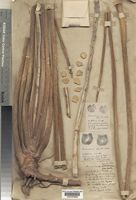
Sansevieria deserti
1 Images see all
Name
Identification
Sansevieria deserti N.E.Br. [family DRACAENACEAE ] (stored under name); Verified by Unknown,
Related name
- Sansevieria deserti
Flora
Entry for Sansevieria deserti N.E.Br. [family DRACAENACEAE]
Herbarium
Royal Botanic Gardens, Kew (K)
Collection
Flora of Tropical East Africa
Resource Type
Reference Sources
Entry From
Flora of Tropical East Africa, page 1, (2007) Author: Geoffrey Mwachala & Paul Mbugua
Names
Sansevieria deserti N.E.Br. [family DRACAENACEAE], in K.B. 1915: 208 (1915), as deserti . Type: Botswana, on the banks of the River Botletle in the Kalahari desert, Lugard 9 (K!, syn.); shore of Lake Ngami and the River Botletle, Apr. 1890, Nicholls s.n. (K!, syn.)
Information
Rosulate herb; rhizome subterranean, 0.6–1.2 cm in diameter. Leaves erect, (4–)5–10, twisted-distichous, compressed-cylindric, 30–60 cm long, ± 4.5–6 cm broad at the sheathing base, gradually tapering to the horny white terete and sharp spine, apex 1–1.7 cm long, margins deep red-brown, less than 1 mm wide, acute, edged with white, thin membrane in some parts, very wide at base in old leaves in lower half, more or less obtuse and green towards the apex, the red-brown edge of the margin run like a collar around the base of the white apical point, slightly rough to very rough, channelled on the face and with ± 7–12 shallow grooves on the rounded back, thickness from the bottom of the channel to the back measured ± one third of the way up 0.8–1.5 cm; channel as wide as leaf near the base and gradually narrowing upwards, especially narrow on the inner (i.e. youngest) leaf; scaly leaves 1–5, 3–10 cm long, stiff, rounded apex, more or less deltoid, broad-based and clasping, red-brown margin with wide white-brown membrane. Inflorescence a terminal spike-like raceme ± 50 cm long; axis pale green, terete, 0.5–0.6 cm in diameter; flowers (3–)4–6 per cluster; lower inflorescence bracts 3, membranous, ± 5 cm long, clasping two-thirds of the circumference at the base of the peduncle; bracteoles 3–10 mm long, fleshy at the base, and thence produced into a membranous acuminate early withering scale; pedicels 5–8 mm long, jointed about the middle, the upper part early deciduous with flower. Flower buds cylindric, 2.1–2.4 cm long, with a lustrous appearance, drab yellow or white faintly flushed with pink or mauve and drab yellow or white faintly flushed with a mauve and the lightly clavate tip greyish-olive; tube ± 8–10 mm long, lobes linear, 12 mm long, obtuse, strongly revolute near the base; filaments yellowish, ± as long as the perianth, anthers 2.5–3 mm long; style whitish, ± 2 cm long. Fruit up to 2 per cluster, a globose berry 0.6–0.9 cm diameter. Fig. 3, p. 29.
Range
DISTR. T 7
Distribution
TANZANIA Rungwe District Kyimbila, 1915, Stolz s.n.!
Distribution (external)
Zambia
Mozambique
Zimbabwe
Botswana
Notes
USES. No data. CONSERVATION Least concern. This taxon was also seen at Brookside Nurseries, Kent, where it had a spiral-distichous leaf arrangement and a very abrupt twist. Newton in Ill. Handbook Succ. plants (2001) regards it as a synonym of S. pearsonii N.E. Brown.