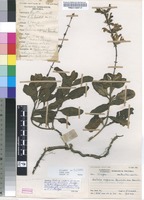
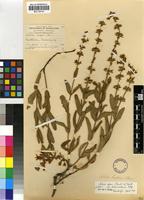
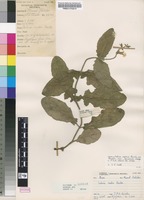
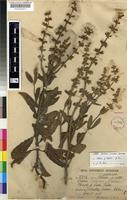
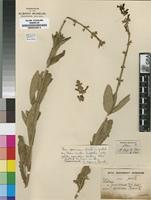
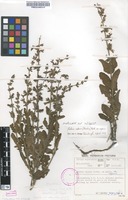
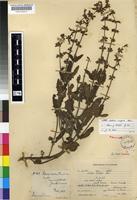
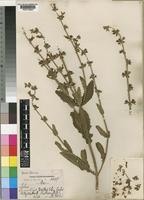
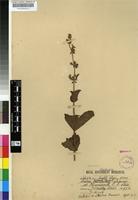
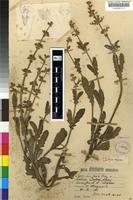
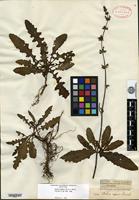
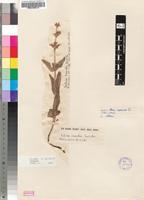
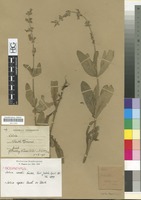
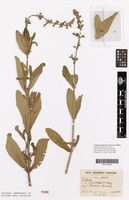
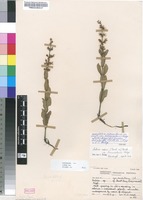
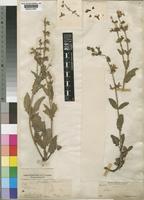
a perennial herb; stem creeping and branched at the base underground, the aerial part ascending, up to 2 ft. high or more, usually simple, weak, flexuose, very sparingly hispidly puberulous; leaves somewhat tufted at the base, and in very distant pairs on the stem, the lower petiolate, the upper sessile, lanceolate, oblong or sometimes obovate-oblong, pinnatifid or sometimes only slightly lobed, almost quite glabrous, or very sparingly pubescent chiefly on the nerves beneath; blade 2–4 in. long, 3/4–1 1/3 in. broad, usually acute; terminal lobe about 1 in. long and 1/2 in. broad; lateral lobes 2–5 each side, subdeltoid, acute, 3–5 lin. long, 1 1/2–4 lin. broad, broadly toothed like the terminal lobe; whorls usually 6-flowered, distant, in slender mostly unbranched racemes up to 1 ft. long; bracts ovate, acuminate or lanceolate, shorter than the calyx or the lower sometimes longer; pedicels up to 2 lin. long; calyx narrowly campanulate, 3 1/4–4 lin. long, somewhat hispidly pubescent, gland-dotted; tube 1 1/4–2 lin. long; upper lip 1 2/3–2 lin. long, 3-toothed; teeth subulate, sometimes much broadened at the base, 1/3–1 1/4 lin. long; lower lip 1 1/2–2 lin. long, bifid; teeth linear-triangular, 1 1/4–1 3/4 lin. long; corolla blue or mauve, 6–8 lin. long; tube 3 1/2–6 lin. long, funnel-shaped, somewhat ventricose, annular-pilose inside about 1 1/4 lin. from the base; upper lip oblong-obovate, 2–2 1/2 lin. long, emarginate or shortly 2-lobed; lower lip 2 1/3–3 lin. long; median lobe broadly obcordate, 1 1/4–2 lin. long, 1 3/4–2 1/2 lin. broad; lateral lobes short, rounded. null