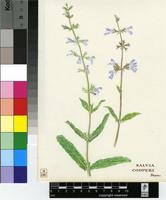
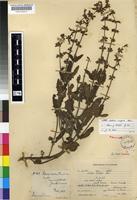
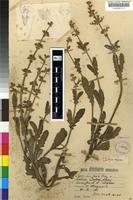
a perennial herb with a woody subterranean caudex; stem branched, erect, up to 1 1/2 ft. high or more, 3/4–1 lin. in diam., more or less covered with slender hairs; internodes 1 1/4–3 in. long; lower leaves petiolate, upper sessile, lanceolate-oblong or sometimes elliptic-obovate, the lower about 2 in. long (rarely up to 3 1/2 in. long), 6–11 lin. broad, the upper gradually becoming smaller, rounded, obtuse or acute at the apex, rounded or slightly narrowed at the base, rather regularly crenate, irregularly erose-dentate or sometimes only slightly undulate, occasionally lobed in the lower part, prominently 5- or 6-nerved each side, sparingly covered with short stiff hairs above, hispid on the nerves beneath or almost glabrous, densely gland-dotted; petiole 2–10 lin. long; whorls 2–6-flowered, distant, in a terminal simple or few-branched raceme 3–12 in. long; bracts ovate, spinescent-acuminate, shorter than the calyx; pedicels 1–2 lin. long, villous; calyx campanulate, 3 1/4–3 3/4 lin. long, about 4 lin. long when mature, rather sparingly pubescent, gland-dotted; tube 1 3/4 lin. long; upper lip about 2 lin. long, finally truncate, 3-toothed; teeth subulate from a broad base, 1/2– 3/4 lin. long, spinescent; lower lip about 1 3/4 lin. long, bifid; teeth linear- or lanceolate-triangular, 1 1/2 lin. long, spinescent; corolla pale blue or purple-blue, 6 1/2–7 lin. long, puberulous; tube broad, 3 3/4–4 3/4 lin. long, 3/4–1 lin. broad at the base, broadly ventricose at the throat, slightly recurved; upper lip obovate-oblong, 2 1/2–3 lin. long, bilobed; lower lip 3–4 1/4 lin. long; median lobe broadly obcordate, 1 3/4–2 1/4 lin. long, nearly 2 1/2–3 3/4 lin. broad; lateral lobes shorter, rounded. null