JSTOR Global Plants Home
  • Home
  • Browse
  • About
  • Access
  • Account
    • Saved Items
    • Profile
  • Log in

Global Plants

Skip to Main Content
  • JSTOR Global Plants Home
  • Global Plants

    • Browse
    • About
    • Access
    • Account
      • Saved Items
      • Profile
Log in
  • Browse
  • About
  • Access
  • Account
    • Saved Items
    • Profile
Advanced Search

Compilation
Salix tyrrellii

4 Images see all

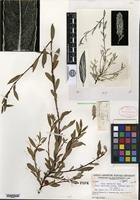
Type of Salix tyrrellii Raup [family SALICACEAE]
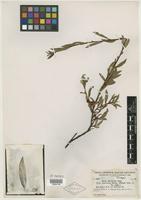
Isotype of Salix tyrrellii Raup [family SALICACEAE]
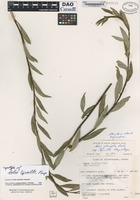
not on sheet of Salix tyrrellii Raup [family SALICACEAE]
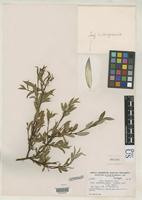
Isotype of Salix tyrrellii Raup, H.M. 1936 [family SALICACEAE]
Previous
Next

Name

Identification
Salix tyrrellii Raup [family SALICACEAE ] (stored under name); Verified by Raup, 1936
Related name
  • Salix tyrrellii
Common name
  • Tyrrell’s willow, Flora of North America Vol. 7

Flora

Entry for Salix tyrrellii Raup [family SALICACEAE]
Herbarium
Flora of North America (FNA)
Collection
Flora of North America
Resource Type
Reference Sources
Entry From
Flora of North America, Vol 7,
Names
Salix tyrrellii Raup [family SALICACEAE], J. Arnold Arbor., 17: 231, plate 192. 1936
Salix planifolia Pursh subsp. tyrrellii (Raup) Argus [family SALICACEAE]
Treatment Author(s)
George W. Argus
Information
Shrubs, 0.6–3.5 m, (sometimes forming clones by layering). Stems: branches and branchlets red-brown, not to strongly glaucous, glabrous, (buds caprea-type or intermediate). Leaves: stipules rudimentary or foliaceous (often brownish) on early ones, foliaceous or rudimentary on late ones, (ca. 4 mm), apex acute; petiole convex to flat, or shallowly grooved adaxially, 1–3.4–16 mm, glabrous, pilose, or short-silky adaxially; largest medial blade (amphistomatous), narrowly elliptic, elliptic, oblanceolate, or obovate, 15–29–65 × 3.5–8.8–18 mm, 2.3–3.3–4.4 times as long as wide, base cuneate or convex, margins strongly to slightly revolute, entire, or very shallowly serrulate or shallowly serrulate-crenulate, apex acute, acuminate, or convex, abaxial surface glaucous, sparsely long-silky to glabrescent, hairs (ferruginous), straight, adaxial highly glossy, glabrous or sparsely short-silky (hairs white, sometimes also ferruginous); proximal blade margins entire; juvenile blade yellowish green or sometimes reddish, sparsely long-silky abaxially, hairs white and ferruginous. Catkins flowering before leaves emerge; staminate stout, 14–35 × 12–16 mm, flowering branchlet 0 mm; pistillate densely flowered, stout, 17–51 × 10–13–22 mm, flowering branchlet 0–4 mm; floral bract brown, black, or bicolor, 1–3.7 mm, apex acute to acuminate or rounded, abaxially hairy, hairs long, straight. Staminate flowers: adaxial nectary oblong, 0.8–1.1 mm; filaments distinct, glabrous or hairy basally; anthers purple turning yellow, ellipsoid, 0.4–0.7 mm. Pistillate flowers: adaxial nectary oblong or flask-shaped, 0.6–1.1 mm, equal to or shorter than stipe; stipe 0.2–1 mm (–1.4 mm in cultivation); ovary pyriform, long-silky, beak gradually tapering to styles; ovules 12–16 per ovary; styles 0.6–1.2 mm; stigmas flat, abaxially non-papillate with rounded tip, or slenderly cylindrical, 0.44–0.55–0.75 mm. Capsules 3.6–5 mm.
Phenology
jun-jul (summer)
Altitude range
200–600 m;
Distribution
Canada Alta.Canada N.W.T.Canada NunavutCanada Sask.
Discussion
Salix tyrrellii, first described from Lake Athabasca sand dunes in northwestern Saskatchewan and adjacent Alberta, is characterized by slender, amphistomatous leaves and relatively long, slender branchlets (G. W. Argus and J. W. Steele 1979). It probably evolved, in the past 10,000 years, from the widespread boreal S. planifolia. Originally, it was thought to be endemic to Lake Athabasca but recent collections from Nunavut and the Northwest Territories suggest that it may have a much wider range. Plants from Nunavut and the Northwest Territories do not have the long, slender branchlets found in sand dune populations, and identification is primarily based on the presence of amphistomatous leaves. This character, however, may be unreliable. For example, S. planifolia from 2610 m in the Glass Mountains, California, have amphistomatous leaves, suggesting that this character may be under environmental influence. The appropriate rank for this taxon remains uncertain.

Related Materials

  • Terms and Conditions
  • Privacy Policy
  • Cookie Policy
  • Cookie Settings
  • Accessibility
  • Help
  • Contact Us
  • Facebook
  • Twitter
ITHAKA

JSTOR is part of ITHAKA, a not-for-profit organization helping the academic community use digital technologies to preserve the scholarly record and to advance research and teaching in sustainable ways.

©2000-2026 ITHAKA. All Rights Reserved. JSTOR®, the JSTOR logo, JPASS®, Aluka®, and ITHAKA® are registered trademarks of ITHAKA.

╳