JSTOR Global Plants Home
  • Home
  • Browse
  • About
  • Access
  • Account
    • Saved Items
    • Profile
  • Log in

Global Plants

Skip to Main Content
  • JSTOR Global Plants Home
  • Global Plants

    • Browse
    • About
    • Access
    • Account
      • Saved Items
      • Profile
Log in
  • Browse
  • About
  • Access
  • Account
    • Saved Items
    • Profile
Advanced Search

Compilation
Salix sphenophylla

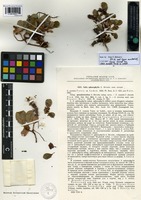
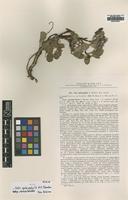
2 Images see all

Filed as Salix sphenophylla A. Skvorts. [family SALICACEAE]
Isotype of Salix sphenophylla A.K.Skvortsov ssp. pseudotorulosa [family SALICACEAE]
Previous
Next

Name

Identification
Isotype of Salix sphenophylla A.K.Skvortsov [family SALICACEAE ] (stored under name); Verified by Irina Belyaeva, Salix sphenophylla A.K.Skvortsov [family SALICACEAE ]
Related name
  • Salix sphenophylla
Common name
  • Wedge-leaf willow, Flora of North America Vol. 7

Flora

Entry for Salix sphenophylla A. K. Skvortsov [family SALICACEAE]
Herbarium
Flora of North America (FNA)
Collection
Flora of North America
Resource Type
Reference Sources
Entry From
Flora of North America, Vol 7,
Names
Salix sphenophylla A. K. Skvortsov [family SALICACEAE], Spisok Rast. Gerb. Fl. S.S.S.R. Bot. Inst. Vsesoyuzn. Akad. Nauk, 16: 62. 1966
Salix sphenophylla subsp. pseudotorulosa A. K. Skvortsov [family SALICACEAE]
Treatment Author(s)
George W. Argus
Information
Plants 0.03–0.12 m, not clonal or forming clones by layering. Stems trailing and rooting; branches yellow-brown or brownish, glabrous; branchlets yellow-brown, glabrous. Leaves: stipules absent or rudimentary; petiole 4–25 mm, (glabrous or pilose adaxially); largest medial blade hypostomatous, narrowly elliptic, broadly elliptic, obovate, or very broadly obovate, 19–52 × 10–28 mm, 1–3 times as long as wide, base cuneate or convex, margins flat or slightly revolute, entire, apex convex, retuse, or rounded, abaxial surface glabrous, pilose or sparsely long-silky to glabrescent, hairs straight or wavy, adaxial slightly glossy, glabrous or pilose; proximal blade margins entire; juvenile blade (reddish), very sparsely long-silky abaxially. Catkins: staminate 21–53 × 7–13 mm, flowering branchlet 8–20 mm; pistillate loosely to densely flowered, slender or stout, 32–79 × 7–18 mm, flowering branchlet 4–27 mm; floral bract brown or black, 1.1–2 mm, apex rounded, entire, abaxially hairy or ciliate, hairs straight. Staminate flowers: abaxial nectary absent, adaxial nectary oblong, 0.6–1 mm; filaments distinct; anthers ellipsoid or shortly cylindrical, 0.4–0.6 mm. Pistillate flowers: adaxial nectary oblong or ovate, 0.7–1.6 mm, equal to or longer than stipe; stipe 0.5–1.4 mm; ovary obclavate or pyriform, glabrous, or patchy or streaky pilose or villous, especially on beak, beak gradually tapering to or slightly bulged below styles; ovules 10–18 per ovary; styles 0.6–1.8 mm; stigmas flat, abaxially non-papillate with pointed tip, or slenderly cylindrical, 0.32–0.5–0.68 mm. Capsules 4–12 mm. 2n = 38, 57.
Phenology
jun
summer
jul
early aug
Altitude range
10–900 m;
Distribution
e Asia (Chukotka).e Asia (Russian Far East).e Asia (e Siberia).USA AlaskaCanada N.W.T.Canada Yukon
Discussion
The patchy or streaky indumentum on the ovaries of some plants suggests that they may be hybrids.

Related Materials

  • Terms and Conditions
  • Privacy Policy
  • Cookie Policy
  • Cookie Settings
  • Accessibility
  • Help
  • Contact Us
  • Facebook
  • Twitter
ITHAKA

JSTOR is part of ITHAKA, a not-for-profit organization helping the academic community use digital technologies to preserve the scholarly record and to advance research and teaching in sustainable ways.

©2000-2026 ITHAKA. All Rights Reserved. JSTOR®, the JSTOR logo, JPASS®, Aluka®, and ITHAKA® are registered trademarks of ITHAKA.

╳