JSTOR Global Plants Home
  • Home
  • Browse
  • About
  • Access
  • Account
    • Saved Items
    • Profile
  • Log in

Global Plants

Skip to Main Content
  • JSTOR Global Plants Home
  • Global Plants

    • Browse
    • About
    • Access
    • Account
      • Saved Items
      • Profile
Log in
  • Browse
  • About
  • Access
  • Account
    • Saved Items
    • Profile
Advanced Search

Compilation
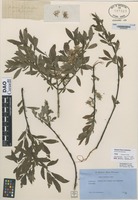
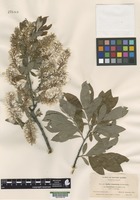
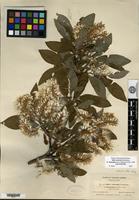
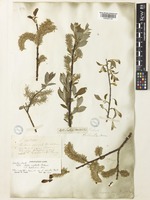
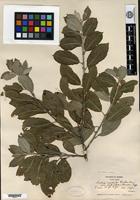
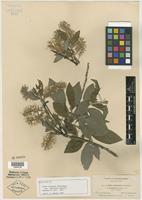
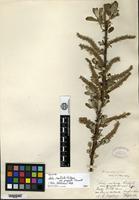
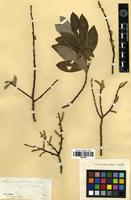
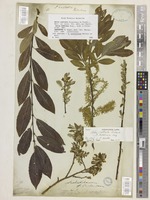
Salix rostrata

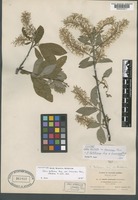
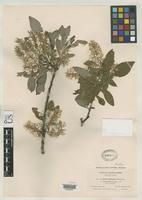
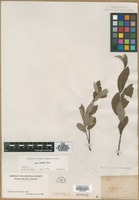
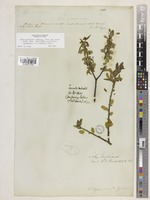
21 Images see all

Type of not on sheet [family NOT ON SHEET]
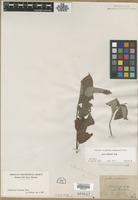
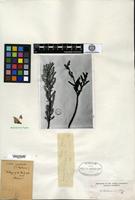
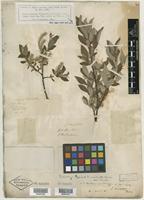
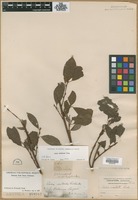
Isosyntype of Salix rostrata Thuill. [family SALICACEAE]
Lectotype of Salix rostrata Richardson var. luxurians Fernald [family SALICACEAE]
Salix bebbiana Sarg. [family SALICACEAE]
Type? of Salix rostrata Richards., non Thuill. var. luxurians Fern. [family SALICACEAE]
Isolectotype of Salix rostrata Richardson, non Thuill. var. luxurians Fernald [family SALICACEAE]
Type of Salix bebbiana Sarg. var. rostrata [family SALICACEAE]
Syntype of Salix rostrata Richardson var. luxurians Fernald [family SALICACEAE]
Type of Salix rostrata Richardson var. capreifolia Fernald [family SALICACEAE]
Isosyntype of Salix rostrata var. luxurians Fernald [family SALICACEAE]
Holotype of Salix rostrata Richardson var. projecta Fernald [family SALICACEAE]
Type? of Salix bebbiana Sarg. [family SALICACEAE]
Isosyntype of Salix rostrata Richardson var. luxurians Fernald [family SALICACEAE]
Isotype of Salix rostrata var. luxurians Fernald, M.L. 1907 [family SALICACEAE]
Filed as Salix rostrata Richardson [family SALICACEAE]
Lectotype of Salix geyeriana Andersson [family SALICACEAE]
Filed as Salix rostrata Richardson [family SALICACEAE]
Type? of Salix rostrata Richardson [family SALICACEAE]
Isotype of Salix rostrata Richardson [family SALICACEAE]
Filed as Salix rostrata Richardson [family SALICACEAE]
Salix bebbiana Sarg. var. rostrata [family SALICACEAE]
Previous
Next

Name

Identification
Salix rostrata Richardson [family SALICACEAE ] (stored under name); Verified by Richardson, 1823
Related name
  • Salix rostrata
  • Salix livida
  • Salix vagans
  • Salix bebbiana
Common name
  • Gray or Bebb’s or long-beaked willow, Flora of North America Vol. 7

Flora

Entry for Salix bebbiana Sargent [family SALICACEAE]
Herbarium
Flora of North America (FNA)
Collection
Flora of North America
Resource Type
Reference Sources
Entry From
Flora of North America, Vol 7,
Names
Salix bebbiana Sargent [family SALICACEAE], Gard. & Forest, 8: 463. 1895
Salix rostrata Richardson [family SALICACEAE], in J. Franklin et al., Narr. Journey Polar Sea, 753. 1823,. not Thuillier 1799
Salix bebbiana var. capreifolia (Fernald) Fernald [family SALICACEAE]
Salix bebbiana var. depilis Raup [family SALICACEAE]
Salix bebbiana var. luxurians (Fernald) Fernald [family SALICACEAE]
Salix bebbiana var. perrostrata (Rydberg) C. K. Schneider [family SALICACEAE]
Salix bebbiana var. projecta (Fernald) C. K. Schneider [family SALICACEAE]
Salix depressa Linnaeus subsp. rostrata (Andersson) Hiitonen [family SALICACEAE]
Treatment Author(s)
George W. Argus
Information
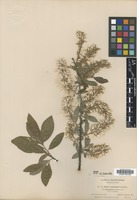
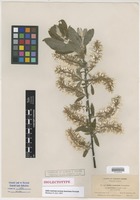
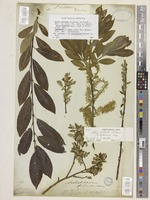
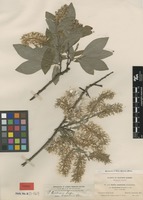
Stems: branches divaricate, sometimes ± brittle at base, yellow-brown to dark red-brown, not or weakly glaucous, pilose to glabrescent, peeled wood often with very dense striae, to 25 mm; branchlets yellow-green or red-brown, moderately to very densely villous to glabrescent. Leaves: stipules rudimentary or absent on early ones, apex acute, acuminate, or convex; petiole convex to flat adaxially, 2–5.5–13 mm, pubescent adaxially; largest medial blade narrowly oblong, narrowly elliptic, elliptic, oblanceolate, or obovate, 20–44–87 × 10–16–45 mm, base cuneate, convex, or rounded, margins flat, entire, crenate, or irregularly serrate, glands submarginal, apex acute, acuminate, or convex, abaxial surface glaucous, moderately densely pubescent or long-silky to glabrescent, hairs white or gray, wavy, adaxial finely impressed-reticulate, dull or slightly glossy, moderately densely pubescent, sparsely short-silky, or glabrescent, hairs white or gray; proximal blade margins entire, gland-dotted; juvenile blade yellowish green or reddish, pilose or sparsely to moderately densely tomentose or long-silky abaxially, hairs white. Catkins: staminate flowering just before leaves emerge, pistillate flowering as leaves emerge; staminate stout to globose, 10–42 × 7–16 mm, flowering branchlet 0.5–11 mm; pistillate loosely flowered, stout, slender, or subglobose, 16.5–85 × 9–32 mm, flowering branchlet 1–26 mm; floral bract tawny, 1.2–3.2 mm, apex rounded, abaxially hairy to glabrescent, hairs straight or wavy. Staminate flowers: adaxial nectary oblong or ovate, 0.3–0.8 mm; filaments distinct or connate less than 1/2 their lengths, glabrous or hairy on proximal 1/2; anthers yellow or purple turning yellow, ellipsoid or shortly cylindrical, 0.5–0.8 mm. Pistillate flowers: adaxial nectary oblong or square, 0.3–0.8 mm; ovary obclavate, beak slightly bulged below styles (long-beaked); ovules 6–16 per ovary; styles 0.1–0.4 mm; stigmas slenderly to broadly cylindrical. Capsules 5–9 mm. 2n = 38.
Phenology
apr-may (spring), jun (summer)
Altitude range
0–3300 m;
Distribution
Asia.USA AlaskaUSA Ariz.USA Calif.USA Colo.USA Conn.USA IdahoUSA Ill.USA Ind.USA IowaUSA MaineUSA Md.USA Mass.USA Mich.USA Minn.USA Mont.USA Nebr.USA Nev.USA N.H.USA N.J.USA N.Mex.USA N.Y.USA N.Dak.USA OhioUSA Oreg.USA Pa.USA R.I.USA S.Dak.USA UtahUSA Vt.USA Wash.USA Wis.USA Wyo.Canada Alta.Canada B.C.Canada Man.Canada N.B.Canada Nfld. and Labr.Canada N.W.T.Canada N.S.Canada NunavutCanada Ont.Canada P.E.I.Canada Que.Canada Sask.Canada Yukon
Discussion
Salix bebbiana occurs in Nunavut on Akimiski Island in James Bay.
Hybrids:
Salix bebbiana forms natural hybrids with S. candida, S. geyeriana, S. humilis, and S. petiolaris. Reports of hybrids with S. discolor (C. K. Schneider 1921; M. L. Fernald 1950) are not based on convincing specimens, and synthetic hybrids could not be made (G. W. Argus 1974). Reports of hybrids with S. eriocephala and S. myricoides (Fernald) are unverified. Controlled pollinations with S. eriocephala and S. interior had low seed viability (A. Mosseler 1990).
Salix bebbiana × S. candida (S. ×cryptodonta Fernald, as species) is intermediate between parental species. It resembles S. candida in having juvenile leaves densely woolly, mature leaves sparsely to moderately woolly abaxially, margins strongly revolute to crenulate, and ovaries woolly; and S. bebbiana in having stipes 2.8–3 mm and capsules long-beaked, 8–9 mm. The hybrid commonly occurs in Newfoundland.
Salix bebbiana × S. geyeriana: A plant with the pistillate catkins and flowers of S. bebbiana and the narrow, entire or slightly serrulate leaves with white and ferruginous hairs of S. geyeriana was collected by R. D. Dorn in a mixed population in Montana (Beaverhead County).
Salix bebbiana × S. humilis: Reported by C. K. Schneider (1921) and M. L. Fernald (1950) and successfully synthesized by G. W. Argus (1974, 1986).
Salix bebbiana × S. petiolaris is known from Ontario, based on an infertile pistillate specimen, and from Alberta and Saskatchewan, where it is relatively uncommon. It was successfully synthesized (G. W. Argus 1974, 1986) and controlled pollinations showed high seed viability (A. Mosseler 1990).

Related Materials

  • Terms and Conditions
  • Privacy Policy
  • Cookie Policy
  • Cookie Settings
  • Accessibility
  • Help
  • Contact Us
  • Facebook
  • Twitter
ITHAKA

JSTOR is part of ITHAKA, a not-for-profit organization helping the academic community use digital technologies to preserve the scholarly record and to advance research and teaching in sustainable ways.

©2000-2026 ITHAKA. All Rights Reserved. JSTOR®, the JSTOR logo, JPASS®, Aluka®, and ITHAKA® are registered trademarks of ITHAKA.

╳