JSTOR Global Plants Home
  • Home
  • Browse
  • About
  • Access
  • Account
    • Saved Items
    • Profile
  • Log in

Global Plants

Skip to Main Content
  • JSTOR Global Plants Home
  • Global Plants

    • Browse
    • About
    • Access
    • Account
      • Saved Items
      • Profile
Log in
  • Browse
  • About
  • Access
  • Account
    • Saved Items
    • Profile
Advanced Search

Compilation
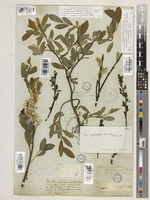
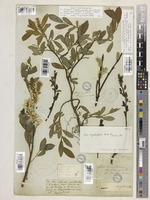
Salix pseudomyrsinites

6 Images see all

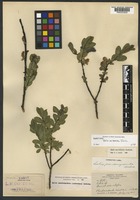
Paratype of Salix arizonica Dorn [family SALICACEAE]
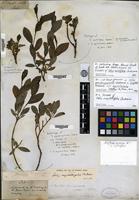
Type of Salix pseudomyrsinites Andersson var. lingulata Andersson [family SALICACEAE]
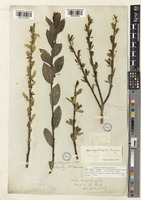
Salix novae-angliae Andersson [infrasp.unranked] pseudomyrsinites (Andersson) Andersson [family SALICACEAE]
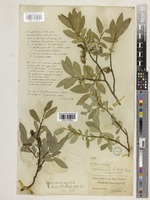
Syntype of Salix pseudomyrsinites Andersson [family SALICACEAE]
Lectotype of Salix pseudomyrsinites Andersson [family SALICACEAE]
Previous
Next

Name

Identification
Salix pseudomyrsinites Andersson [family SALICACEAE ] (stored under name); Verified by Andersson,
Related name
  • Salix pseudomyrsinites
Common name
  • Tall blueberry willow, Flora of North America Vol. 7

Flora

Entry for Salix pseudomyrsinites Andersson [family SALICACEAE]
Herbarium
Flora of North America (FNA)
Collection
Flora of North America
Resource Type
Reference Sources
Entry From
Flora of North America, Vol 7,
Names
Salix pseudomyrsinites Andersson [family SALICACEAE], Öfvers. Kongl. Vetensk.-Akad. Förh., 15: 129. 1858
Salix myrtillifolia Andersson var. cordata (Andersson) Dorn [family SALICACEAE]
Salix myrtillifolia var. pseudomyrsinites (Andersson) C. R. Ball ex Hultén [family SALICACEAE]
Salix novae-angliae Andersson var. cordata Andersson [family SALICACEAE]
Past names
pseudo-myrsinites
Treatment Author(s)
George W. Argus
Information
Plants 1–7 m. Stems: branches gray-brown, red-brown, or yellow-brown, glaucous to strongly so (slightly to highly glossy), villous to glabrescent; branchlets gray-brown, red-brown, yellow-brown, or yellow-green, (not or weakly glaucous), pilose, densely villous, or tomentose. Leaves: stipules rudimentary or foliaceous on early ones, foliaceous on late ones, (0.6–8 mm), apex acute or obtuse; petiole shallowly to deeply grooved adaxially, 2.5–8 mm, glabrous or villous adaxially; largest medial blade (sometimes amphistomatous), narrowly to broadly elliptic, oblong to oblanceolate or obovate, 32–109 × 10–47 mm, 1.8–4.8 times as long as wide, base convex, cuneate, or subcordate, sometimes cordate, margins flat, entire, crenate, or serrulate, apex acute, convex, or acuminate, abaxial surface not glaucous, glabrous or pilose, hairs (white, sometimes also ferruginous), wavy, adaxial slightly glossy, glabrous, pilose, pubescent, moderately densely short-silky, or velvety, midrib remaining pilose or short-hairy, (hairs sometimes also ferruginous, straight and geniculate); proximal blade margins serrulate or entire; juvenile blade sometimes reddish or yellowish green, abaxially glabrous, or midrib sparsely pubescent, or densely villous or short-silky, hairs white, sometimes also ferruginous. Catkins flowering as leaves emerge; staminate stout, 16.5–35.5 × 7–15 mm, flowering branchlet 0.5–12 mm; pistillate moderately or densely flowered, slender or stout, 10.5–68 × 5–20 mm, flowering branchlet 0.5–10 mm; floral bract brown, black, tawny, or bicolor, 0.6–1.1 mm, apex retuse, abaxially hairy, hairs long-wavy or curly. Staminate flowers: adaxial nectary oblong square, 0.2–0.4–0.6 mm; filaments distinct, glabrous; anthers purple turning yellow, 0.4–0.7 mm. Pistillate flowers: adaxial nectary square or oblong, 0.2–0.4 mm, shorter than stipe; stipe 0.8–1.4 mm; ovary pyriform, glabrous, beak slightly bulged below styles; ovules 11–18 per ovary; styles 0.4–1.6 mm; stigmas flat, abaxially non-papillate with rounded tip, or 2 plump lobes, 0.16–0.24–0.32 mm. Capsules 4.4–6.4 mm. 2n = 76.
Phenology
may (spring), jun-jul (summer)
Altitude range
40–1000 m;
Distribution
USA Alaska.Canada Alta.Canada B.C.Canada Man.Canada N.W.T.Canada NunavutCanada Ont.Canada Sask.Canada Yukon
Discussion
Salix pseudomyrsinites occurs in Nunavut on Akimiski Island in James Bay.
Salix pseudomyrsinites and S. myrtillifolia, although sometimes treated as conspecific (R. D. Dorn 1975), deserve species rank. They differ in chromosome number and are distinct in habit, habitat, and general appearance, including glossiness of leaves, as well as a number of technical characteristics (L. A. Viereck and E. L. Little Jr. 1972; G. W. Argus 1973, 1997). There is no field evidence of hybridization, but some herbarium specimens appear to be intermediates, having the habit or habitat of one species and the leaf hairiness of the other.
Salix myrtillifolia is distinguished from S. pseudomyrsinites by having shrubs low, decumbent, 0.1–0.6 m, rarely to 1 m, of treed bogs and fens, juvenile and mature leaves typically glabrous, stipules usually rudimentary, 0.2–1.8(–5) mm, and styles often shorter, 0.3–0.7 mm; S. pseudomyrsinites has shrubs tall, erect, 1–7 m, of riparian habitats, juvenile leaves pubescent with hairs persisting on mature leaves, at least on adaxial midrib, stipules usually prominent and foliaceous, 0.6–8 mm, and styles often longer, 0.4–1.6 mm.
The nomenclature of these species is confusing. When treating them as varieties E. Hultén (1968) used the name Salix myrtillifolia var. pseudomyrsinites and R. D. Dorn (1975) used the name S. myrtillifolia var. cordata. At the species level, the name S. novae-angliae was used (L. A. Viereck and E. L. Little Jr. 1972; G. W. Argus 1973), but that name is illegitimate (Dorn) and is replaced by S. pseudomyrsinites (Argus 1997).
Hybrids:
Salix pseudomyrsinites forms natural hybrids with S. barrattiana.
Salix pseudomyrsinites × S. barrattiana is a rare hybrid that combines the characters of the two parents.

Related Materials

  • Terms and Conditions
  • Privacy Policy
  • Cookie Policy
  • Cookie Settings
  • Accessibility
  • Help
  • Contact Us
  • Facebook
  • Twitter
ITHAKA

JSTOR is part of ITHAKA, a not-for-profit organization helping the academic community use digital technologies to preserve the scholarly record and to advance research and teaching in sustainable ways.

©2000-2026 ITHAKA. All Rights Reserved. JSTOR®, the JSTOR logo, JPASS®, Aluka®, and ITHAKA® are registered trademarks of ITHAKA.

╳