JSTOR Global Plants Home
  • Home
  • Browse
  • About
  • Access
  • Account
    • Saved Items
    • Profile
  • Log in

Global Plants

Skip to Main Content
  • JSTOR Global Plants Home
  • Global Plants

    • Browse
    • About
    • Access
    • Account
      • Saved Items
      • Profile
Log in
  • Browse
  • About
  • Access
  • Account
    • Saved Items
    • Profile
Advanced Search

Compilation
Salix muriei

4 Images see all

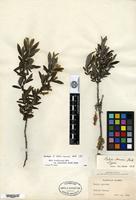
Holotype of Salix muriei Hultén [family SALICACEAE]
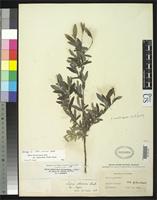
Isotype of Salix muriei Hulten, E. 1943 [family SALICACEAE]
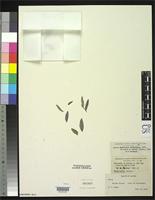
Filed as Salix muriei Hulten, E. 1943 [family SALICACEAE]
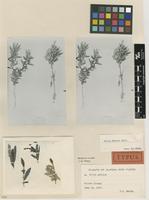
Type of Salix muriei Hultén [family SALICACEAE]
Previous
Next

Name

Identification
Salix brachycarpa Nuttall [family SALICACEAE ] (stored under name); Verified by G. W. Argus, Salix muriei Hultén [family SALICACEAE ] Verified by Hultén, 1943
Related name
  • Salix brachycarpa
  • Salix muriei
  • Salix pulchra
Common name
  • Barren-ground or snow willow, Flora of North America Vol. 7

Flora

Entry for Salix niphoclada Rydberg [family SALICACEAE]
Herbarium
Flora of North America (FNA)
Collection
Flora of North America
Resource Type
Reference Sources
Entry From
Flora of North America, Vol 7,
Names
Salix niphoclada Rydberg [family SALICACEAE], Bull. New York Bot. Gard., 1: 272. 1899
Salix brachycarpa Nuttall subsp. fullertonensis (C. K. Schneider) Á. Löve & D. Löve [family SALICACEAE]
Salix brachycarpa var. fullertonensis (C. K. Schneider) Argus [family SALICACEAE]
Salix brachycarpa var. mexiae C. R. Ball [family SALICACEAE]
Salix brachycarpa subsp. niphoclada (Rydberg) Argus [family SALICACEAE]
Salix fullertonensis C. K. Schneider [family SALICACEAE]
Salix glauca Linnaeus var. niphoclada (Rydberg) Wiggins [family SALICACEAE]
Salix muriei Hultén [family SALICACEAE]
Salix niphoclada var. fullertonensis (C. K. Schneider) Raup [family SALICACEAE]
Salix niphoclada var. mexiae (C. R. Ball) Hultén [family SALICACEAE]
Salix niphoclada var. muriei (Hultén) Raup [family SALICACEAE]
Treatment Author(s)
George W. Argus
Information
Plants 0.3–1.5(–3) m, not clonal. Stems erect, decumbent, or trailing; branches gray-brown, yellow-brown, or red-brown, pilose, villous, or long-silky to glabrescent; branchlets violet, red-brown, or yellow-brown, pilose, densely villous, long-silky, or tomentose. Leaves: stipules (sometimes marcescent), foliaceous, (sometimes obscured by hairs); petiole (shallowly grooved adaxially), 2–5.5 mm, (usually shorter than or barely exceeding subtended bud, villous adaxially); largest medial blade hypostomatous or amphistomatous, narrowly oblong, narrowly to broadly elliptic, lanceolate, or obovate, 13–64 × 6–22 mm, 1.6–5.5 times as long as wide, base convex, margins slightly revolute, entire (obscured by hairs), apex acuminate or acute, abaxial surface densely villous or woolly to pilose, hairs straight or wavy, adaxial slightly glossy, moderately densely to sparsely villous; proximal blade margins entire; juvenile blade abaxially densely long-silky. Catkins: staminate 12–42 × 4–14 mm, flowering branchlet 0–20 mm; pistillate densely flowered, slender, stout, or subglobose, 16–69 × 4–13 mm, flowering branchlet 4–30 mm; floral bract tawny, brown, or black, 1.2–3.2 mm, apex rounded, entire, abaxially sparsely to moderately densely hairy, hairs wavy. Staminate flowers: abaxial nectary 0.5–1.2 mm, adaxial nectary narrowly oblong to ovate or flask-shaped, 0.5–1.5 mm, nectaries distinct or connate and cup-shaped; filaments distinct, glabrous, or sparsely hairy on proximal 1/2; anthers ellipsoid or globose, 0.3–0.5 mm. Pistillate flowers: abaxial nectary rarely present, 0.7 mm, adaxial nectary narrowly oblong, ovoid, or flask-shaped, 0.5–2 mm, longer than stipe; stipe 0–0.5 mm; ovary pyriform, very densely villous or long-silky, beak slightly bulged below or abruptly tapering to styles; ovules 8–20 per ovary; styles connate to almost distinct, 0.2–0.8 mm; stigmas slenderly to broadly cylindrical, 0.2–0.36–0.6 mm. Capsules 4–6 mm.
Phenology
jun-jul (summer)
Altitude range
10–2300 m;
Distribution
Asia (Russia).USA AlaskaCanada B.C.Canada N.W.T.Canada NunavutCanada Yukon
Discussion
Salix niphoclada was treated as S. brachycarpa subsp. niphoclada (G. W. Argus 1965, 1973) because where the ranges of the two taxa overlap in northern British Columbia they appeared to intergrade. Species rank is used here, however, because there is no evidence to suggest that intergradation is common or extends beyond the small area of overlap.
Salix brachycarpa var. fullertonensis, which mainly occurs in southern Nunavut and the western side of Hudson Bay, is characterized by smaller leaves and catkins, broad, reddish floral bracts, and more sparsely hairy branchlets (G. W. Argus 1965). Its intergradation with S. niphoclada is so extensive that it is not recognized here as a separate taxon.
Hybrids:
Salix niphoclada forms natural hybrids with S. glauca var. acutifolia and S. setchelliana.
Salix niphoclada × S. setchelliana is a putative hybrid from Sheep Mountain, Kluane, Yukon, at 1180 m. It resembles S. niphoclada in leaf shape and indumentum, stigmas 0.6 mm, floral bracts oblong, 1.8 mm, and in the shape and length of pistillate catkins, but it has the glabrous, reddish ovaries of S. setchelliana. Both putative parents occur in the area.

Related Materials

  • Terms and Conditions
  • Privacy Policy
  • Cookie Policy
  • Cookie Settings
  • Accessibility
  • Help
  • Contact Us
  • Facebook
  • Twitter
ITHAKA

JSTOR is part of ITHAKA, a not-for-profit organization helping the academic community use digital technologies to preserve the scholarly record and to advance research and teaching in sustainable ways.

©2000-2026 ITHAKA. All Rights Reserved. JSTOR®, the JSTOR logo, JPASS®, Aluka®, and ITHAKA® are registered trademarks of ITHAKA.

╳