JSTOR Global Plants Home
  • Home
  • Browse
  • About
  • Access
  • Account
    • Saved Items
    • Profile
  • Log in

Global Plants

Skip to Main Content
  • JSTOR Global Plants Home
  • Global Plants

    • Browse
    • About
    • Access
    • Account
      • Saved Items
      • Profile
Log in
  • Browse
  • About
  • Access
  • Account
    • Saved Items
    • Profile
Advanced Search

Compilation
Salix drummondiana

17 Images see all

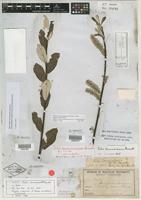
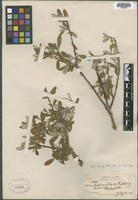
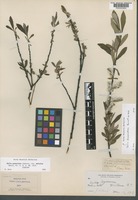
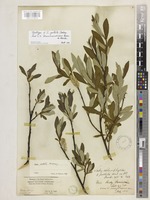
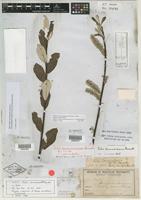
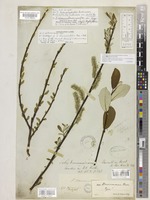
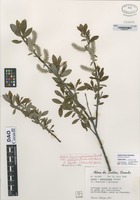
Paratype of Salix drummondiana Barratt ex Hook. [family SALICACEAE]
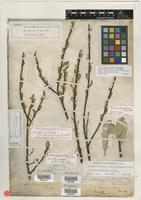
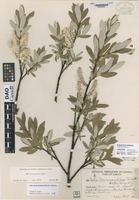
Isotype of Salix drummondiana Barratt [family SALICACEAE]
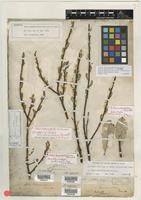
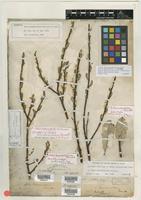
Syntype of Salix pellita Andersson [family SALICACEAE]
Isotype of Salix drummondiana Barratt ex Hook. [family SALICACEAE]
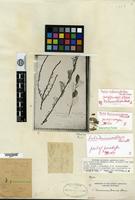
not on sheet of Salix drummondiana Barratt [family SALICACEAE]
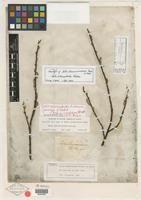
Paratype of Salix drummondiana Barratt ex Hook. [family SALICACEAE]
Syntype of Salix geyeriana Andersson var. meleina J. K. Henry [family SALICEAE]
Syntype of Salix pellita unrecorded [family SALICACEAE]
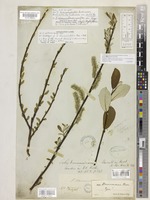
Syntype of Salix drummondiana Barratt ex Hook. [family SALICACEAE]
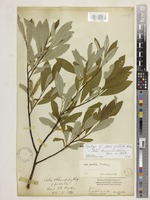
Salix drummondiana Barr. [family SALICACEAE]
not on sheet of Salix ×pellicolor Lepage [family SALICACEAE]
Type of Salix subcoerulea Piper [family SALICACEAE]
Isolectotype of Salix drummondiana Barratt ex Hook. [family SALICACEAE]
Lectotype of Salix drummondiana Barr. [family SALICACEAE]
Salix drummondiana Barr. [family SALICACEAE]
Previous
Next

Name

Identification
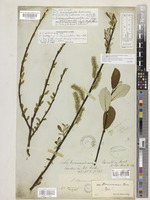
Isotype of Salix drummondiana Barratt [family SALICACEAE ] (stored under name); Verified by Barratt, 1838
Related name
  • Salix drummondiana
  • Salix subcoerulea
  • Salix pellita
Common name
  • Drummond’s willow, Flora of North America Vol. 7

Flora

Entry for Salix drummondiana Barratt ex Hooker [family SALICACEAE]
Herbarium
Flora of North America (FNA)
Collection
Flora of North America
Resource Type
Reference Sources
Entry From
Flora of North America, Vol 7,
Names
Salix drummondiana Barratt ex Hooker [family SALICACEAE], Fl. Bor.-Amer., 2: 144. 1838
Salix drummondiana var. bella (Piper) C. R. Ball [family SALICACEAE]
Salix drummondiana var. subcoerulea (Piper) C. R. Ball [family SALICACEAE]
Salix subcoerulea Piper [family SALICACEAE]
Treatment Author(s)
George W. Argus
Information
Shrubs, 1–5 m, (sometimes forming clones by stem fragmentation). Stems: branches (highly to ± brittle at base), yellow-brown or red-brown, usually strongly glaucous, (slightly glossy), glabrous or glabrescent; branchlets red-brown or mottled yellow-brown, (strongly to not glaucous), glabrous, puberulent, pilose, or velvety, (buds caprea-type or intermediate). Leaves: stipules usually rudimentary or absent, or foliaceous, then small and ovate or slender, apex acute; petiole convex to flat, or shallowly grooved adaxially, 2–12 mm, villous or velvety adaxially; largest medial blade lorate, narrowly elliptic, elliptic, or oblanceolate, 40–85 × 9–26 mm, 3–6.2 times as long as wide, base cuneate or convex, margins slightly revolute, entire, or shallowly crenate to sinuate, apex acute, acuminate, or convex, abaxial surface glaucous (obscured by hairs), densely short- to long-silky, hairs (white, sometimes also ferruginous), straight or wavy, adaxial slightly glossy or dull, sparsely short-silky to glabrescent, (hairs white, sometimes also ferruginous); proximal blade margins entire; juvenile blade green, very densely short-silky abaxially (sparsely so adaxially), hairs white, sometimes also ferruginous. Catkins flowering before leaves emerge; staminate stout, 19–40 × 8–20 mm, flowering branchlet 0 mm; pistillate densely flowered, slender or stout, 22–87(–105 in fruit) × 8–18 mm, flowering branchlet 0–3(–6) mm; floral bract brown or black, 1.2–2.8 mm, apex acute or rounded, abaxially hairy, hairs straight. Staminate flowers: adaxial nectary oblong, 0.3–0.6 mm; filaments distinct, glabrous; anthers purple turning yellow, ellipsoid to shortly cylindrical, 0.4–0.6 mm. Pistillate flowers: adaxial nectary narrowly oblong, oblong, or ovate, 0.4–1 mm, shorter to longer than stipe; stipe 0.3–2 mm; ovary pyriform, short-silky, beak gradually tapering to styles; ovules 6–17 per ovary; styles 0.5–1.5 mm; stigmas flat, abaxially non-papillate with pointed tip, or slenderly to broadly cylindrical, 0.32–0.43–1 mm. Capsules 2.5–6 mm. 2n = 38, 57, 76.
Phenology
apr-may (spring), jun-jul (summer)
Altitude range
200–3400 m;
Distribution
USA Calif.USA Colo.USA IdahoUSA Mont.USA Nev.USA N.Mex.USA Oreg.USA UtahUSA Wash.USA Wyo.Canada Alta.Canada B.C.Canada N.W.T.Canada Sask.Canada Yukon
Discussion
Western American Salix drummondiana and eastern S. pellita have the same close relationship as do S. scouleriana and S. humilis. In Saskatchewan, where their ranges overlap, separation is difficult. The characters shown in the comparison below often overlap but they will usually serve to separate the two. A useful diagnostic vegetative character is the frequent presence in S. pellita of epilaminal glands, which are borne on adaxial leaf surfaces well in from margins.
Salix drummondiana is distinguished from S. pellita by having stipules on early leaves absent or rudimentary, sometimes foliaceous, staminate nectaries 0.3–0.6 mm, largest medial blade margins with submarginal glands, surfaces glabrescent, short-silky, dull or slightly glossy adaxially, petioles villous or velvety adaxially, and juvenile blades short-silky; S. pellita has stipules on early leaves absent or rudimentary, staminate nectaries 0.6–1 mm, largest medial blade margins with epilaminal or submarginal glands, surfaces glabrous, glabrescent, pubescent, or villous, and slightly or highly glossy adaxially, petioles glabrous or pubescent adaxially, and juvenile blades glabrous, glabrescent, pubescent, or tomentose.
Salix drummondiana is distinguished from the similar, but unrelated, S. sitchensis by having branches often strongly glaucous, branchlets sparsely hairy, largest medial blades lorate, narrowly elliptic, elliptic, or oblanceolate, usually narrower, 3–6.2 times as long as wide, margins slightly revolute, and surfaces with white hairs, sometimes also ferruginous; S. sitchensis has branches not glaucous or weakly so, branchlets usually moderately to very densely hairy, largest medial blades elliptic, narrowly oblanceolate, oblanceolate, or obovate, usually slightly broader, 2.1–3.1–4 times as long as wide, margins strongly revolute, and surfaces with white hairs.
Vegetative specimens of Salix drummondiana are distinguished from S. geyeriana by having largest medial blade margins revolute, surfaces usually densely short-silky adaxially, and midribs glabrous; S. geyeriana has largest medial blade margins flat, surfaces usually moderately densely long-silky adaxially, and midribs silky or glabrous.
Salix drummondiana and S. lemmonii can be separated on the basis of variable characters including: branch glaucousness, leaf size, blade hair density and color, catkin size and shape, anther length, petiole length, and chromosome number. Hybridization is rare but may occur in Lassen and Sierra counties, California.
The diploid and tetraploid chromosome numbers for Salix drummondiana have been reported from Wyoming (R. D. Dorn 1975b) and the triploid count from a disjunct population in the Lake Athabasca sand dunes, northern Saskatchewan (Y. Suda and G. W. Argus 1968).
Hybrids:
Salix drummondiana forms natural hybrids with S. alaxensis var. alaxensis, S. irrorata, and S. planifolia.

Related Materials

  • Terms and Conditions
  • Privacy Policy
  • Cookie Policy
  • Cookie Settings
  • Accessibility
  • Help
  • Contact Us
  • Facebook
  • Twitter
ITHAKA

JSTOR is part of ITHAKA, a not-for-profit organization helping the academic community use digital technologies to preserve the scholarly record and to advance research and teaching in sustainable ways.

©2000-2026 ITHAKA. All Rights Reserved. JSTOR®, the JSTOR logo, JPASS®, Aluka®, and ITHAKA® are registered trademarks of ITHAKA.

╳