JSTOR Global Plants Home
  • Home
  • Browse
  • About
  • Access
  • Account
    • Saved Items
    • Profile
  • Log in

Global Plants

Skip to Main Content
  • JSTOR Global Plants Home
  • Global Plants

    • Browse
    • About
    • Access
    • Account
      • Saved Items
      • Profile
Log in
  • Browse
  • About
  • Access
  • Account
    • Saved Items
    • Profile
Advanced Search

Compilation
Salix chlorophylla

12 Images see all

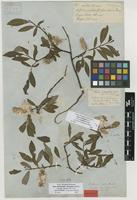
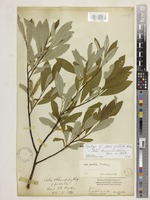
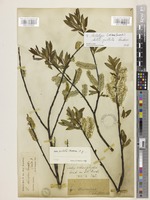
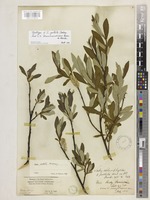
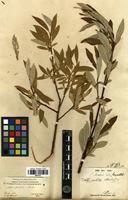
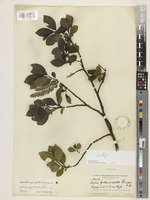
Lectotype of Salix chlorophylla-denudata Andersson [family SALICACEAE]
Lectotype of Salix chlorophylla Andersson [family SALICACEAE]
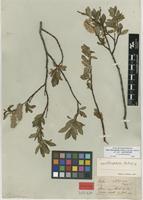
Isotype of Salix amoena Fernald [family SALICACEAE]
Lectotype of Salix pellita Andersson [family SALICACEAE]
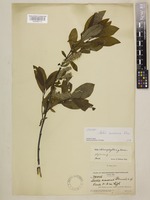
Syntype of Salix pellita Andersson [family SALICACEAE]
Lectotype of Salix pellita Andersson [family SALICACEAE]
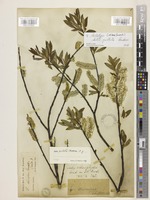
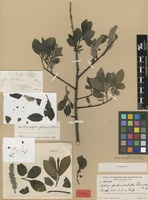
Syntype of Salix pellita unrecorded [family SALICACEAE]
Syntype of Salix pellita (Andersson) Bebb [family SALICACEAE]
Salix pedunculata Fernald [family SALICACEAE]
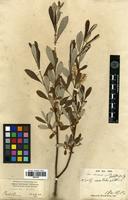
Syntype of Salix chlorophylla Andersson [family SALICACEAE]
Isotype of Salix pedunculata Fernald [family SALICACEAE]
Type? of Salix pellita (Andersson) Bebb [family SALICACEAE]
Previous
Next

Name

Identification
Salix chlorophylla Andersson [family SALICACEAE ] (stored under name); Verified by Not on sheet, Salix pellita (Andersson) Bebb [family SALICACEAE ] Verified by Not on sheet,
Related name
  • Salix ovalifolia
  • Salix phylicifolia
  • Salix chlorophylla-denudata
  • Salix planifolia
  • Salix pellita
  • Salix arctica
  • Salix stolonifera
  • Salix not on sheet
  • Salix chlorophylla
  • Salix cordata
  • Salix eriocephala
Common name
  • Satiny willow, Flora of North America Vol. 7

Flora

Entry for Salix pellita (Andersson) Bebb [family SALICACEAE]
Herbarium
Flora of North America (FNA)
Collection
Flora of North America
Resource Type
Reference Sources
Entry From
Flora of North America, Vol 7,
Names
Salix pellita (Andersson) Bebb [family SALICACEAE], Bot. Gaz., 16: 106. 1891
Salix chlorophylla Andersson [unranked] pellita Andersson [family SALICACEAE], Monogr. Salicum, 139, plate 7, fig. 72*. 1867
Treatment Author(s)
George W. Argus
Information
Shrubs, 0.5–6 m, (sometimes forming clones by stem fragmen-tation). Stems: branches (highly to ± brittle at base), red-brown, violet or yellow-brown, usually strongly glaucous, glabrescent; branchlets yellow-brown or red-brown, (usually strongly glaucous), glabrous or densely to sparsely pubescent or tomentose, (buds caprea-type). Leaves: stipules absent or rudimentary on early ones, rudimentary, absent, or foliaceous on late ones; petiole convex to flat, or shallowly grooved adaxially, 3–6.3–14 mm, (sometimes dark spherical glands distally), glabrous or pubescent adaxially; largest medial blade linear, lorate, or narrowly elliptic 40–79–123 × 6–12–20 mm, (2.3–)4.2–7.2–11.3 times as long as wide, base convex or cuneate, margins strongly or slightly revolute, entire, sinuate or sometimes crenulate, (glands submarginal or epilaminal), apex acuminate to acute, abaxial surface glaucous (sometimes obscured by hairs), densely villous, short-silky, woolly, or tomentose to glabrescent, hairs (white, sometimes also ferruginous), straight or wavy, adaxial slightly to highly glossy, glabrous, sparsely villous or pubescent (hairs white, sometimes also ferruginous); proximal blade margins entire; juvenile blade reddish or yellowish green, densely tomentose, short-silky, pubescent, or glabrous abaxially, hairs white, sometimes also ferruginous. Catkins flowering before leaves emerge; staminate stout, 20–39 × 7–20 mm, flowering branchlet 0–2 mm; pistillate densely flowered, slender, stout, or subglobose, 19–65(–80 in fruit) × 7–17 mm, flowering branchlet 0–7 mm; floral bract tawny, brown, or black, 1–2.6 mm, apex acute, convex, or rounded, abaxially hairy, hairs straight. Staminate flowers: adaxial nectary oblong or narrowly oblong, 0.6–1 mm; filaments distinct, glabrous or hairy basally; anthers purple turning yellow, ellipsoid, 0.4–0.6 mm. Pistillate flowers: adaxial nectary oblong to depressed-ovate, 0.3–1 mm, shorter than or equal to stipe; stipe 0.5–1.1 mm; ovary pyriform, short-silky, beak sometimes slightly bulged below styles; ovules 10–18 per ovary; styles 0.6–1.5 mm; stigmas slenderly cylindrical, 0.4–0.55–0.76 mm. Capsules 3.5–6.5 mm. 2n = 38.
Phenology
apr-may (spring), jun (summer)
Altitude range
0–800 m;
Distribution
St. Pierre and MiquelonUSA MaineUSA Mich.USA Minn.USA N.H.USA Vt.USA Wis.Canada Man.Canada N.B.Canada Nfld. and Labr.Canada N.S.Canada Ont.Canada Que.Canada Sask.
Discussion
Salix pellita sometimes has foliaceous stipules on late leaves. When present, they are correlated with hairy rather than glabrous branchlets. There is no clear evidence of hybridity in such specimens but further study is indicated.
Vegetative specimens of Salix pellita can be difficult to separate from S. viminalis and S. ×smithiana in eastern Canada, where the latter were introduced for coarse basketry and have become naturalized. The introduced species usually are tall shrubs to small trees, with branches usually flexible at base and not strongly glaucous, and their leaves tend to be broader. In contrast, S. pellita is a mid shrub rarely to 6 m but never tree-like, its branches usually are highly brittle at the base and often strongly glaucous, and its leaves tend to be narrower.
See 85. Salix drummondiana for further comparative descriptions.
Hybrids:
Salix pellita forms natural hybrids with S. alaxensis var. alaxensis, S. discolor, S. pedicellaris, S. petiolaris, and S. planifolia.
Salix pellita × S. petiolaris: Leaves of this hybrid are distinctly serrate and flat, as in S. petiolaris, but branchlets are glaucous and bud gradation is caprea-type as in S. pellita. It is uncommon in eastern Saskatchewan.
Salix pellita × S. planifolia: This cross is suspected to occur in Labrador, Newfoundland, Quebec, and Ontario. Both parents are tetraploids and flower at the same time. The name S. pellita forma psila may apply to this hybrid.

Related Materials

  • Terms and Conditions
  • Privacy Policy
  • Cookie Policy
  • Cookie Settings
  • Accessibility
  • Help
  • Contact Us
  • Facebook
  • Twitter
ITHAKA

JSTOR is part of ITHAKA, a not-for-profit organization helping the academic community use digital technologies to preserve the scholarly record and to advance research and teaching in sustainable ways.

©2000-2026 ITHAKA. All Rights Reserved. JSTOR®, the JSTOR logo, JPASS®, Aluka®, and ITHAKA® are registered trademarks of ITHAKA.

╳