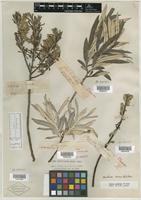
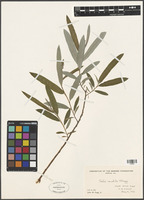
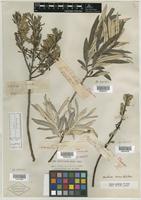
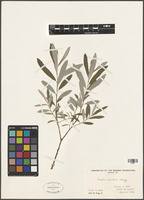
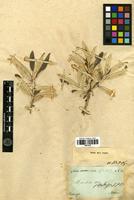
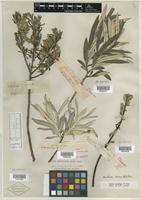
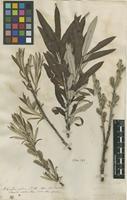
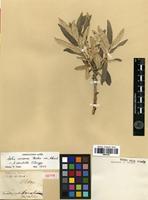
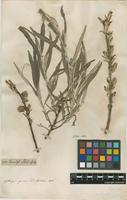
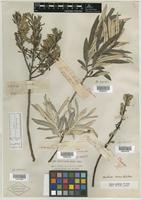
Occurrence of Salix candida in Nunavut is on Akimiski Island in James Bay.
Salix candida is geographically wide-ranging but limited to calcareous habitats and, for that reason, it is quite local or even rare in some parts of its range.
Hybrids:
Salix candida forms natural hybrids with S. bebbiana, S. brachycarpa var. brachycarpa, S. calcicola, S. eriocephala, S. famelica, S. myrtillifolia, S. petiolaris, and S. planifolia. Hybrids with S. discolor, S. petiolaris, and S. sericea have been reported (the latter also by C. K. Schneider 1921; M. L. Fernald 1950) but no convincing specimens have been seen. Salix candida hybrids are recognized from their woolly indumentum that often is conspicuous on leaves, stems, and ovaries. In hybrids, these characters, especially woolly patches on ovaries, stand out as discordant variation.
Salix candida × S. eriocephala (S. ×rubella Bebb ex C. K. Schneider) was described by W. W. Rowlee and K. M. Wiegand (1896) as S. candida × S. cordata. In addition to woolly patches on the ovaries, they noted that buds of the hybrids usually are shorter, more divergent, and blunter than those in S. eriocephala, and are glabrous or hairy. Known from New York and Newfoundland; it should be expected throughout the sympatric range of the parental species.
Salix candida × S. famelica: The Saskatchewan specimen resembles S. famelica but has the leaf indumentum of S. candida.
Salix candida × S. myrtillifolia: Saskatchewan specimens combine characters of the two parents.
Salix candida × S. petiolaris: Intermediates between these species are known from Michigan and New York (W. W. Rowlee and K. M. Wiegand 1896) as well as Ontario and Saskatchewan, but can be expected wherever the two grow together. The invalid name “S. ×clarkei” is sometimes used for this hybrid.
The glabrescent form of Salix candida, forma denudata (Andersson) Rouleau, may be of hybrid origin.