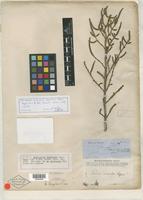
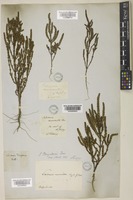
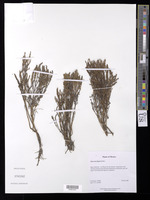
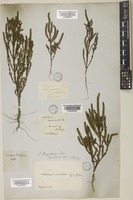
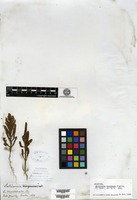
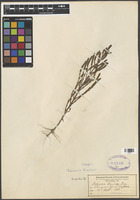
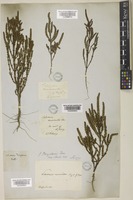
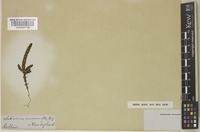
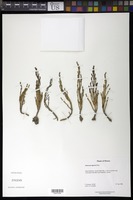
Isotype of Salicornia bigeloviiTorr. [family CHENOPODIACEAE ] (stored under name); Verified by Not on sheet,
Related name
Salicornia bigelovii
Flora
Entry for Salicornia bigelovii Torrey [family CHENOPODIACEAE]
Herbarium
Flora of North America (FNA)
Collection
Flora of North America
Resource Type
Reference Sources
Entry From
Flora of North America, Vol 4,
Names
Salicornia bigeloviiTorrey [family CHENOPODIACEAE], in W. H. Emory, Rep. U.S. Mex. Bound., 2(1): 184. 1859
Treatment Author(s)
Peter W. Ball
Information
Stems erect, green sometimes becoming red, simple or with primary and secondary branches, 5–60 cm, ultimate branches short or long; leaf and bract apices acute, sharply mucronate. Spikes cylindric and slightly torulose, 2–10 cm, with 5–25 fertile segments; bracts almost obscuring cymes. Fertile segments 4–5 × 4.5–6.2 mm, wider than long, widest distally, margins ca. 0.5 mm wide, scarious. Central flower semicircular distally, 2.2–2.8 × 2–2.8 mm, about as long as wide, usually reaching top of segment, only slightly larger than lateral flowers; anthers exserted, dehiscing after exsertion. 2n = 36.
Phenology
jun-aug (summer), sep-nov (fall)
Altitude range
0–100 m;
Distribution
n Mexico (Caribbean and Pacific coasts).USA Calif.USA Fla.USA Ga.USA MaineUSA Md.USA Mass.USA N.J.USA N.Y.USA N.C.USA S.C.USA Tex.USA Va.
Discussion
Salicornia bigelovii probably also occurs in Alabama, Mississippi, and Louisiana, but no specimens have been seen that confirm its presence in these states.