JSTOR Global Plants Home
  • Home
  • Browse
  • About
  • Access
  • Account
    • Saved Items
    • Profile
  • Log in

Global Plants

Skip to Main Content
  • JSTOR Global Plants Home
  • Global Plants

    • Browse
    • About
    • Access
    • Account
      • Saved Items
      • Profile
Log in
  • Browse
  • About
  • Access
  • Account
    • Saved Items
    • Profile
Advanced Search

Compilation
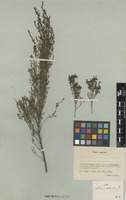
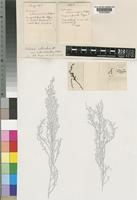
Salaxis octandra

2 Images see all

Filed as Erica axillaris Thunb. [family ERICACEAE]
Type of Salaxis artemisioides Klotzsch [family ERICACEAE]
Previous
Next

Name

Identification
Salaxis octandra Klotzsch [family ERICACEAE ] (stored under name); Salaxis artemisioides Klotzsch [family ERICACEAE ] Salaxis octandra Klotzsch [family ERICACEAE ] Erica artemisioides E.Mey. [family ERICACEAE ]
Related name
  • Erica artemisioides
  • Salaxis artemisioides
  • Salaxis octandra

Flora

Entry for SALAXIS octandra Klotzsch [family ERICACEAE]
Herbarium
Royal Botanic Gardens, Kew (K)
Collection
Flora Capensis
Resource Type
Reference Sources
Entry From
Flora Capensis, Vol 4, page 2, (1909) Author: By H. BOLUS, F. GUTHRIE, and N. E. BROWN.
Names
SALAXIS octandra Klotzsch [family ERICACEAE], in Linnæa, ix. 353;—Klotzsch in Linnæa, xii. 212; Benth. in DC. Prodr. vii. 711; Dietr. Synop. Pl. ii. 1261.
Information
apparently about 1 ft. high; branchlets slender, erect, subparallel to very flexuose, distinctly or very minutely puberulous, sometimes becoming glabrous, pale brown or greyish; leaves 3-nate, varying from adpressed and shorter than the internodes to erectly imbricate, 3/4–3 1/2 lin. long, narrowly linear, acute, glabrous; flowers axillary and terminal, 1–3 (rarely 4–5) together, subsessile; calyx (excluding the long lobe) 1/3– 1/2 lin. long, shorter than the corolla-tube, unequally lobed to the middle or the long lobe nearly free, glabrous; lobes oblong or ovate, acute or subobtuse or the long one acuminate, all minutely ciliate; corolla about 2/3 lin. long, campanulate or subglobose-campanulate, glabrous; stamens 8; filaments about 1/2 as long as the anthers, rarely less, connate for 1/3– 3/4 of their length and sometimes up to (but not with) the base of the anthers, becoming more or less free in fruit and narrower at their apex than the base of the 1/3 to nearly 1/2 lin. long oblong anthers; ovary acutely 2–4-angled on the upper half, 2–4-celled, glabrous; style very short to almost none; stigma deeply funnel-shaped with erect or slightly inflexed sides to the cup, glabrous; fruit distinctly 3–4- (occasionally 2-) angled on the smooth hardened upper half, slightly reticulate-rugulose below. null
Distribution
COAST REGION Worcester Div.; mountains of Bains Kloof, 4000 ft., Schlechter, 9127! Caledon Div.; mountain near Greitjes Gat, 2000–4000 ft., Ecklon & Zeyher! Bredasdorp Div.; sand-dunes near the mouth of Ratel River, 50 ft., Bolus, 6770! Var. β: Worcester Div.; “Dietris Kloof” an error for Dutoits Kloof, Drège, 1168!SOUTH AFRICA without locality, Mund & Maire, ex Klotzsch.
Notes
Drège has evidently mixed up three plants under the name of Erica artemisioides, for the two specimens at Kew, distributed under that name, are quite distinct from the type of Salaxis artemisioides at Berlin, and appear to belong respectively to S. Sieberi and S. axillaris. Bentham in DC. Prodr. vii. 711 referred these two specimens to S. hexandra (Coccosperma forbesianum), from which, however, they are entirely different.

Related Materials

  • Terms and Conditions
  • Privacy Policy
  • Cookie Policy
  • Cookie Settings
  • Accessibility
  • Help
  • Contact Us
  • Facebook
  • Twitter
ITHAKA

JSTOR is part of ITHAKA, a not-for-profit organization helping the academic community use digital technologies to preserve the scholarly record and to advance research and teaching in sustainable ways.

©2000-2026 ITHAKA. All Rights Reserved. JSTOR®, the JSTOR logo, JPASS®, Aluka®, and ITHAKA® are registered trademarks of ITHAKA.

╳