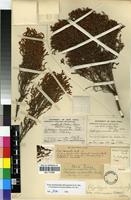
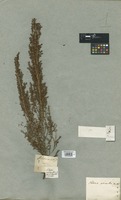
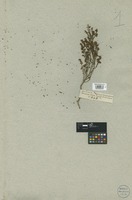
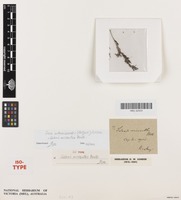
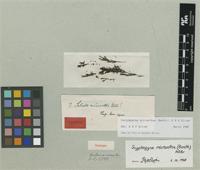
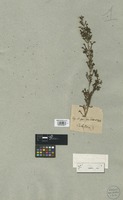
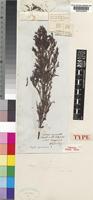
probably 1 1/2 ft. or more high, with stout main branches, densely much branched above; branchlets slender, erect, often flexuose, very minutely subtomentose to subglabrous, greyish, becoming brown; leaves 3-nate, erect or ascending-spreading, usually longer than the internodes, 1 1/3–2 1/2 lin. long, linear, acute or subacute, slender, glabrous; flowers 1–3 together, axillary or on very minute axillary branchlets, shorter than the petioles of the leaves subtending them, subsessile; calyx usually about 1/3 lin. long, rather broad and shallow, truncate at the base, unequally or subequally 4-toothed to the middle, usually glabrous or sometimes puberulous on the same specimen; teeth ovate, acute, or the larger one sometimes with a linear point, very minutely ciliate; corolla much exceeding the calyx, 1/2 lin. long, subovoid or subglobose-campanulate, 4-lobed, thin, usually glabrous, but sometimes puberulous on the same specimen; lobes 1/3– 1/2 as long as the tube, incurved, deltoid-ovate, obtuse or rounded; stamens 4–8, included; filaments free or very shortly and irregularly connate at the base; anthers connate, about 1/4 lin. long, subquadrate or oblong, notched and very minutely scabrid or subhispid at the apex, not subglandular as originally described; ovary ovoid with a minute tuft of hairs at the apex, 1-celled; style slender, arising by the side of the tuft and becoming more and more oblique or sublateral as the ovary enlarges and becomes more globose, when it bends over to the apex of the ovary; stigma very large in proportion to the ovary, peltate, crater-like with the margin incurved, puberulous on the underside, not exserted from the corolla; fruit subglobose, coriaceous or perhaps crustaceous when ripe, 1-seeded. null