

Compilation
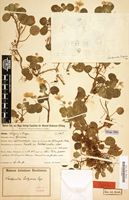
Saintpaulia goetzeana
1 Images see all
Name
Identification
Saintpaulia goetzeana Engl. [family GESNERIACEAE ] (stored under name); Verified by Not on sheet.,
Related name
- Saintpaulia goetzeana
Flora
Entry for Saintpaulia goetzeana Engl. [family GESNERIACEAE]
Herbarium
Royal Botanic Gardens, Kew (K)
Collection
Flora of Tropical East Africa
Resource Type
Reference Sources
Entry From
Flora of Tropical East Africa, page 1, (2006) Author: IAIN DARBYSHIRE
Names
Saintpaulia goetzeana Engl. [family GESNERIACEAE], in E.J. 28: 481, t. 6 (1900); Baker & C.B. Clarke in F.T.A. 4(2): 501 (1906); B.L. Burtt in Notes Roy. Bot. Gard. Edinb. 22: 562 (1958); Watkins et al., Wild Afr. Violet: 28 (2002). Type: Tanzania, Morogoro District, Uluguru Mts, Lukwangule Plateau, Goetze 245 (B†, holo.)
Information
Trailing caulescent herb. Stems to 40 cm long when mature, densely pilose. Leaves usually purplish or reddish beneath; blade orbicular to broadly ovate, 1.6–3.8 cm long, 1.4–3.6 cm wide, base often somewhat asymmetric, rounded to shallowly cordate, margin subentire or shallowly crenulate-serrulate, apex rounded to obtuse, surfaces densely pilose, particularly above, the hairs erect or curved; lateral nerves (3–)4 pairs, inconspicuous particularly above; petiole 0.7–5.5 cm long, densely pilose. Inflorescences 1–2(–5)-flowered; peduncles (1.5–)2–4 cm long; pedicels (3–)6–11 mm long, both pilose; bracts linear-lanceolate, 0.7–2(–2.5) mm long, pilose. Calyx lobes lanceolate, 2–3.7 mm long, outer surface densely pilose. Corolla white with the lobes of the upper lip blue to violet, pilose on the limb outside and with shorter, predominantly glandular hairs along the margin of the lobes; tube subcampanulate, 2–3 mm long; limb 11–21 mm long; upper lip 4–8 mm long, lobes rounded, 3–6.5 mm long, 4–6.5 mm wide; lower lip 7–12.5 mm long, lobes ± rounded, 4–8 mm long, 4–9.5 mm wide. Filaments rather slender, 2.5–4.5 mm long; anther thecae 1.2–2 mm long; staminodes 3, to 1 mm long. Ovary broadly ovoid, 1.3–1.7 mm long, villose; style 3.5–5 mm long; stigma 0.2–0.4 mm diameter, papillose. Capsule broadly ovoid, 5–9.5 mm long, 2.8–4.5 mm diameter, pilose, style persistent. Seeds 0.5–0.65 mm long, longitudinally ridged with scalariform transverse ridges, the latter sometimes verruculose.
Range
DISTR. T 6 restricted to the Uluguru Mts and ? Nguru Mts
Altitude range
1700–2150 m
Distribution
TANZANIA Morogoro District Uluguru Mts, S Uluguru Forest Reserve, edge of Lukwangule Plateau, Mar. 1953, Drummond & Hemsley 3656! & SW ridge of Lupanga above Mbete village, Nov. 1970, Pócs & Nchimbi 6285/N! & N Uluguru Forest Reserve, Vidago, Dec. 1993, Kisena 910!
Notes
USES. None recorded on herbarium specimens. CONSERVATION Although recorded from only a small range, S. goetzeana appears locally frequent in high altitude forest in the Uluguru Mts. Reported collections of this species from the Nguru Mts could not be confirmed as the material (Baatvik 86830 & 86831, UPS) was unavailable for study by the author. In view of this uncertainty, the conservation rating of Data Deficient (DD) applied by Eastwood et al. (in Bot. Mag. 15: 59 (1998)) is here maintained. However, as human disturbance is likely to be minimal in its high altutude sites, this species may currently be unthreatened. Stem and leaf indumentum are somewhat variable in this species. The majority of collections have a very dense indumentum of rather long hairs. However, those from the southern end of the range, the Lukwangule Plateau (Drummond & Hemsley 3656) and the Mzinga River catchment (Simiyu et al. Mzinga 2b, 7b, 8c, 9b), have considerably shorter hairs though at a similar density; these collections also have proportionally the broadest and shortest fruits. Michelmore 861, from Lupanga Peak, has a notably lower density of hairs on the leaves than other collections from the same locality, particularly beneath, but is otherwise consistent with this distinctive taxon. Phylogenetic studies have also recorded notable variability within this species (Lindqvist & Albert in K.B. 54: 371 (1999)). A specimen recently received from Dr Haston, collected from above Tegetero mission in the Uluguru Mts (Haston 99), is vegetatively similar to small specimens of S. goetzeana but it has minute flowers which lack darker upper lobes. The specimen seen is however scant and more ample material is needed for further analysis.