

Compilation
Saintpaulia confusa
1 Images see all
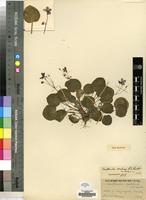
Name
Identification
Saintpaulia confusa B.L.Burtt [family GESNERIACEAE ] Verified by B. L. Burtt, Saintpaulia ionantha H. Wendl. [family GESNERIACEAE ] (stored under name); Verified by Darbyshire, I., 2006
Related name
- Saintpaulia confusa
- Saintpaulia ionantha
Flora
Entry for Saintpaulia ionantha (Engl.) I.Darbysh. subsp. grotei [family GESNERIACEAE]
Herbarium
Royal Botanic Gardens, Kew (K)
Collection
Flora of Tropical East Africa
Resource Type
Reference Sources
Entry From
Flora of Tropical East Africa, page 1, (2006) Author: IAIN DARBYSHIRE
Names
Saintpaulia ionantha (Engl.) I.Darbysh. subsp. grotei [family GESNERIACEAE], stat. nov. Type: Tanzania, Lushoto District, E Usambara Mts, near Amani, Grote 3708 (B†, holo., K!, illus.; EA!, iso.)
Saintpaulia grotei Engl. [family GESNERIACEAE], in E.J. 57: 202 (1921); B.L. Burtt in Notes Roy. Bot. Gard. Edinb. 22: 566 (1958); Iversen in Symb. Bot. Upsal. 28: 243 (1988); Watkins et al., Wild Afr. Violet: 30 (2002)
Saintpaulia magungensis E.P.Roberts [family GESNERIACEAE], in Afr. Violet Mag. 3(4): 6 (1950); B.L. Burtt in Notes Roy. Bot. Gard. Edinb. 22: 567 (1958) & in Notes Roy. Bot. Gard. Edinb. 25: 195 (1964); Iversen in Symb. Bot. Upsal. 28: 243 (1988); Watkins et al., Wild Afr. Violet: 34 (2002). Type: Tanzania, Lushoto District, E Usambara Mts, Magunga, cult. in Michigan State Coll., E.P. Roberts 1 (Michigan holo.), syn. nov.
Saintpaulia amaniensis E.P.Roberts [family GESNERIACEAE], in Afr. Violet Mag. 4(2): 7 (1950); B.L. Burtt in Notes Roy. Bot. Gard. Edinb. 22: 566 (1958). Type: Tanzania, Lushoto District, E Usambara Mts, near Amani, cult. Michigan State Coll., E.P. Roberts 2 (Michigan, holo.) syn. nov.
Saintpaulia confusa B.L.Burtt [family GESNERIACEAE], in Baileya 4: 164 (1956) & in Notes Roy. Bot. Gard. Edinb. 22: 566 (1958); Iversen in Symb. Bot. Upsal. 28: 243 (1988); Watkins et al., Wild Afr. Violet: 25 (2002). Type: Tanzania, Lushoto District, E Usambara Mts, cult, in R.B.G. Kew (E!, holo.), syn. nov.
Saintpaulia difficilis B.L.Burtt [family GESNERIACEAE], in Notes Roy. Bot. Gard. Edinb. 22: 565 (1958); Iversen in Symb. Bot. Upsal. 28: 243 (1988); Watkins et al., Wild Afr. Violet: 26 (2002). Type: Tanzania, Lushoto District, E Usambara Mts, Sigi headwaters above Monga, comm. Punter ref. Q, cult. in R.B.G. Edinb., C.1578 (E!, holo.), syn. nov.
Saintpaulia magungensis B.L.Burtt var. minima [family GESNERIACEAE], in Notes Roy. Bot. Gard. Edinb. 25: 195 (1964); Iversen in Symb. Bot. Upsal. 28: 243 (1988); Watkins et al., Wild Afr. Violet: 35 (2002). Type: Tanzania, Lushoto District, E Usambara Mts, Mavoera estate near Amani, comm. Punter ref. 59/4352, cult. in R.B.G. Edinb., C.3724 (E!, holo.), syn. nov.
Saintpaulia diplotricha [family GESNERIACEAE], [ sensu B.L. Burtt in Gard. Chron., ser. 3, 122: 23 (1947) pro parte quoad spec. cult. R.B.G. Kew]
Information
Plants rosulate or caulescent and trailing, internodes sparsely pilose. Leaves pale green or tinged purple beneath; blade broadly ovate, suborbicular or (oblong-)elliptic, 3–10 cm long, margin coarsely to obscurely (crenate-)serrate, apex obtuse, rounded or more rarely acute to subattenuate, upper surface with appressed hairs of subequal or more often variable length, at least some short, sometimes diplotrichous, the longest hairs sometimes arced or suberect. Petioles, peduncles and pedicels with predominantly appressed or strongly ascending hairs, the longest hairs sometimes subspreading. Inflorescences 1–4(–6)-flowered. Corolla pale mauve to deep blue-violet, margin with mixed glandular and eglandular or predominantly eglandular hairs. Capsule 8–20 mm long, 1.5–3 mm diameter.
Range
DISTR. T 3 restricted to the central and southern E Usambara Mts
Altitude range
900–1100 m
Distribution
TANZANIA Lushoto District E Usambara Mts, Kwamkoro to Kihuhwi, Dec. 1936, Greenway 4797! & Kwamkoro Forest Reserve, from Kwamkoro Tea Estate to Kimbo summit, Oct. 1986, Iversen et al. 86201!TANZANIA Tanga District E Usambara Mts, Mt Mlinga, Dec. 1991, Raistrick SP/3!
Notes
USES. None recorded on herbarium specimens. CONSERVATION This taxon has been recorded from many of the forests of the central and southern E Usambara Mts and healthy populations remain at some of the protected sites. However, its range is centred around the town of Amani, around which large areas of forest have been cleared for forestry and agriculture, thus many previous sites for subsp. grotei have been lost. It is therefore provisionally assessed as Vulnerable (VU A2c). The distinction between S. grotei and S. magungensis (within which S. amaniensis was reduced to synonymy by B.L. Burtt in Roy. Bot. Gard. Edinb. 25: 195 (1964)) has always been rather unclear. The name S. grotei has usually been applied to larger specimens with long petioles and leaves with distinctly crenate margins. Burtt also indicated that S. grotei has paler flowers than S. magungensis. Both entities have been recorded growing together on Mt Mlinga by both Greenway and Raistrick. However, analysis of the Mlinga material indicates that there is considerable variability in flower colour, colour of the underside of the leaf, and size of the plants there; separation into two discrete taxa does not seem possible. A third entity recorded on Mt Mlinga, with a rosulate habit, is typical of plants previously assigned to S. confusa. Indeed, the differing habit appears to be the only significant separating character. Whilst both the caulescent and rosulate forms do develop under similar conditions in cultivation, thus not being entirely phenotypic or age-related, the recognition of the two forms in the wild is highly problematic. Plants of Saintpaulia often flower when young, thus plants which later become caulescent may be rosulate at the time of observation. More significantly, plants displaying an intermediate growth form which is subrosulate or with short internodes developing are recorded, for example from the Magrotto area (e.g. Mwasumbi & Suleimani 17450!). The rosulate plants tend to have more flowers per inflorescence ((1–)2–4(–6)) than the caulescent plants (1–2(–3)) but there is considerable overlap. It is here considered that the three entities all represent a single taxon. Mt Mlinga therefore displays a good example of the range of variation possible within a Saintpaulia population. Plants previously named S. difficilis have more narrowly ovate to ovate-elliptic leaves with an acute apex and rather coarsley serrate margins, and the indumentum is more clearly diplotrichous, with long arced to suberect hairs and short appressed hairs. Such plants appear rather intermediate between subsp. grotei and subsp. ionantha var. diplotricha and indeed may form a continuum between the two taxa. However, they are placed within subsp. grotei here on account of their having more elongate, narrower fruit (length to width ratio (2.5–)5–8.8:1) and less numerous glandular hairs on the margin of the corolla than in subsp. ionantha, in addition to the fact that they have an appressed element to their leaf indumentum. These populations are perhaps worthy of varietal status, though specimens intermediate with typical subsp. grotei are regularly recorded (e.g. Simiyu et al. H78! from Ngua Forest Reserve, and Raistrick SP/1! from Kiganga Forest Reserve). S. magungensis var. minima was described on the basis of two cultivated plants from material from a single locality, it being a more slender plant than S. “ magungensis ”with smaller leaves and flowers. In view of the wide range in flower and leaf size recorded in most Saintpaulia taxa, this appears a rather insignificant difference. Furthermore, plants grown at R.B.G., Kew from the type plant produced considerably larger leaves and flowers, well within the range typical of subsp . grotei. A wild collection from the type locality (Iversen & Steiner 86683!) also has similarly larger leaves and flowers.