

Compilation
Sagenia gemmifera
2 Images see all
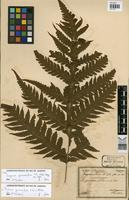
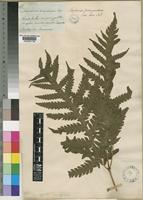
Name
Identification
Tectaria gemmifera (Fée) Alston [family DRYOPTERIDACEAE ] (stored under name); Aspidium viviparum Mett. [family PTERIDOPHYTA ] Sagenia gemmifera Fée [family PTERIDOPHYTA ]
Related name
- Sagenia gemmifera
- Tectaria gemmifera
- Aspidium viviparum
Flora
Entry for Tectaria gemmifera (Fée) Alston [family DRYOPTERIDACEAE]
Herbarium
Royal Botanic Gardens, Kew (K)
Collection
Flora of Tropical East Africa
Resource Type
Reference Sources
Entry From
Flora of Tropical East Africa, page 1, (2007) Author: J.P. Roux, Monika Shaffer-Fehre & Bernard Verdcourt
Names
Tectaria gemmifera (Fée) Alston [family DRYOPTERIDACEAE], in J. Bot. 77: 288 (1939); Schelpe, F.Z., Pter.: 234, t. 64D (1970); Burrows, S. Afr. Ferns: 324, fig. 54.2, fig. 78, map (1990); Faden in U.K.W.F. ed. 2: 35 (1994); J.P. Roux, Conspect. southern Afr. Pterid.: 132 (2001). Type: Madagascar, ‘habitat in insula Madagascariens’, Pervillé s.n. (missing)
Sagenia gemmifera Fée [family DRYOPTERIDACEAE], Mem. Foug. 5: 313 (1852)
Aspidium coadunatum (Feé) Kuhn var. gemmiferum [family DRYOPTERIDACEAE], Filic. Afr.: 128 (1868)
Aspidium gemmiferum (Feé) Ching [family DRYOPTERIDACEAE], in Bull. Fan. Mem. Inst. Biol. 10: 237 (1941)
Information
Terrestrial; rhizome to 13 cm high, 2 cm in diameter, with dark brown lanceolate scales 5–10≈1 mm, with pale borders. Fronds in tufts of 4–9, to 1.8 m long; stipe pale brown, 70–72 cm long, 5 mm in diameter at base, adaxially grooved, basal 3–5 cm covered in scales similar to those of rhizome; lamina membranous to coriaceous, dark green, deltoid-pentagonal, 45–100≈30–80 cm, 3-pinnatifid; pinnae in 4–6 pairs, basal pinna pair the longest and stalked, terminal segment pinnatifid; pinnules to 18 cm long, the basal the largest, divided in up to 10 secondary pinnules; ultimate segments oblong, falcate, with crenate margins; veins and veinlets anastomosing; free included veinlets in areoles not frequent, absent along the rachis and rare in the triangular areoles between rachis and costa; small glandular hairs ± 0.5 mm long thinly scattered on axes from rachis to costa, denser at pinna base and pinna margins where it is decurrent between pinna segments, on sinus margin and adaxially, above sinus, on rachis, pinna costa and costa, resembling velvet; minute scales sometimes present in central areoles; glabrous when mature. Gemmae sometimes present at pinnae bases or along pinnae costa. Sori inframarginal to median, in up to 4 pairs per segment, 0.5–2(–3) mm in diameter; indusium small, reniform, minutely ciliate. Spores pale brown, monolete, perispore winged, cristate. Fig. 1: 8–11 & Fig. 2: 5.
Range
DISTR. U 1–4; K 1, 3–7; T 2–4, 6–8 Congo-Kinshasa, Rwanda, Burundi, Angola and south to South Africa; Madagascar, ?southeast Asia
Altitude range
600–2550 m
Distribution
KENYA Trans Nzoia District Cherangani Hills, Kabolet, Aug. 1963, Tweedie 2702!KENYA Nyeri District Gaturu, Aug. 1963, Mathenge 228!KENYA Masai District Chyulu Hills, main forest N, Dec. 1993, Luke & Luke 3883!TANZANIA Lushoto District E Usambara Mts, Amani-Sigi Forest Resereve, along Sigi R., Oct. 1986, Borhidi et al. 86/308!TANZANIA Kigoma District Gombe National Park, Kakombe Valley, Dec. 1963, Pirozynski P104!TANZANIA Iringa District Mwanihana Forest Reserve above Sanje, Sep. 1984, D.W. Thomas 3685!UGANDA Karamoja District Mt Kadam, Apr. 1959, J. Wilson 775!UGANDA Bunyoro District Budongo Forest, Apr. 1994, Sheil 1807!UGANDA Mbale District Kami [Khami] R. valley, Apr. 1951, Wood 190!
Notes
USES. None recorded. CONSERVATION Widespread; least concern (LC). Sori of fertile specimens of T. gemmifera vary from barely 0.5 mm diameter (gemmae present) to almost 3 mm diameter (gemmae absent); the precociously fertile or, indeed, sterile specimens will almost always be covered by the largest (7 mm in diameter) or the most numerous (to 25 in Pirozynski P104) gemmae; i.e. a large physiological debt arises to account for the production of gemmae; but only one 5 mm gemma and a fully sporiferous blade in Thomas 1498.In the presence of gemmae sori will occasionally develop only in segments near tips of pinnules. From the point of reproduction, large sori in the absence of gemmae or many gemmae on sterile or precociously fertile fronds, may offer an equal chance of creating progeny. An increased dissection of the blade can carry a larger number of gemmae. A caution must be sounded to check gemmae closely. Due to occasional infestation by psychids (Psychideae, insects) specimens have been wrongly identified as T. gemmifera. Psychids coat their coccoon with “locally available” materials. On fern blades spores serve this purpose. As the larva clings to the vascular supply, a thick coat of spores is sometimes mistaken for a gemma. In the literature ‘white hairs’ are mentioned with the indumentum; during this survey they were observed just once (Pirozynski P104), a fine down of white, septate hairs (lost early) arranged regularly, following the vascular system and admixed with stout glandular cells.