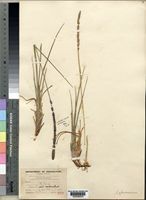
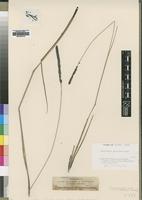
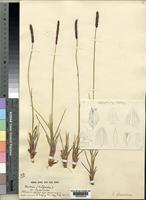
Perennial from a creeping rhizome, up to 1 ft. high; innovations extravaginal with pale rather thin and papery cataphylls. Culms slender, erect or shortly ascending, terete, glabrous and smooth, 1-noded above the basal tuft of leaves, with the node much below the middle. Leaf-sheaths rather unequal, those of the basal leaf-tuft (2–3) short, wide, spongy-papery, rounded on the back, 1/2–1 in. long, the following more herbaceous, glaucous or purplish, the uppermost tight, 2 to over 3 in. long, all sparingly hairy, at least upwards, and ciliate along the margins, or the lower silkily subtomentose, closely striate, those of the base reticulate if spongy, without shoulders or auricles at the mouth; ligules very short, truncate, subhyaline; blades linear from an equally wide base, tapering to a firm almost acicular point, up to 6 in. by 1–1 1/2 lin., rigid, mostly convolute, glaucous, somewhat plump, glabrous or more or less softly hairy, midrib and nerves very slender, slightly raised, smooth. False spike on a long-exserted peduncle, cylindric, straight or slightly curved, compact, 3–5 in. by 2 1/2 lin.; pedicels glabrous and smooth or with a few minute hairs, tips minutely discoid. Spikelets ovate-oblong, obtuse or subobtuse, symmetrical or very slightly oblique in profile, not gaping, subterete, up to 1 lin. by 1/2 lin., greyish-green to greyish-purple, glabrous. Glumes finely and prominently nerved, herbaceous with hyaline white margins; lower half to over half the length of the spikelet, 5-nerved; upper ovate (in back view), subobtuse, 7-nerved. Lower floret ♂: valve very similar to the upper glume and of the same length, 9-nerved; valvule narrow, linear-lanceolate, acute, up to almost as long as the valve; anthers 2/3 lin. long. Upper floret hermaphrodite, oblong, acute, 2/3 lin. by 1/4 lin., white, polished.