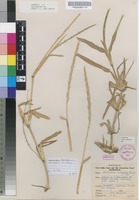
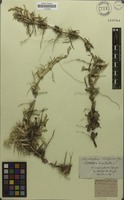
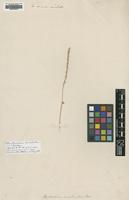
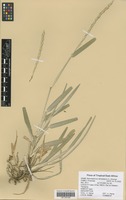
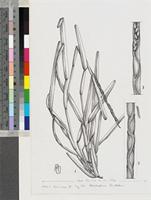
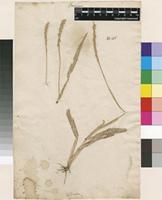
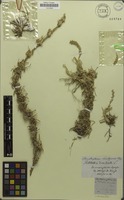
culms ascending, prostrate or creeping and frequently rooting at the nodes, often very long, strongly compressed, glabrous, smooth, many-noded; leaves glabrous or more or less hairy at the mouth of the sheath or at its junction with the blade, lower crowded at the base of the branches, more or less flabellate, followed often by a pseudo-opposite pair of and 2–4 distant leaves; sheaths strongly compressed, keeled, pallid, soon thrown aside, lower persistent; ligule a fringe of very short hairs; blades linear, obtuse, 1–6 in. by 1–3 lin., first folded, then flat or at length involute, rather firm, glaucous or light green, smooth; false spikes terminal and lateral from the upper leaves, erect, stiff or curved, 1–4 in. long, compressed, glabrous; rhachis linear, entire, 1–2 1/2 lin. broad, with or without transverse depressed lines on the back indicating the joints, often hollowed out in front; branches very short, more or less sunk in the hollows or adpressed to the margin of the rhachis, compressed or angular, often very stout; spikelets solitary from the inner side of the base of the branch, sunk in the adjoining hollow, or 2–5 crowded along the branch, lanceolate-oblong to oblong, acute, 2 1/2 lin. long, pallid; lower glume hyaline, very short, broad, truncate, nerveless, upper ovate-oblong, concave, almost as long as the spikelet, 7-nerved, firmly membranous; lower floret ♂; valve lanceolate-oblong to oblong, acute, equalling the spikelet, chartaceous, faintly 7–9-nerved, dorsally flattened, somewhat rough; anthers 1 1/4–1 1/2 lin. long; upper floret hermaphrodite; valve similar to the lower, but more acute, firmly membranous, 5-nerved. null