JSTOR Global Plants Home
  • Home
  • Browse
  • About
  • Access
  • Account
    • Saved Items
    • Profile
  • Log in

Global Plants

Skip to Main Content
  • JSTOR Global Plants Home
  • Global Plants

    • Browse
    • About
    • Access
    • Account
      • Saved Items
      • Profile
Log in
  • Browse
  • About
  • Access
  • Account
    • Saved Items
    • Profile
Advanced Search

Compilation
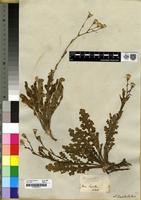
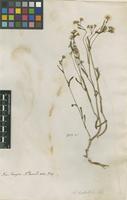
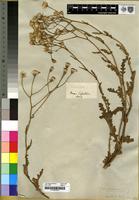
Senecio hastulatus

3 Images see all

Filed as Senecio hastulatus L. [family ASTERACEAE]
Previous
Next

Name

Identification
Senecio hastulatus L. [family ASTERACEAE ] (stored under name); Verified by Not on sheet,
Related name
  • Senecio hastulatus

Flora

Entry for SENECIO hastulatus Linn. [family COMPOSITAE]
Herbarium
Royal Botanic Gardens, Kew (K)
Collection
Flora Capensis
Resource Type
Reference Sources
Entry From
Flora Capensis, Vol 3, page 44, (1894) Author: (By W. H. HARVEY).
Names
SENECIO hastulatus Linn. [family COMPOSITAE], Sp. 1218;—DC. l. c. 383. Dill.! Elth. t. 152, f. 184.
SENECIO panduratus DC.? [family COMPOSITAE], l. c. (exlc. syn. Less.! and Th.!). E. & Z.! Drege! Herb.
SENECIO glutinosus Eckl. [family COMPOSITAE], ! (ex parte).
SENECIO? brachyrhynchoides DC. [family ], ! l. c. ex Hb. Drege!
Information
rootstock thick and woody, subhorizontal, not woolly at the crown; radical leaves numerous, petiolate, inciso-pinnatifid, viscoso-pubescent, the lobes in several pairs, short, blunt, eroso-dentate or coarsely toothed or lobulate, the sinuses rounded; stems herbaceous, leafy, corymboso-paniculate upwards, striate, pubescent; cauline leaves ear-clasping, inciso-pinnatifid, with short, toothed lobes; corymb laxly few or several-headed, the pedicels long; heads multi-radiate; inv. nearly nude at base, of many scabrid, linear-attenuate, round-backed scales; achenes finely striate, minutely downy. Rhizome 1/2 inch thick. Root leaves (from the crown) 4–7 inches long, 1–2 inches wide; their lobes 1/2– 3/4 inch wide. Stems 1–2 feet high, fistular, pale, corymboso-paniculate; pedicels 3–4 inches long. Heads 5 lines long, as many wide. Rays yellow, spreading. Known from S. glutinosus, which it resembles in foliage, by the rootstock; from S. erosus by the non-woolly crown, &c. S.? brachyrhynchoides, DC., according to a specimen from Drege (Hb. Hk.), is surely only a dwarf state of this species. Our var β. in its typical state, with obovate, crenate leaves, and nude, subsimple stems, looks different, but Dr. Pappe's specimens, all collected in the same spot, vary with deeply cut leaves, closely approaching those of the common variety. Dillenius figure, above quoted, is an excellent representation of the normal form.
Distribution
SOUTH AFRICA Round Capetown and Simonstown, Bowie! W.H.H., C. Wright, 306. Tulbagh, Dr. Pappe! Zwarteberg and Groenekloof, Drege! Caledon, Eckl.! Distr. of Queenstown, T. Cooper! 232. Buffelsjagt, Gill! Basutu Land, T. Cooper, 715 (depauperated). β, near Beaufort, Drege. Zwartkops R., Pappe! (Hb. D., Hk., Sd., Cap.)

Related Materials

  • Terms and Conditions
  • Privacy Policy
  • Cookie Policy
  • Cookie Settings
  • Accessibility
  • Help
  • Contact Us
  • Facebook
  • Twitter
ITHAKA

JSTOR is part of ITHAKA, a not-for-profit organization helping the academic community use digital technologies to preserve the scholarly record and to advance research and teaching in sustainable ways.

©2000-2026 ITHAKA. All Rights Reserved. JSTOR®, the JSTOR logo, JPASS®, Aluka®, and ITHAKA® are registered trademarks of ITHAKA.

╳