JSTOR Global Plants Home
  • Home
  • Browse
  • About
  • Access
  • Account
    • Saved Items
    • Profile
  • Log in

Global Plants

Skip to Main Content
  • JSTOR Global Plants Home
  • Global Plants

    • Browse
    • About
    • Access
    • Account
      • Saved Items
      • Profile
Log in
  • Browse
  • About
  • Access
  • Account
    • Saved Items
    • Profile
Advanced Search

Compilation
Salix capensis

8 Images see all

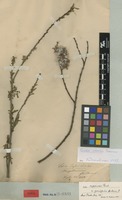
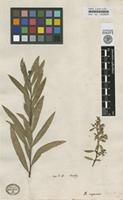
Isotype of Salix zeyheri Sond. ex Fr. [family SALICACEAE]
Salix capensis Thunb. from South Africa
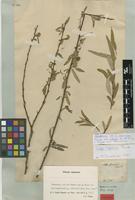
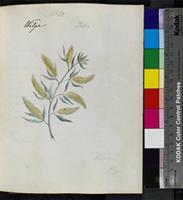
Isotype of Salix mucronata Thunb. var. integra Burtt Davy [family SALICACEAE]
Salix capensis Thunb. from South Africa
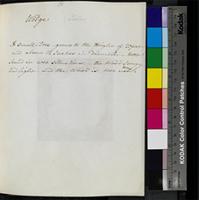
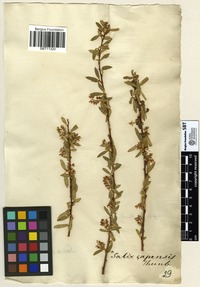
Type of Salix capensis Thunb. [family SALICACEAE]
Salix capensis Thunb. from South Africa
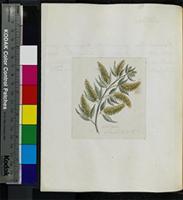
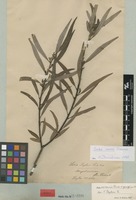
Filed as Salix capensis Thunb. [family SALICACEAE]
Isotype of Salix zeyheri Sond. ex Fr. [family SALICACEAE]
Previous
Next

Name

Identification
Salix capensis Thunb. [family SALICACEAE ]
Related name
  • Salix capensis

Flora

Entry for SALIX capensis Thunb. [family SALICACEAE]
Herbarium
Royal Botanic Gardens, Kew (K)
Collection
Flora Capensis
Resource Type
Reference Sources
Entry From
Flora Capensis, Vol 5, Part 2, page 574, (1925) Author: (By S. A. SKAN.)
Names
SALIX capensis Thunb. [family SALICACEAE], Fl. Cap. i. 139, and ed. Schult. 31;—Fries in Öfvers. Vet.-Akad Förhandl. Stockh. xiii. (1856) 121; Anderss. in Vet.-Akad. Handl. Stockh. vi. (1867) no. 1, 13, t. 1, fig. 11, and in DC. Prodr. xvi. ii. 197; Sim, For. Fl. Cape Col. 328, t. 146 (var. a, normalis, Sim); Marloth, Fl. S. Afr. i. 130, figs. 72–73; Skan in Prain, Fl. Trop. Afr. vi. ii. 319.
SALIX ægyptiaca Thunb. [family SALICACEAE], Prodr. 6, not of Linn.
Information
a shrub or tree up to 50 ft. high or more, very much branched; branchlets very slender, sometimes more or less pubescent when young, quite glabrous, often shining and reddish to dark brown when older; leaves narrowly lanceolate or lanceolate, rarely broadly lanceolate, usually 3/4–1 1/4 in., rarely up to 2 in. long, 1 1/2–3 lin., rarely up to 6 lin. broad, often thin, becoming more or less coriaceous, acute to acuminate at the apex, more or less cuneate at the base, entire or closely or remotely serrulate, glabrous or sometimes slightly pubescent when young, green on both sides or green above and glaucescent beneath; petiole 1/2–2 lin. long; stipules minute or 0; catkins appearing with the leaves; peduncles 2–12 lin. long, bearing 1–5 shortly stalked or subsessile leaves similar to the others but usually smaller; male catkins narrowly cylindric, 1/2–1 1/2 in. long; bracts ovate to elliptic or suborbicular, 3/4–1 lin. long, 2/3– 3/4 lin. broad, more or less villous inside, villous outside or glabrous except at the base, sometimes nearly quite glabrous; disc-glands fleshy, scarcely 1/4 lin. long; stamens 4–8 (usually 5 or 6); filaments villous below the middle; female catkins cylindric or ovoid, 1/3–1 in. long; rhachis glabrous to densely villous; bracts as in the male, soon deciduous; disc-gland cup-shaped, nearly or quite surrounding the pedicel, about 1/4 lin. long; pedicel 1/2–1 1/4 lin. long; ovary narrowly ovoid, 1–1 3/4 lin. long, glabrous; style very short or none; capsule ovoid, 1 1/2–2 1/2 lin. long. null
Range
Also in Rhodesia.
Distribution
CENTRAL REGION Calvinia Div.; Hantam, Thunberg. Somerset Div.; Somerset, Bowker! between the Great and Little Fish Rivers, 2500 ft., Mac-Owan, 468! Graaff Reinet Div.; on the banks of the Sundays River near Graaff Reinet, 2500 ft., Bolus, 468! Aliwal North Div.? by the Orange River, Atherley, 109! Var. β: Aliwal North Div.; banks of the Orange River near Aliwal North, 4300 ft., Drège, b! Philipstown Div.; Orange River near Petrusville, Burchell, 2669! Prieska Div.; banks of the Orange River, Burchell, 1637!COAST REGION Clanwilliam Div., Zeyher! Tulbagh Div.; near Tulbagh, Thunberg. Tulbagh Waterfall, Pappe! New Kloof, 500 ft., Schlechter, 9016! 9017; Ceres Div.; between Ceres and Leeuwfontein, 2000 ft., Pearson, 3255! Worcester Div.; banks of streams on mountains near Worcester, 1500 ft., MacOwan in MacOwan & Bolus, Herb. Norm. Austr.-Afr. 1645! Uitenhage Div.; Zeyher, 147! Tredgold, 35! Enon, on the Witte River, Gill! Queenstown Div.; Shiloh, 3500 ft., Baur, 935! Zwart Kei and Klipplaat Rivers, 2200–3500 ft., Galpin, 7873! British Kaffraria, Cooper, 223! Eastern Districts, Cooper, 48! Var. β: Clanwilliam Div.; Wupperthal, Drège, d, Wurmb. Caledon Div.; Genadenthal and Zondereinde River, Drège, e. Var. γ: Paarl Div.; damp meadows by the Berg River near Paarl, below 500 ft., Drège, 8251!EASTERN REGION Tembuland; Bazeia, 2000 ft., Baur, 512! Natal; Coast land, Sutherland!KALAHARI REGION Transvaal; Rustenburg District, Miss Nation, 302! Var. β: banks of the Vaal River, Nelson, 171!SOUTH AFRICA without precise locality, Masson! Thom! Oldenburg, 967! 1155! Var. β: without precise locality, Drege, a! Var. γ: without precise locality, Thunberg, Ecklon, 1256.WESTERN REGION Var. β: Great Namaqualand; on the Orange River, Fleck, 308 A. Aris Drift, Schenck, 235, Pohle. Little Namaqualand; on the banks of the Groen River, below 1000 ft., Drège! by the Orange River at Ramans Drift, 700 ft, Pearson, 3111! river bed, south of Tweefontein, 2700 ft., Pearson, 3759!
Notes
Drège's specimen from the banks of the Groen River, Little Namaqualand, labelled at Kew “ Salix an ægyptiaca, L.?” is very probably the form of the variety gariepina distinguished by Andersson (Vet.-Akad. Handl. Stockh. vi. (1867) no. 1, 14) as axillaris, in which the catkins are in the axils of persistent leaves. In the material at Kew the catkins are very young. Andersson's form puberula (l.c.) of the same variety may be represented by Drège's specimen d from Camdeboo, Aberdeen Division. I have seen only a sterile shoot, the leaves of which are markedly different from those of any form of S. capensis.

Related Materials

  • Terms and Conditions
  • Privacy Policy
  • Cookie Policy
  • Cookie Settings
  • Accessibility
  • Help
  • Contact Us
  • Facebook
  • Twitter
ITHAKA

JSTOR is part of ITHAKA, a not-for-profit organization helping the academic community use digital technologies to preserve the scholarly record and to advance research and teaching in sustainable ways.

©2000-2026 ITHAKA. All Rights Reserved. JSTOR®, the JSTOR logo, JPASS®, Aluka®, and ITHAKA® are registered trademarks of ITHAKA.

╳