

Compilation
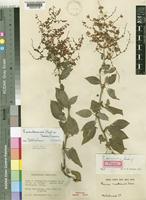
Rumex trinervius
1 Images see all
Name
Identification
Rumex trinervius Rech.f. [family POLYGONACEAE ] Verified by Rechinger, K. H., Rumex usambarensis (Dammer) Dammer [family POLYGONACEAE ] (stored under name); Verified by Graham, R. A., Rumex maderensis Lowe [family POLYGONACEAE ]
Related name
- Rumex usambarensis
- Rumex maderensis
- Rumex trinervius
Flora
Entry for Rumex usambarensis (Dammer) Dammer [family POLYGONACEAE]
Herbarium
Royal Botanic Gardens, Kew (K)
Collection
Flora of Tropical East Africa
Resource Type
Reference Sources
Entry From
Flora of Tropical East Africa, page 1, (1958) Author: R. A. GRAHAM
Names
Rumex usambarensis (Dammer) Dammer [family POLYGONACEAE], in E.J. 38: 61 (1905); R. A. Graham in K.B. 1956: 254 (1956). Type: W. Usambara Mts., Mlalo, Holst 2429 (K, lecto.!)
Rumex maderensis [family POLYGONACEAE], sensu F.T.A. 6 (1): 115 (1909); F.D.O.-A. 2: 198 (1932) F.P.N.A. 1: 113 (1948); non Lowe (1838)
Rumex nervosus Dammer var. usambarensis [family POLYGONACEAE], in P.O.A. C: 169 (1895)
Rumex trinervius Rech. f. [family POLYGONACEAE], in Oest. Bot. Zeitschr. 99: 523 (1952) & in Bot. Not., Suppl. 3 (3): 17 (1954). Type: Tanganyika, Ufipa District, Mbisi Mts., Michelmore 711 (K, holo.!)
Information
A shrub or straggling glabrous climber, up to 3 m. tall or more. Stems brown. Leaves astringent, petiolate, often clustered, narrowly to broadly elliptic with a hastate base, a little narrowed above the basal lobes, up to 5 (–9) cm. long, apically acute; lobes reflexed, small, not exceeding 5 × 2 mm.; leaves markedly trinervate (except in very narrow leaves), the lateral nerves arising arcuately from the base of the midrib and remaining complementarily parallel throughout most of their length. Petioles 1–4 cm. long. Inflorescence a much-branched, ± slender, leafless panicle. Flowers in fascicles, on filiform pedicels up to 5 mm. long. Outer tepals 1.75–2 mm. long, ovate, obtuse, later reflexing. Inner tepals wing-like, 5–7 mm. in diameter, ± pellucid, subequal, circular when mature, with a squarish basal sinus 1–1.5 mm. deep, red or reddish-brown, reticulately veined and with a small wart-like reflexed protuberance at the base. Nut trigonous, ovoid, 2–2.5 × 1 mm., brown, shining. Fig. 2/1 and 2.
Range
DISTR. U2–4; K3–4, 6; T2–4, 7
Altitude range
870–2400 m.;
Distribution
KENYA Nakuru District around Lake Elmenteita, Aug. 1947, Bogdan 988!;KENYA Machakos District Kima, Mar. 1930, Napier 32!;KENYA Masai District near Murueshi, Nov. 1932, C. G. Rogers 79!TANGANYIKA Moshi District Marangu, Mar. 1943, Greenway 3890!;TANGANYIKA Lushoto District Lushoto—Soni road near Nyassa bridge, June 1953, Drummond & Hemsley 3010!TANGANYIKA Mbeya, Mar. 1932, R. M. Davies 428!UGANDA Kigezi District Kisoro, June 1939, Purseglove 746!;UGANDA Teso District Serere, May 1932, Chandler 698!;UGANDA Mengo District Entebbe, July 1922, Maitland 4!
Distribution (external)
Nyasaland
Belgian Congo
Notes
This species has been confused with R. maderensis Lowe, an endemic of Madeira and the Canary Islands, from which it is immediately told by the presence of the small protuberance at the base of the inner tepals, and by the marked trinervation of the leaves.