JSTOR Global Plants Home
  • Home
  • Browse
  • About
  • Access
  • Account
    • Saved Items
    • Profile
  • Log in

Global Plants

Skip to Main Content
  • JSTOR Global Plants Home
  • Global Plants

    • Browse
    • About
    • Access
    • Account
      • Saved Items
      • Profile
Log in
  • Browse
  • About
  • Access
  • Account
    • Saved Items
    • Profile
Advanced Search

Compilation
Rumex thyrsiflorus

10 Images see all

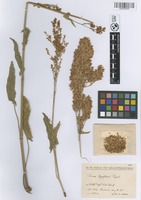
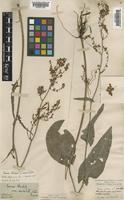
Filed as Rumex thyrsiflorus Fingerh. [family POLYGONACEAE]
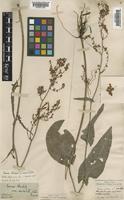
Rumex thyrsiflorus Fingerh. [family POLYGONACEAE]
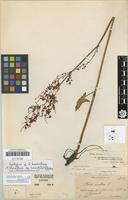
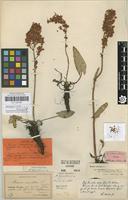
Syntype of Rumex haematinus Kihlm. 1900 [family POLYGONACEAE]
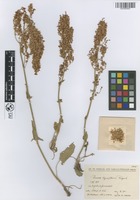
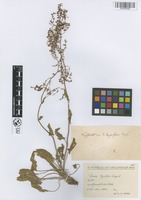
Filed as Rumex thyrsiflorus Fingerh. [family POLYGONACEAE]
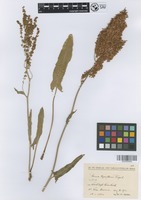
Lectotype of Rumex haematinus Kihlm. 1900 [family POLYGONACEAE]
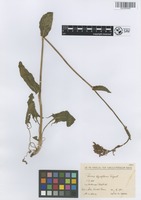
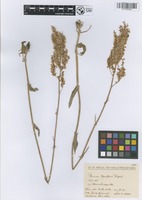
Rumex thyrsiflorus Fingerh. [family POLYGONACEAE]
Previous
Next

Name

Identification
Rumex haematinus Kihlm. 1900 [family POLYGONACEAE ] (stored under name); Verified by A. Borodina-Grabovskaya, 2006 Rumex thyrsiflorus Fingerh. [family POLYGONACEAE ] Verified by A. Borodina-Grabovskaya, 2006
Related name
  • Rumex haematinus
  • Rumex thyrsiflorus
  • Rumex acetosa
Common name
  • grande oseille thyrsiflore, Flora of North America Vol. 5
  • Narrow-leaved sorrel, Flora of North America Vol. 5

Flora

Entry for Rumex thyrsiflorus Fingerhuth [family POLYGONACEAE]
Herbarium
Flora of North America (FNA)
Collection
Flora of North America
Resource Type
Reference Sources
Entry From
Flora of North America, Vol 5,
Names
Rumex thyrsiflorus Fingerhuth [family POLYGONACEAE], Linnaea, 4: 380. 1829
Acetosa thyrsiflora (Fingerhuth) Á. Löve & D. Löve [family POLYGONACEAE]
Rumex acetosa Linnaeus subsp. auriculatus (Wallroth) A. Blytt & O. C. Dahl [family POLYGONACEAE]
Rumex acetosa var. auriculatus Wallroth [family POLYGONACEAE]
Rumex acetosa var. crispus (Roth)    elakovský [family POLYGONACEAE]
Rumex acetosa var. haplorhizus (Czernjaev ex Turczaninow) Trautvetter [family POLYGONACEAE]
Rumex acetosa subsp. thyrsiflorus (Fingerhuth) elakovský [family POLYGONACEAE]
Rumex auriculatus (Wallroth) Murbeck [family POLYGONACEAE]
Rumex haplorhizus Czernjaev ex Turczaninow [family POLYGONACEAE]
Treatment Author(s)
Sergei L. Mosyakin
Information
Plants perennial, glabrous or nearly so, with thick, vertical or oblique rootstock (reaching deep into substrate) and remote 2d-order roots. Stems usually erect, several from base, or occasionally solitary, branched in distal 1/2 (in inflorescence), (30–)40–100(–130) cm. Leaves: ocrea often with fringed margins; blade oblong-lanceolate to lanceolate, 3–12(–15) × 1–3(–5) cm, usually more than 4 times as long as wide, base sagittate or sometimes hastate (with acute lobes directed downward, ± parallel to petiole, or often reflexed outward), margins entire to obscurely and irregularly repand, usually crisped and undulate, occasionally flat, apex acute. Inflorescences terminal, occupying distal 1/3 of stem, usually dense, or interrupted in proximal part, broadly paniculate, pyramidal (1st-order branches usually repeatedly branched, with numerous 2d-order branches). Pedicels articulated near middle, filiform, 2–6(–7) mm, articulation distinct. Flowers (3–)4–8(–12) in whorls; inner tepals orbiculate, occasionally broadly ovate, 2.5–3.5(–4) × 2.5–3.5 mm, base rounded, truncate, or slightly cordate, apex obtuse; tubercles small or occasionally absent. Achenes black or dark brown, 1.5–1.8 × 0.8–1.2 mm, normally smooth. 2n = 14 (pistillate plants), 15 (staminate plants).
Phenology
mar-may (spring), jun-aug (summer)
Altitude range
0–1400 m (in Europe);
Distribution
ce Europec Asia (s Siberia)introduced elsewhere.USA Mich.Canada N.B.Canada N.S.Canada Ont.Canada Que.Canada Sask.
Discussion
Rumex thyrsiflorus is commonly misidentified as R. acetosa. The growth habit (stout, vertical rootstock), narrower, often undulate leaves with often slightly spreading basal lobes (however, some European specimens have the lobes of distal and middle cauline leaves curved inward), and pyramidal, usually much-branched panicle of R. thyrsiflorus are traits especially useful for field identification. In addition, the inner tepals of R. thyrsiflorus are distinctly smaller than those of R. acetosa. The southern European (Mediterranean) race of R. thyrsiflorus, characterized by narrower leaves with more spreading, almost hastate basal lobes and fruiting inner tepals less cordate at the base, is sometimes recognized as R. intermedius de Candolle [= Acetosa thyrsiflora subsp. intermedia (de Candolle) Á. Löve]. The same forms occasionally occur in North America (Á. Löve 1986).
Native/Introduced
introduced;

Related Materials

  • Terms and Conditions
  • Privacy Policy
  • Cookie Policy
  • Cookie Settings
  • Accessibility
  • Help
  • Contact Us
  • Facebook
  • Twitter
ITHAKA

JSTOR is part of ITHAKA, a not-for-profit organization helping the academic community use digital technologies to preserve the scholarly record and to advance research and teaching in sustainable ways.

©2000-2026 ITHAKA. All Rights Reserved. JSTOR®, the JSTOR logo, JPASS®, Aluka®, and ITHAKA® are registered trademarks of ITHAKA.

╳