JSTOR Global Plants Home
  • Home
  • Browse
  • About
  • Access
  • Account
    • Saved Items
    • Profile
  • Log in

Global Plants

Skip to Main Content
  • JSTOR Global Plants Home
  • Global Plants

    • Browse
    • About
    • Access
    • Account
      • Saved Items
      • Profile
Log in
  • Browse
  • About
  • Access
  • Account
    • Saved Items
    • Profile
Advanced Search

Compilation
Rumex quarrei

6 Images see all

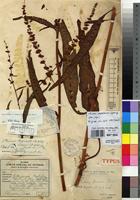
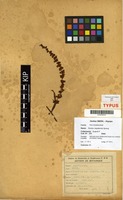
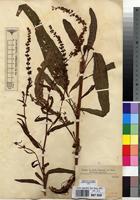
Lectotype of Rumex quarrei De Wild. [family POLYGONACEAE]
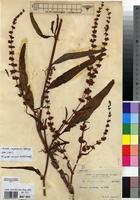
Syntype of Rumex quarrei De Wild. [family POLYGONACEAE]
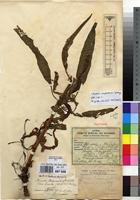
Isotype of Rumex quarrei De Wild. [family POLYGALACEAE]
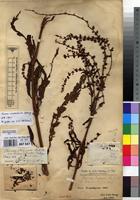
Syntype of Rumex quarrei De Wild. [family POLYGONACEAE]
Previous
Next

Name

Identification
Rumex quarrei De Wild. [family POLYGONACEAE ] Verified by Not on sheet, Rumex nepalensis Spreng. [family POLYGONACEAE ] (stored under name); Verified by Not on sheet,
Related name
  • Rumex nepalensis
  • Rumex quarrei

Flora

Entry for Rumex bequaertii De Wild. [family POLYGONACEAE]
Herbarium
Royal Botanic Gardens, Kew (K)
Collection
Flora of Tropical East Africa
Resource Type
Reference Sources
Entry From
Flora of Tropical East Africa, page 1, (1958) Author: R. A. GRAHAM
Names
Rumex bequaertii De Wild. [family POLYGONACEAE], Pl.. Bequaert. 5: 2 (1929); F.P.N.A. 1: 116 (1948); F.C.B. 1: 400 (1948); Rech. f. in Bot. Not., Suppl. 3 (3): 93 (1954); F.W.T.A., ed. 2, 1: 139 (1954). Type: Belgian Congo, Mukule, Bequaert 5905 (BR, lecto., fide Rech. f.)
Rumex nepalensis [family POLYGONACEAE], sensu F.T.A. 6 (1): 117 (1909), non Spreng.
Rumex quarrei De Wild. [family POLYGONACEAE], Pl. Bequaert. 5: 3 (1929). Type: Belgian Congo, Katanga, Kufubu, Quarré 269 (BR, lecto. fide Rech. f.)
Rumex camptodon Rech. f. [family POLYGONACEAE], in Bot. Centr., Beih. 49 (2): 76 (1932). Type: Mt. Kenya, near Forest Station, Fries 583 (S, syn.)
Rumex bequaertii (De Wild.) Robyns var. quarrei [family POLYGONACEAE], in F.C.B. 1: 401 (1948); F.P.N.A. 1: 117 (1948)
Information
An erect, ± glabrous, stout, perennial herb, up to 1.8 m. tall. Stems green to greenish brown. Leaves narrow and long, up to 33 cm. long but rarely exceeding 6 cm. broad (usually approximately 7–9 times as long as broad), oblong-lanceolate, often ± parallel sided, apically obtuse, sometimes rounded, basally cuneate; glabrous or with scattered papillae on the undersurface; flat or crispate on the margins. Inflorescence an open, ± stout panicle with long branches. Flowers in fascicles, pendulous. Inner tepals accrescent, dark brown, opaque, elongate-triangular, 3–4 (–5) mm. long, with or without tubercles, usually with an unarmed, obtuse, lanceolate apex but the margins otherwise armed with 56 strongly hooked teeth 1.52 mm. long. Nut trigonous, ovoid, brown, shining, 2.53 × 1.52 mm.
Range
DISTR. U2–4; K3–5,? 6; T2, 3, 6–8 widely spread through eastern Africa reaching Ethiopia and the Transvaal
Altitude range
690–3700 m.
Distribution
KENYA Nakuru District near Thomson’s Falls, Oct. 1931, Pierce 1462!;KENYA Kiambu District Limuru, Feb. 1915, Dummer 1603!KENYA Kisumu-Londiani District Lumbwa, Bondui, Mau Forest, Jan. 1946, Bally 4992!TANGANYIKA Masai District Ngorongoro crater, Apr. 1941, Bally 2302!;TANGANYIKA Lushoto District Mkuzi, Apr. 1953, Drummond & Hemsley 2169!;TANGANYIKA Rungwe District Mbeye, below Poroto Mts., Mar. 1932, St. Clair-Thompson 820!UGANDA Toro District Bwamba, Oct. 1925, Fyffe 37!;UGANDA Mbale District Bulambuli, Sept. 1932, A. S. Thomas 566!;UGANDA Masaka District Malabigambo Forest, near Katera, Oct. 1953, Drummond do Hemsley 4552!
Distribution (external)
the Cameroons
Madagascar
Notes
R. quarrei has been distinguished from R. bequaertii by its having large tubercles on all the inner tepals (rarely only on one), whereas in typical R. bequaertii they are absent or, as it seems, only in a most rudimentary state of development. R. camptodon lies between the two in having a large tubercle on one tepal and smaller ones on the others. Apparently the matter is simply one of the degree of accrescence of the midrib, and when material is very immature it is sometimes impossible to forecast which “ species ” is being handled. It is therefore proposed to sink R. camptodon and R. quarrei into synonymy with R. bequaertii. The tubercled form is perhaps commoner than that wholly without tubercles.  Certain examples from Kilimanjaro (Volkens 676!; Greenway 3860!) have broader leaves, inner tepals 4–5 mm. long, and nuts 2.75–3 mm. long, thus suggesting an approach to R. steudelii Hochst. ex A. Rich. Both have however been determined as R. bequaertii by Rechinger, apart from which the presence in our area of R. steudelii — a dock of Ethiopia, Somaliland, and South Africa — as an isolated occurrence would be rather unlikely. Further collecting on Kilimanjaro, especially in the altitude range 2400–2700 m., is nevertheless desirable. Another example, from Kenya, neighbourhood of Thomson’s Falls, Blain in E.A.H. 10915, has basal leaves 9 cm. broad, inner tepals 6–5 mm. long, and nuts 2.5–3 mm. long, and has much the appearance of R. steudelii. This example may merely represent a large form of R. bequartii, to which, following Rechinger, it is here referred.

Related Materials

  • Terms and Conditions
  • Privacy Policy
  • Cookie Policy
  • Cookie Settings
  • Accessibility
  • Help
  • Contact Us
  • Facebook
  • Twitter
ITHAKA

JSTOR is part of ITHAKA, a not-for-profit organization helping the academic community use digital technologies to preserve the scholarly record and to advance research and teaching in sustainable ways.

©2000-2026 ITHAKA. All Rights Reserved. JSTOR®, the JSTOR logo, JPASS®, Aluka®, and ITHAKA® are registered trademarks of ITHAKA.

╳