JSTOR Global Plants Home
  • Home
  • Browse
  • About
  • Access
  • Account
    • Saved Items
    • Profile
  • Log in

Global Plants

Skip to Main Content
  • JSTOR Global Plants Home
  • Global Plants

    • Browse
    • About
    • Access
    • Account
      • Saved Items
      • Profile
Log in
  • Browse
  • About
  • Access
  • Account
    • Saved Items
    • Profile
Advanced Search

Compilation
Rumex cristatus

5 Images see all

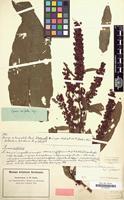
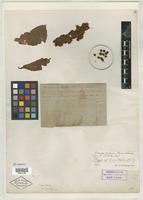
Type of Rumex cristatus Wall. [family POLYGONACEAE]
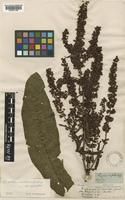
Rumex crispus L. [family POLYGONACEAE]
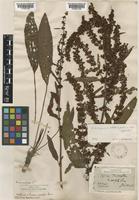
Type of Rumex xenogenus Rech.f. [family POLYGONACEAE]
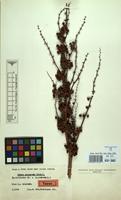
Type of Rumex cristatus DC. [family POLYGONACEAE]
Previous
Next

Name

Identification
Rumex xenogenus Rech.f. [family POLYGONACEAE ] Verified by Not on sheet, Rumex cristatus DC. [family POLYGONACEAE ] (stored under name); Verified by Not on sheet,
Related name
  • Rumex ambiguus
  • Rumex acutus
  • Rumex pratensis
  • Rumex xenogenus
  • Rumex crispus
  • Rumex cristatus
  • Rumex oxylapathum
Common name
  • Greek or crested dock, Flora of North America Vol. 5
  • Kerner’s dock, Flora of North America Vol. 5

Flora

Entry for Rumex cristatus de Candolle [family POLYGONACEAE]
Herbarium
Flora of North America (FNA)
Collection
Flora of North America
Resource Type
Reference Sources
Entry From
Flora of North America, Vol 5,
Names
Rumex cristatus de Candolle [family POLYGONACEAE], Cat. Pl. Hort. Monsp., 139. 1813
Rumex graecus Boissier & Heldreich [family POLYGONACEAE]
Rumex patientia Linnaeus subsp. graecus (Boissier & Heldreich) Lindberg [family POLYGONACEAE]
Treatment Author(s)
Sergei L. Mosyakin
Information
Plants perennial, glabrous or indistinctly papillose exclusively on veins of leaf blades abaxially, with fusiform, vertical rootstock. Stems erect, branched from above middle or in distal 2/3, 70–150(–200) cm. Leaves: ocrea deciduous or partially persistent at maturity; blade broadly lanceolate to oblong-lanceolate, normally 15–25(–35) × 5–7(–12) cm, base truncate, rounded, or slightly cordate, margins entire, undulate or weakly crisped, occasionally flat, apex acute or acuminate. Inflorescences terminal, occupying distal 1/2–2/3 of stem, normally dense or interrupted near base, broadly paniculate (branches of inflorescence mostly with 2d-order branches), branches usually straight or arcuate, rarely indistinctly flexuous. Pedicels articulated near middle, filiform, 6–14 mm, articulation distinctly swollen. Flowers 15–20 in whorls; inner tepals orbiculate, 6–8(–9) × 6–7.5(–8) mm, base usually distinctly cordate, margins entire or subentire near apex, distinctly dentate in basal 1/2, apex acute or subacute, teeth 0.5–1 mm; tubercles normally 3, rarely 1, distinctly unequal. Achenes dark brown or brown, 2.8–3.5 × 2–2.5 mm. 2n = 80.
Phenology
mar-may (spring), jun-aug (summer)
Altitude range
100–300 m;
Distribution
se Europe (Balkans)se Europe (Greece)naturalized elsewhere in s Europe.USA Ill.USA Kans.USA Mo.
Discussion
Rumex cristatus is known from Missouri, Illinois, and Kansas; it may occur also in adjacent states (P. Shildneck et al. 1981). Although separable by the characters given in the key, R. cristatus sometimes is misidentified as R. patientia. The morphological distinctions between these related species are obscured by possible hybridization. Such hybrids are known as R. ×xenogenus Rechinger f. (G. D. Kitchener 2002); they may be expected in North America in areas where the parental species grow together.
Native/Introduced
introduced;

Related Materials

  • Terms and Conditions
  • Privacy Policy
  • Cookie Policy
  • Cookie Settings
  • Accessibility
  • Help
  • Contact Us
  • Facebook
  • Twitter
ITHAKA

JSTOR is part of ITHAKA, a not-for-profit organization helping the academic community use digital technologies to preserve the scholarly record and to advance research and teaching in sustainable ways.

©2000-2026 ITHAKA. All Rights Reserved. JSTOR®, the JSTOR logo, JPASS®, Aluka®, and ITHAKA® are registered trademarks of ITHAKA.

╳