

Compilation
Rumex crispatulus
1 Images see all
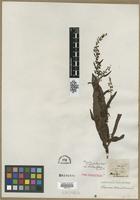
Name
Identification
Rumex crispatulus Michx. [family POLYGONACEAE ] (stored under name); Verified by Not on Sheet, Rumex crispatulus Michx. [family POLYGONACEAE ] Verified by Not on Sheet, Rumex maritimus L. [family POLYGONACEAE ] Verified by Not on Sheet,
Related name
- Rumex maritimus
- Rumex crispatulus
Common name
- Broad-leaved or broadleaf or bitter dock, Flora of North America Vol. 5
- patience a feuilles obtuses, Flora of North America Vol. 5
Flora
Entry for Rumex obtusifolius Linnaeus [family POLYGONACEAE]
Herbarium
Flora of North America (FNA)
Collection
Flora of North America
Resource Type
Reference Sources
Entry From
Flora of North America, Vol 5,
Names
Rumex obtusifolius Linnaeus [family POLYGONACEAE], Sp. Pl., 1: 335. 1753
Rumex crispatulus Michaux [family POLYGONACEAE]
Rumex rugelii Meisner [family POLYGONACEAE]
Treatment Author(s)
Sergei L. Mosyakin
Information
Plants perennial, glabrous or ± papillose especially on veins of leaf blades abaxially, with fusi-form, vertical rootstock. Stems erect, branched distal to middle or occasionally in distal 2/3, often with few flowering stems from rootstock, 60–120(–150) cm. Leaves: ocrea deciduous to partially persistent at maturity; blade oblong to ovate-oblong, sometimes broadly ovate, 20–40 × 10–15 cm, usually less than 4 times as long as wide, base normally distinctly cordate, occasionally rounded, rarely truncate, margins normally entire, flat or undulate, rarely slightly crisped, apex obtuse or subacute. Inflorescences terminal, occupying distal 2/3 of stem, usually lax and interrupted, narrowly or broadly paniculate, branches usually forming angle of 30–45° with 1st-order stem. Pedicels articulated in proximal 1/3 or rarely near middle, filiform, 2.5–8.5(–10) mm, articulation distinctly swollen. Flowers 10–25 in lax whorls; inner tepals ovate-triangular, deltoid or, occasionally, lingulate, 3–6 × 2–3.5 mm (excluding teeth), ca. 1.5–2 times as long as wide, base truncate, margins usually distinctly dentate, rarely subentire, apex obtuse to subacute, straight, teeth 2–5, normally at each side of margin, short-subulate or triangular-subulate, straight, 0.5–1.8 mm, or shorter than width of inner tepals; tubercle usually 1, sometimes 3, then 1 distinctly larger, smooth. Achenes brown to reddish brown, 2–2.7 × 1.2–1.7 mm. 2n = 40.
Phenology
mar-may (spring), jun-aug (summer), sep-nov (fall)
Altitude range
0–2300 m;
Distribution
GreenlandSt. Pierre and MiquelonEuropew Asiaintroduced elsewhere.USA Ala.USA AlaskaUSA Ariz.USA Ark.USA Calif.USA Colo.USA Conn.USA Del.USA D.C.USA Fla.USA Ga.USA IdahoUSA Ill.USA Ind.USA IowaUSA Kans.USA Ky.USA La.USA MaineUSA Md.USA Mass.USA Mich.USA Minn.USA Miss.USA Mo.USA Mont.USA Nebr.USA N.H.USA N.J.USA N.Mex.USA N.Y.USA N.C.USA OhioUSA Okla.USA Oreg.USA Pa.USA R.I.USA S.C.USA Tenn.USA Tex.USA UtahUSA Vt.USA Va.USA Wash.USA W.Va.USA Wis.Canada B.C.Canada N.B.Canada Nfld. and Labr. (Nfld.)Canada N.S.Canada Ont.Canada P.E.I.Canada Que.
Discussion
Rumex obtusifolius, a member of subsect. Obtusifolii Rechinger f. (K. H. Rechinger 1937), is a polymorphic species represented in Eurasia by three or four rather distinct races often treated by European authors as subspecies or varieties. These taxa differ mostly in inner tepal dentation and geographic distribution. In North America the morphotypes often intergrade. In Eurasia this species is differentiated into predominantly western subsp. obtusifolius [including R. obtusifolius subsp. agrestis (Fries) Danser], eastern subsp. sylvestris (Wallroth) Rechinger f., intermediate central European subsp. transiens (Simonkai) Rechinger f., and montane subsp. subalpinus (Schur) Simonkai. Only subspp. obtusifolius and sylvestris occur in North America; the former seems to be more common. Subspecies obtusifolius differs from subsp. sylvestris in having larger and more prominently dentate inner tepals with one tubercle, or with three distinctly unequal tubercles; in subsp. sylvestris the teeth are usually less than 0.6 mm, developing only near the base of the inner tepals, and the tubercles often almost subequal.
Rumex obtusifolius may be expected elsewhere in the Great Plains region of the United States and Canada.
Native/Introduced
introduced;