JSTOR Global Plants Home
  • Home
  • Browse
  • About
  • Access
  • Account
    • Saved Items
    • Profile
  • Log in

Global Plants

Skip to Main Content
  • JSTOR Global Plants Home
  • Global Plants

    • Browse
    • About
    • Access
    • Account
      • Saved Items
      • Profile
Log in
  • Browse
  • About
  • Access
  • Account
    • Saved Items
    • Profile
Advanced Search

Compilation
Rumex altissimus

5 Images see all

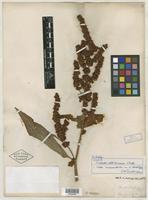
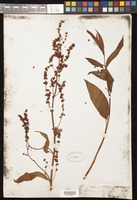
Type? of Rumex altissimus Alph. Wood [family POLYGONACEAE]
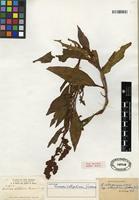
Isotype of Rumex altissimus subsp. ellipticus (Greene) Á. Löve [family POLYGONACEAE]
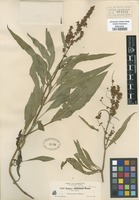
Original material of Rumex hesperius Greene [family POLYGONACEAE]
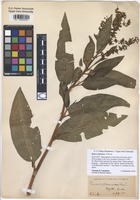
Filed as Rumex altissimus A. Wood [family POLYGONACEAE]
Rumex altissimus Alph. Wood [family POLYGONACEAE]
Previous
Next

Name

Identification
Isotype of Rumex altissimus Not on sheet [family POLYGONACEAE ] (stored under name); Verified by Rechinger, Rumex ellipticus Greene [family POLYGONACEAE ] Verified by Not on sheet, Isotype of Rumex ellipticus Greene [family POLYGONACEAE ] Verified by Not on sheet,
Related name
  • Rumex ellipticus
  • Rumex altissimus
Common name
  • Elliptic tall dock, Flora of North America Vol. 5
  • Tall or pale dock, Flora of North America Vol. 5

Flora

Entry for Rumex altissimus Alph. Wood [family POLYGONACEAE]
Herbarium
Flora of North America (FNA)
Collection
Flora of North America
Resource Type
Reference Sources
Entry From
Flora of North America, Vol 5,
Names
Rumex altissimus Alph. Wood [family POLYGONACEAE], Class-book Bot. ed., 2, 477. 1847
Treatment Author(s)
Sergei L. Mosyakin
Information
Plants perennial, glabrous, with vertical rootstock. Stems erect, rarely ascending, usually pro-ducing axillary shoots below 1st-order inflorescence or at proximal nodes, 50–90(–120) cm. Leaf blades ovate-lanceolate, elliptic-lanceolate, or lanceolate, 10–15 × 3–5.5 cm, usually ca. 2.5–4 times as long as wide, widest in proximal 1/2, thick, often subcoriaceous, base broadly cuneate, rarely almost rounded, margins entire, flat, apex acute or attenuate. Inflorescences terminal and axillary, terminal usually occupying distal 1/5–1/3 of stem, rather dense, normally broadly paniculate. Pedicels articulated in proximal 1/3, sometimes almost near base, thick, (2–)3–7(–8) mm, usually approximately as long as inner tepals, occasionally slightly longer or shorter, articulation swollen. Flowers 12–20 in whorls; inner tepals with broadly triangular, ovate-triangular, or broadly ovate-deltoid, 4.5–6 × 3–4.5(–5) mm, base truncate or indistinctly cordate, margins entire, apex acute; tubercles (2–)3, equal or subequal, glabrous or minutely rugose. Achenes brown or dark reddish brown, 2.5–3.5 × 1.8–2.3 mm. 2n = 20.
Phenology
mar-may (spring), jun-aug (summer)
Altitude range
0–1800 m;
Distribution
n MexicoEurope (introduced in DenmarkSwedenUnited Kingdom.USA Ala.USA Ariz.USA Ark.USA Colo.USA Conn.USA Del.USA D.C.USA Fla.USA Ga.USA Ill.USA Ind.USA IowaUSA Kans.USA Ky.USA La.USA MaineUSA Md.USA Mass.USA Mich.USA Minn.USA Miss.USA Mo.USA Nebr.USA N.H.USA N.J.USA N.Mex.USA N.Y.USA N.C.USA OhioUSA Okla.USA Pa.USA R.I.USA S.C.USA S.Dak.USA Tenn.USA Tex.USA Vt.USA Va.USA W.Va.USA Wis.USA Wyo.Canada Ont.
Discussion
The name Rumex britannica Linnaeus was misapplied to this species by C. F. Meisner (1856) and some North American authors.
Some records of Rumex altissimus from Arizona and New Mexico may refer to R. ellipticus. Two reports from New Mexico were based on misidentification of R. hymenosepalus.

Related Materials

  • Terms and Conditions
  • Privacy Policy
  • Cookie Policy
  • Cookie Settings
  • Accessibility
  • Help
  • Contact Us
  • Facebook
  • Twitter
ITHAKA

JSTOR is part of ITHAKA, a not-for-profit organization helping the academic community use digital technologies to preserve the scholarly record and to advance research and teaching in sustainable ways.

©2000-2026 ITHAKA. All Rights Reserved. JSTOR®, the JSTOR logo, JPASS®, Aluka®, and ITHAKA® are registered trademarks of ITHAKA.

╳