JSTOR Global Plants Home
  • Home
  • Browse
  • About
  • Access
  • Account
    • Saved Items
    • Profile
  • Log in

Global Plants

Skip to Main Content
  • JSTOR Global Plants Home
  • Global Plants

    • Browse
    • About
    • Access
    • Account
      • Saved Items
      • Profile
Log in
  • Browse
  • About
  • Access
  • Account
    • Saved Items
    • Profile
Advanced Search

Compilation
Rubus pinnatiformis

4 Images see all

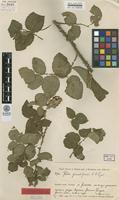
Isosyntype of Rubus pinnatiformis Gust. [family ROSACEAE]
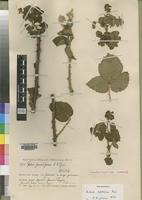
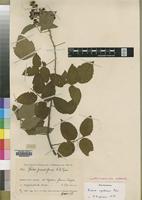
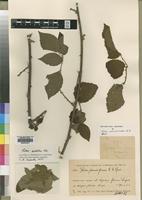
Syntype of Rubus pinnatiformis Gust. [family ROSACEAE]
Previous
Next

Name

Identification
Rubus pinnatiformis Gust. [family ROSACEAE ] Verified by Kupicha,F., Rubus apetalus Poir. [family ROSACEAE ] (stored under name);
Related name
  • Rubus apetalus
  • Rubus pinnatiformis

Flora

Entry for Rubus apetalus Poir. [family ROSACEAE]
Herbarium
Royal Botanic Gardens, Kew (K)
Collection
Flora Zambesiaca
Resource Type
Reference Sources
Entry From
FZ, Vol 4, Part 0, page 7, (1978) Author: E. J. Mendes
Names
Rubus apetalus Poir. [family ROSACEAE], Encycl. Méth. Bot. 6: 242 (1804).—Oliver in F.T.A. 2: 374 (1871) excl. syn.—Focke in Bibl. Bot. 72, 2: 176, t. 72 (1911).—C. E. Gust. in Archiv Bot. 26A, 7: 53 (1934).—R. A. Grah. in F.T.E.A., Rosaceae: 39 (1960) excl. syn. Type from Réunion.
Rubus pinnatiformis C. E. Gust. [family ROSACEAE], in Bot. Notis. 1932: 17 (1932); tom. cit.: 48, t. 8 (1934). Syntypes: Rhodesia, Inyanga near Pungwe R,, c. 1800 m., fr. 6.xi.1930, Fries, Norlindh & Weimarck 2726 (BM; LD); same locality, c. 1700 m., 17.xii.1930, Fries, Norlindh & Weimarck 3866 (BM; LD).
Information
Scrambling shrub to c. 1·5 m. high. Flowering branches sparsely villous, brownish, with few to many decurved brownish-yellow prickles 2–5 mm. long. Leaves 7–16 x 5·5–13 cm., 2–3-jugate or the uppermost ternate; petiole and rhachis villous and aculeate like the stems; lateral leaflets subsessile, terminal one with petiolule 1–2 cm. long. Leaflets ovate-acute or elliptic-acute, with finely to coarsely serrate margin; superior surface brownish-green, thinly appressed-pilose; inferior surface pale brownish-green, villous on main veins and pilose between, or whitish-velutinous, the midrib very sparsely and minutely prickly, the lateral veins without prickles. Stipules narrowly linear. Inflorescences terminal and axillary, 3–19 cm. long, broadly pyramidal to cylindrical, usually much longer than leaves, the branches spreading, villous and aculeate like the stem. Calyx greyish-tomentose, divided into narrowly triangular segments 4–6 mm. long, ± clasping in fruit. Petals almost always absent, when present narrow, shorter than sepals, fugacious. Fruits globose, 0·5–0·8 cm. long, purplish-black and edible when ripe; carpels relatively few (15–36), glabrous or rarely tomentose at the apex.
Habitat
Thickets, shrubby zone at forest margins, riparian fringes
Altitude range
760–2130 m.
2130
760
Distribution
Malawi S Limbe, Bangwe Hill, 4.x.1960, Chapman 932 (FHO; K; SRGH).Zambia E Nyika Plateau, 1·6 km. N. of Rest House, 2130 m., 27.xi.1955, Lees 92 (K).Zambia C Chakwenga Headwaters, 100–129 km. E. of Lusaka, 8.ix.1963, Robinson 5652 (K; SRGH).Zambia W Ndola, 5.ix.1967, Mutimushi 2048 (K; SRGH).Mozambique MS Manica Distr., Báruè, serra deChoa,4.vii.1941, Torre 3019 (COI; LISC; LMU; SRGH).Malawi N Nyika Plateau below Rest House on path to N. Rukuru waterfall, 2150 m., 27.x.1958, Robson 408 (K; LISC).Zimbabwe E Pungwe R., Honde Valley, c. 760 m., 16.ix.1964, Loveridge 1118 (COI; FHO; K; LISC; SRGH).Zambia N Chishinga Ranch near Luwingu, 1580 m., 2.v.1961, Astle 618 (K; SRGH).
Distribution (external)
Gabon
Rwanda
Burundi
Ethiopia
Uganda
Kenya
Tanzania
Mascarenes
Notes
R. apetalus is intermediate between R. pinnatus and R. exsuccus in most morphological characteristics, and the three form a taxonomically difficult complex within which there has been much confusion, both in delimitation of taxa and application of names. Typical R. pinnatus and R. exsuccus (easily distinguished from one another) are common in Mozambique, which has, however, but few representatives of R. apetalus, suggesting that although the three taxa are difficult to define, they may be good species. This conclusion is also supported by the slightly different geographical ranges of the species outside our area.

Related Materials

  • Terms and Conditions
  • Privacy Policy
  • Cookie Policy
  • Cookie Settings
  • Accessibility
  • Help
  • Contact Us
  • Facebook
  • Twitter
ITHAKA

JSTOR is part of ITHAKA, a not-for-profit organization helping the academic community use digital technologies to preserve the scholarly record and to advance research and teaching in sustainable ways.

©2000-2026 ITHAKA. All Rights Reserved. JSTOR®, the JSTOR logo, JPASS®, Aluka®, and ITHAKA® are registered trademarks of ITHAKA.

╳