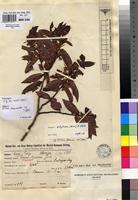
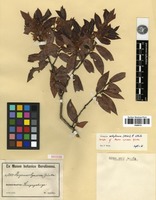
Evergreen shrub or tree 1.2-13 m. tall; bark sepia, rough, shallowly vertically fissured with yellow slash darkening to deep yellow; young shoots red, densely hairy. Leaves drying pale reddish brown and ± shiny above, lanceolate, lanceolate-elliptic or elliptic, 2-8 cm. long, 1-3 cm. wide, tapering acute to subacuminate, rounded to cordate at the base, glossy and glabrous to adpressed pilose above, sparsely pilose with long hairs beneath, particularly on the midrib; margins fringed with long hairs; lateral nerves in ± 6 pairs, the venation indistinct but darker than the lamina beneath. Male flowers 5-6(-7)-merous, solitary, axillary; pedicels 0.5-2 cm. long; bracts 2, leafy, separated, ovate-lanceolate, 6 mm. long, 2.5 mm. wide; inflorescence indumentum of unicellular hairs and shorter multicellular glandular hairs; calyx urceolate, 3.5-7.5 mm. long, shortly toothed, with adpressed to spreading hairs; corolla white or pale orange, sometimes tinged pink, campanulate, 0.5-1.2 cm. long, 5-6-lobed to ± the middle, minutely puberulous; disk fimbriate; stamens 10, all fertile or some replaced by staminodes, 4-5 mm. long; filaments 0.5-1 mm. long, glabrous; anthers lanceolate, 3-4.5 mm. long, setulose on the distal half of the connective, otherwise glabrous; rudimentary ovary conical, tomentellous, with 4-6 locules; styles 2-3, hairy on the united basal half. Female flowers similar to the male; staminodes 6-10, 1.2 mm. long, glabrous or sparsely setulose at the apex; ovary conical, 2 mm. long, 1.5 mm. wide, with 4-6 locules; styles 2-3. Fruit red, subglobose, up to 2 cm. diameter, glabrescent, the calyx green flushed red, accrescent, papery, inflated, bladder-like, 6-7-grooved, completely concealing the fruit. Seeds 4 or fewer, chestnut, oblong-subtrigonous, 7-10 mm. long, 5-6 mm. wide, with smooth endosperm. Fig. 2/15; fig. 6/7-9.