JSTOR Global Plants Home
  • Home
  • Browse
  • About
  • Access
  • Account
    • Saved Items
    • Profile
  • Log in

Global Plants

Skip to Main Content
  • JSTOR Global Plants Home
  • Global Plants

    • Browse
    • About
    • Access
    • Account
      • Saved Items
      • Profile
Log in
  • Browse
  • About
  • Access
  • Account
    • Saved Items
    • Profile
Advanced Search

Compilation
Robynsiella fastigiata

4 Images see all

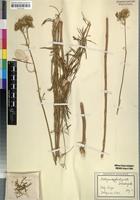
Isotype of Robynsiella fastigiata Suess. [family AMARANTHACEAE]
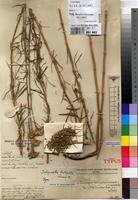
Holotype of Robynsiella fastigiata Suess. [family AMARANTHACEAE]
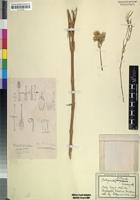
Isotype of Robynsiella fastigiata Suess. [family AMARANTHACEAE]
Previous
Next

Name

Identification
Robynsiella fastigiata Suess. [family AMARANTHACEAE ] Verified by Not on sheet, Centemopsis fastigiata (Suess.) C.C.Towns. [family AMARANTHACEAE ] (stored under name); Verified by Not on sheet,
Related name
  • Centemopsis fastigiata
  • Robynsiella fastigiata

Flora

Entry for Centemopsis fastigiata Suesseng. Townsend [family AMARANTHACEAE]
Herbarium
Royal Botanic Gardens, Kew (K)
Collection
Flora Zambesiaca
Resource Type
Reference Sources
Entry From
FZ, Vol 9, Part 1, page 28, (1988) Author: C. C. Townsend
Names
Centemopsis fastigiata Suesseng. Townsend [family AMARANTHACEAE], in Publ. Cairo Univ. Herb. 7 & 8: 70 (1977). TAB. 18 B. Type from Zaire.
Robynsiella fastigiata Suesseng. [family AMARANTHACEAE], in Bull. Jard. Bot. Nat. Belg. 15: 70 (1938).—Hauman in F.C.B. 2: 52 (1951).—Cavaco in Mém. Mus. Hist. Nat. Paris Sér. B, 13 : 155 (1962). Type as above.
Centemopsis trichotoma Suesseng. [family AMARANTHACEAE], in Mitt. Bot. Staatss. München 1: 187 (1953). Type: Zambia, path to Koa village from Mbala, Richards 748 (K, holotype).
Information
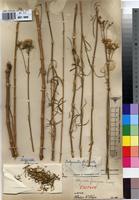
Perennial herb with numerous rigidly erect stems from the base, 0.2–1.3 (2) m. tall. Stems wiry and tough, strongly striate with pale ridges, smooth and glabrous throughout or scabrid below the nodes, simple or sparingly branched with long, ascending branches. Leaves narrowly linear to narrowly elliptic, 2.5–8.5 × 0.6–1.3 cm., glabrous or slightly puberulent when young, entirely smooth or scabrid along the prominent lower surface of the midrib and the revolute margins, attenuate both above and below, apex sharply mucronate. Inflorescence greenish-white or creamy to deep carmine-red, condensed, repeatedly branched and cymose-fastigiate, forming a more or less round-topped head up to 7 cm. across but often less; shorter upper branches more or less white-lanate, sulcate, after fruit-fall densely clad with the patent, persistent bracts. Bracts ovate-lanceolate, c.2 mm. long, membranous, mucronate with the shortly excurrent yellowish or reddish midrib, glabrous or very sparingly whitish-pilose. Bracteoles similar to the bracts. Flowers solitary in the axils of the bracts. Tepals 4–5.5 mm. long, oblong; outer 2 at anthesis firm centrally with a rather obscure slightly excurrent midrib and 2 faint lateral nerves, more or less white-pilose below, increasingly broadly hyaline-margined and delicate above with the margins inflexed; inner 3 increasingly shorter, narrower and more broadly hyaline-margined, the margins of the innermost wider than the narrow, firm centre. Tepals indurate at the base in fruit, slightly or markedly more prominently nerved. Filaments very slender, c. 5–6 mm. long, the pseudostaminodes c. 1–2.5 mm. long, oblong, fimbriate around the apex. Ovary ellipsoid, pilose in most of the upper part with the hairs sometimes ascending the base of the style at least on one side. Style slender, c. 3.5–4 mm. long, symmetrically placed. Capsule ovoid-ellipsoid, 2–2.5 mm. long. Seed ovoid, pyriform, shining brown, feebly reticulate, c. 2 mm. long.
Habitat
On sandy or damp loamy soil by paths, in woodland or bush, in long grass in open woodland or in rough grassland
Altitude range
1200–1520 m.
1520
1200
Distribution
Zambia N Kasama Distr., Chibutubutu, 1320 m., 26.ii.1960, Richards 12613 (K; SRGH).
Distribution (external)
Tanzania
Zaire

Related Materials

  • Terms and Conditions
  • Privacy Policy
  • Cookie Policy
  • Cookie Settings
  • Accessibility
  • Help
  • Contact Us
  • Facebook
  • Twitter
ITHAKA

JSTOR is part of ITHAKA, a not-for-profit organization helping the academic community use digital technologies to preserve the scholarly record and to advance research and teaching in sustainable ways.

©2000-2026 ITHAKA. All Rights Reserved. JSTOR®, the JSTOR logo, JPASS®, Aluka®, and ITHAKA® are registered trademarks of ITHAKA.

╳