JSTOR Global Plants Home
  • Home
  • Browse
  • About
  • Access
  • Account
    • Saved Items
    • Profile
  • Log in

Global Plants

Skip to Main Content
  • JSTOR Global Plants Home
  • Global Plants

    • Browse
    • About
    • Access
    • Account
      • Saved Items
      • Profile
Log in
  • Browse
  • About
  • Access
  • Account
    • Saved Items
    • Profile
Advanced Search

Compilation
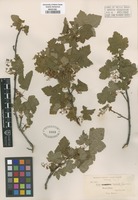
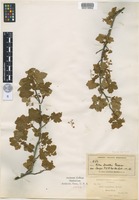
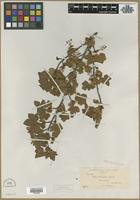
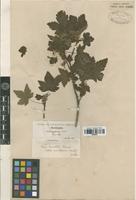
Ribes acerifolium

7 Images see all

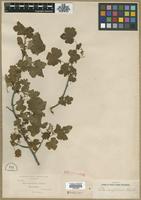
Original material of Ribes howellii Greene [family SAXIFRAGACEAE]
Type of Ribes acerifolium Howell [family GROSSULARIACEAE]
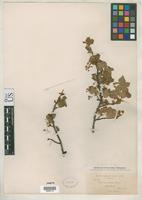
Type? of Ribes acerifolium Howell [family GROSSULARIACEAE]
Filed as Ribes howellii Greene [family GROSSULARIACEAE]
Type? of Ribes acerifolium Howell [family GROSSULARIACEAE]
Filed as Ribes acerifolium Howell, T.J. 1895 [family SAXIFRAGACEAE]
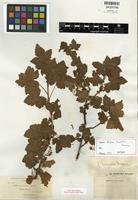
Syntype of Ribes acerifolium Howell [family GROSSULARIACEAE]
Previous
Next

Name

Identification
Ribes acerifolium Howell [family GROSSULARIACEAE ] (stored under name); Verified by Not on sheet,
Related name
  • Ribes acerifolium
  • Ribes howellii
Common name
  • Maple-leaved currant, Flora of North America Vol. 8

Flora

Entry for Ribes acerifolium Howell [family GROSSULARIACEAE]
Herbarium
Flora of North America (FNA)
Collection
Flora of North America
Resource Type
Reference Sources
Entry From
Flora of North America, Vol 8,
Names
Ribes acerifolium Howell [family GROSSULARIACEAE], Erythea, 3: 34. 1895 ,
Information
Plants 0.5–1 m. Stems spreading to erect, finely puberulent, often thickly sprinkled with small, nearly sessile to rather strongly stipitate glands; spines at nodes absent; prickles on internodes absent. Leaves: petiole 2–5.5 cm, pubescent, stipitate-glandular; blade orbiculate, lobed into 3 main and 2 smaller segments, cleft 1/2 to midrib, 3–8 cm, base deeply cordate, surfaces puberulent and stipitate-glandular abaxially, glabrous adaxially, lobes ovate-deltate, margins 2 times crenate-serrate, apex acute. Inflorescences pendent, 7–15-flowered racemes, 3–5 cm, axis crisped-puberulent, stipitate-glandular, flowers evenly spaced. Pedicels jointed, 2–8 mm, crisped-puberulent, stipitate-glandular; bracts lanceolate, 6–8 mm, crisped-puberulent, stipitate-glandular. Flowers: hypanthium greenish white with pinkish tinge, shallowly bowl-shaped, 1–1.5 mm, crisped-puberulent, stipitate-glandular; sepals nearly overlapping, spreading, tips usually recurved, pinkish or white streaked with pink, broadly oblong-ovate to nearly deltate-obovate, 2–3 mm; petals very slightly connate or distinct, spreading with sepals, rose-red, obovate-cuneate, (inwardly pouched and nearly keeled in center), 1–1.5 mm; nectary disc greenish or cream, raised, angled, covering ovary; stamens nearly as long as petals; filaments oblong, 1 mm, glabrous; anthers cream, oval, 0.2–0.3 mm, apex acute; ovary finely crisped-puberulent; styles connate 3/4 their lengths, 0.7–1 mm, glabrous. Berries palatability not known, gray-black, spheric, to 10 mm, slightly pubescent, sparsely glandular.
Phenology
Flowering Jun–Aug
Altitude range
900–2200 m
Distribution
USA IdahoUSA Oreg.USA Wash.Canada B.C.
Discussion
Ribes acerifolium K. Koch (1869), which was believed to block the use of R. acerifolium Howell, was not validly published. Consequently, the name R. howellii Greene, proposed as a substitute name, is superfluous; it appears in many floras and on many herbarium specimens.

Related Materials

  • Terms and Conditions
  • Privacy Policy
  • Cookie Policy
  • Cookie Settings
  • Accessibility
  • Help
  • Contact Us
  • Facebook
  • Twitter
ITHAKA

JSTOR is part of ITHAKA, a not-for-profit organization helping the academic community use digital technologies to preserve the scholarly record and to advance research and teaching in sustainable ways.

©2000-2026 ITHAKA. All Rights Reserved. JSTOR®, the JSTOR logo, JPASS®, Aluka®, and ITHAKA® are registered trademarks of ITHAKA.

╳