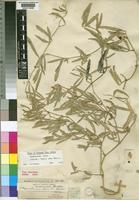
In general habit closely resembling Dolichos biflorus. A very curious plant (R? antennulifera, Baker), gathered by Dr. Meller in Zambesiland, has the ovary and stamens of this genus, but the leaves are unknown, and the habit is entirely different from that of any known species. The racemes are from six inches to more than a foot long, and arise singly or two or three together from a straight terete woody glabrous stem. The axis of the stem is woody in the lower part, straight, and clothed with grey pubescence. The flowers extend nearly or quite to the base, the lower ones in lax fascicles of three or four together, the upper crowded. The bracteoles are linear, 1/4 in. long, with a long filiform point thickened upwards. The calyx is distinctly stalked, 5/8– 3/4 in. long, cleft three quarters of the way down, densely clothed with firm ascending grey hairs on the outside, the two upper teeth slightly connate, the three lower ones lanceolate in the lower part, but the points still more distinctly lengthened out than those of the bracts into a filiform awn, thickened towards the apex so as to resemble closely the antenna of an insect. The corolla appears to be dull yellow, and distinctly exceeds the calyx, the standard being oblong, 3 1/2–4 lines broad, and the wings under 2 lines broad, both about equalling the keel.